
Practical Work on Element of Design – JSS2 Cultural & Creative Arts Lesson Note (First Term)
Download Lesson NoteLesson note at a glance
- Subject
- Cultural & Creative Arts
- Class
- JSS2
- Term
- First Term
- Topic
- Practical Work on Element of Design
- Order
- Topic 3 of 11 this term
- Reading time
- 6 min
Practical work on elements of design
Subject: Creative Arts (Cultural and Creative Arts)
Class: JSS2
Duration: 40 minutes
Practical work means doing something with your own hands. It is not just reading or talking about art. It is actually creating art yourself. In this lesson, we will use our hands, pencils, crayons, and other materials to make real artwork.
When we do practical work, we learn better because we practice what we have learned. It is like learning to ride a bicycle – you cannot learn just by reading about it. You must get on the bicycle and practice riding it yourself.
Today, we will focus on using lines to create beautiful designs. Lines are very important in art because they are the first thing we learn to draw when we are little children.
Application of Elements of Design Using Types of Lines
Application means using something in real life. We will now use what we learned about the elements of design, especially lines, to create our own artwork. We will draw different types of lines and use them to make patterns and pictures.
What Are Lines?
A line is a mark that goes from one point to another point. You make lines every day when you write your name or draw a picture. Lines are everywhere around us, and they are the easiest element of design to use.
Different Types of Lines
There are many different types of lines. Each type of line looks different and can be used for different things. Let us learn about each type:
- Straight Lines
Straight lines go in one direction without bending or curving. They look neat and organized.
Examples:
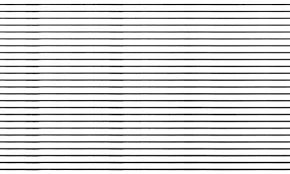
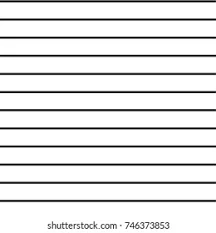
Horizontal lines go from left to right (like the horizon where the sky meets the ground)
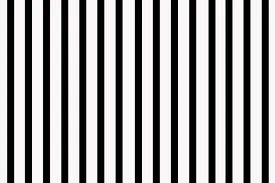
Vertical lines go up and down (like a standing tree or a pole)
Diagonal lines go in a slanting direction (like slide in aa playground)

How to draw straight lines:
- Use a ruler to help you
- Hold your pencil firmly
- Draw slowly and carefully
- Keep your hand steady
What we can make with straight lines:
- Houses and buildings
- Fences
- Tables and chairs
- Boxes and windows
- Ladders and stairs
- Curved Lines
Curved lines bend and flow smoothly. They look soft and gentle. Curved lines have no sharp corners.
Examples:
- The letter ‘C’ is a curved line
- A rainbow is made of curved lines
- Waves in the ocean are curved lines
- A smile is a curved line
How to draw curved lines:
- Move your pencil in a smooth, flowing motion
- Do not lift your pencil while drawing
- Practice making big curves and small curves
- Go slowly until you get better
What we can make with curved lines:
- Flowers and petals
- Clouds in the sky
- Hills and mountains
- Balloons
- The sun and moon
- Zigzag Lines
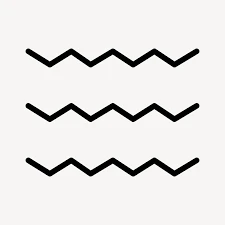
Zigzag lines go up and down sharply. They look like the teeth of a saw or mountains with many peaks. Zigzag lines look energetic and exciting.
How to draw zigzag lines:
- Draw a short diagonal line going up
- Then draw another line going down
- Keep repeating this pattern
- Try to make all the points the same size
What we can make with zigzag lines:
- Mountain ranges
- Lightning in the sky
- Teeth of monsters or dinosaurs
- Decorative borders
- Crowns for kings and queens
- Wavy Lines
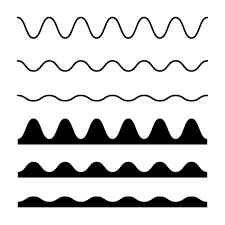
Wavy lines go up and down gently. They look like waves in water or a snake moving. Wavy lines are smooth and flowing.
How to draw wavy lines:
- Move your pencil up and down smoothly
- Make gentle curves, not sharp points
- Keep the waves about the same size
- Practice going slowly first
What we can make with wavy lines:
- Water and rivers
- Snakes
- Ribbons
- Hair
- Smoke rising from a fire
- Dotted Lines

Dotted lines are made of many small dots placed close together. They look like a broken line with spaces between each dot.
How to draw dotted lines:
- Make small dots with your pencil
- Space them evenly
- Follow a straight or curved path
- Try to make all dots the same size
What we can make with dotted lines:
- Paths or roads on a map
- Decoration on cloth
- Borders around pictures
- Outlines that we will cut later
- Broken or Dashed Lines
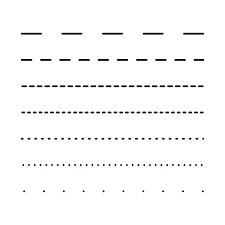
Broken lines are made of short lines with spaces between them. They look like a line that is cut into pieces.
How to draw broken lines:
- Draw a short line
- Leave a small space
- Draw another short line
- Keep repeating this pattern
Practical Activities with Lines
Now let us practice drawing different types of lines. Here are some fun activities you can do:
Activity 1: Line Practice Sheet
What you need:
- Paper
- Pencil
- Ruler
- Eraser
What to do:
- Draw five horizontal lines across your paper using a ruler
- In the first row, practice drawing straight horizontal lines
- In the second row, practice drawing curved lines
- In the third row, practice drawing zigzag lines
- In the fourth row, practice drawing wavy lines
- In the fifth row, practice drawing dotted or broken lines
Do this exercise many times until you can draw each type of line easily.
Activity 2: Creating Patterns with Lines
What you need:
- Paper
- Pencil or crayons
- Ruler
What to do:
- Divide your paper into four squares
- In the first square, make a pattern using only straight lines (you can draw lines going in different directions)
- In the second square, make a pattern using only curved lines
- In the third square, make a pattern using zigzag lines
- In the fourth square, mix different types of lines together
Activity 3: Drawing Pictures with Different Lines
What you need:
- Paper
- Pencil, crayons, or colored pencils
- Eraser
What to do:
- Draw a simple landscape picture using different types of lines:
- Draw straight lines to make a house with a door and windows
- Draw curved lines to make hills in the background
- Draw wavy lines to make a river or road
- Draw zigzag lines to make mountains far away
- Draw curved lines to make the sun and clouds
- Draw straight lines to make trees and fences
- Draw wavy lines to make grass
Tips for Good Line Drawing
- Practice every day – The more you practice, the better you will become
- Hold your pencil correctly – Not too tight and not too loose
- Start slowly – Speed will come with practice
- Use light pressure first – You can always make lines darker later
- Keep your paper steady – Hold it down with your other hand
- Be patient with yourself – Everyone makes mistakes at first
What We Learn from Line Practice
When we practice drawing different types of lines, we learn many important skills:
- Hand control – Our hands become steadier and more skilled
- Concentration – We learn to focus on what we are doing
- Creativity – We discover new ways to use lines
- Patience – We learn that good art takes time
- Confidence – We feel proud when we improve
This term's Cultural & Creative Arts topics
JSS2 First Term · 11 topics
First Term Cultural & Creative Arts (CCA) Lesson Notes for Other Topics
Introduction to Drawing - Objects in Our Environment
Read the full lesson note.

Introduction to Singing
Read the full lesson note.

Singing About Flowery Plants Using Tonic Solfa
Read the full lesson note.
Staging - The Way a Play is Produced and Presented
Read the full lesson note.
Types of Flowers
Read the full lesson note.
Drawing of Staff/Stave, The Grand Staff, and The Clefs
Read the full lesson note.
Use of Lines
Read the full lesson note.
Theatrical Elements and Personnel
Read the full lesson note.
Forms of Dance
Read the full lesson note.
Imaginative and Creative Drawing
Read the full lesson note.

Choral Singing
Read the full lesson note.
Casting and Rehearsal
Read the full lesson note.
Card Making and Decoration
Read the full lesson note.

Introduction to Life Drawing
Read the full lesson note.
Rhythmic Pattern 2
Read the full lesson note.
Lesson Notes for Other Classes

Basic 1 Lesson Note
The complete lesson note to guide your studies.

Basic 2 Lesson Note
The complete lesson note to guide your studies.

Basic 3 Lesson Note
The complete lesson note to guide your studies.

Basic 4 Lesson Note
The complete lesson note to guide your studies.

Basic 5 Lesson Note
The complete lesson note to guide your studies.

Basic 6 Lesson Note
The complete lesson note to guide your studies.

