
Painting – JSS2 Cultural & Creative Arts Lesson Note (First Term)
Download Lesson NoteTopic: Painting
Lesson note at a glance
- Subject
- Cultural & Creative Arts
- Class
- JSS2
- Term
- First Term
- Topic
- Painting
- Order
- Topic 11 of 11 this term
- Reading time
- 7 min
WEEK 10: Painting – Definition and Types (Still-life, Nature, and Landscape Painting)
Subject: Creative Arts (Cultural and Creative Arts)
Class: JSS2
Duration: 40 minutes
LESSON OBJECTIVES
By the end of this lesson, pupils should be able to:
- Explain what painting means in their own words
- Identify and describe three types of painting
- Tell the difference between still-life, nature, and landscape painting
- Appreciate paintings as a form of art and expression
MATERIALS NEEDED
- Sample paintings or pictures showing still-life, nature, and landscape scenes
- Chart paper with examples of each painting type
- Drawing paper for pupils
- Pencils and erasers
- Coloured pencils or crayons
- Real objects (fruits, bottle, book) for still-life demonstration
PREVIOUS KNOWLEDGE
Pupils have learned about colours, colour mixing, and colour application in previous lessons. They know how to use painting materials.
LESSON CONTENT
INTRODUCTION (5 minutes)
The teacher starts by showing pupils a beautiful painting hung on the classroom wall or brought from home. The teacher asks: “What do you see in this picture? How do you think the artist made it?”
After listening to pupils’ responses, the teacher explains that the picture was made through painting. The teacher asks if anyone has watched someone paint before – maybe their father painting the house, or an artist painting a signboard at the market.
The teacher tells pupils that today they will learn about painting as an art form and the different types of painting artists create.
STEP 1: Definition of Painting (7 minutes)
The teacher writes PAINTING on the board and asks pupils what they think it means.
After collecting responses, the teacher gives a clear definition:
Painting is the art of using colours to create pictures on surfaces like paper, canvas, walls, or wood.
The teacher breaks it down further:
- Art means something beautiful that we create with skill
- Colours are the paints, dyes, or crayons we use
- Create pictures means we make images of things we see or imagine
- Surfaces are the materials we paint on
The teacher explains that painting is different from just colouring. When we paint, we are creating our own picture from what we see or think about. When we colour, we are filling in lines that someone else drew.
What do painters use? The teacher lists and shows (if available):
- Brushes (different sizes for different work)
- Paints (powder paint, poster colour, oil paint, watercolour)
- Surfaces (paper, canvas, cardboard, walls, cloth)
- Water containers (for cleaning brushes and mixing paint)
- Palettes (for mixing colours)
Famous Nigerian painters The teacher mentions that Nigeria has many great painters like Ben Enwonwu, Yusuf Grillo, and Bruce Onobrakpeya. These artists have painted pictures that people all over the world admire.
STEP 2: Types of Painting (20 minutes)
The teacher explains that there are many types of painting, but today they will learn about three main types that are easy to understand and practice.
TYPE 1: STILL-LIFE PAINTING
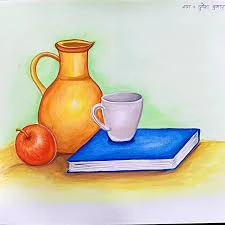
The teacher arranges some objects on a table – maybe three oranges in a bowl, a water bottle, and a book. The teacher asks pupils to observe these objects carefully.
Definition: Still-life painting is when we paint objects that are not moving. These objects stay in one place while we paint them.
The word “still” means not moving, and “life” refers to the objects. So “still-life” means things that are alive in their own way but don’t move around.
What can we paint in still-life?
- Fruits in a basket (oranges, mangoes, bananas)
- Flowers in a vase
- Books on a table
- Kitchen items (pot, cups, plates)
- Bottles and containers
- Vegetables
- Any objects arranged together
Why do artists paint still-life? The teacher explains:
- To practice drawing and painting objects correctly
- To study shapes, colours, and shadows
- To show the beauty of everyday things we usually ignore
- To learn how light falls on objects
The teacher shows a sample still-life painting and asks pupils to identify the objects in it. Pupils point out items like fruits, a jug, or cloth in the painting.
TYPE 2: NATURE PAINTING
The teacher asks: “What do you see when you go outside? Trees? Flowers? Birds? Animals?” These are all parts of nature.
Definition: Nature painting is when we paint living things we find in the natural world around us – plants, animals, birds, insects, and flowers.
Nature painting focuses on one thing or a few things from nature. It can be close-up, showing details of a butterfly’s wings or the petals of a flower.
What can we paint in nature painting?
- A single tree with its branches and leaves
- A bird sitting on a branch
- A butterfly on a flower
- A cat or dog
- Fish swimming
- A beautiful flower in detail
- An anthill
- A lizard on a wall
The difference between nature painting and landscape: The teacher explains that nature painting usually shows one plant or animal up close, while landscape (which they will learn next) shows a big view of many things together.
For example:
- Painting just one mango tree = nature painting
- Painting a whole farm with many trees, a house, and a road = landscape painting
The teacher shows examples of nature paintings – maybe a picture of a single rose flower, or a painting of a parrot. Pupils observe the details and colours used.
TYPE 3: LANDSCAPE PAINTING

The teacher takes pupils to the window (if possible) or asks them to imagine standing outside their house. “What do you see far away? Hills? Roads? Houses? The sky? Trees in the distance?”
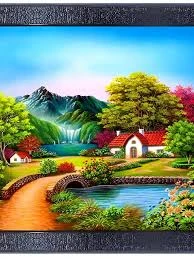
Definition: Landscape painting is when we paint a large view of an area – showing land, sky, and everything we can see in the distance.
The word “landscape” means the land as we see it – all the features of an area including hills, valleys, rivers, buildings, and sky.
What can we paint in landscape painting?
- A village scene with houses and trees
- Mountains or hills in the distance
- A road leading into the horizon
- Farmlands with crops
- The seaside or a river with the sky above
- A market square with buildings around
- Sunrise or sunset over land
- City buildings and streets
Important parts of landscape painting: The teacher explains:
- Foreground – things that are close to us (they look big)
- Middle ground – things that are a medium distance away
- Background – things that are far away (they look small and less detailed)
- Sky – usually takes up the top part of the painting
EVALUATION (5 minutes)
The teacher asks questions to check understanding:
- What is painting?
- If you paint three mangoes on a plate, what type of painting is that?
- What is the difference between nature painting and landscape painting?
- If you paint a picture showing your school compound with the building, playground, trees, and the sky, what type of painting is it?
- Can you name one thing you would like to paint for each type?
Pupils raise their hands to answer. The teacher corrects any misunderstanding gently.
CONCLUSION
The teacher summarizes the lesson: “Today we learned that painting is using colours to create pictures. We learned about three types of painting – still-life (objects that don’t move), nature (plants and animals), and landscape (big outdoor views).”
The teacher encourages pupils by saying that everyone can learn to paint. It doesn’t matter if your first painting doesn’t look perfect. Even famous artists started as beginners. What matters is practicing and enjoying the process.
ASSIGNMENT
- Drawing Assignment: Choose one type of painting and create a simple drawing of it. You don’t need to paint it yet, just draw with pencil:
- For still-life: Draw three objects on your table at home
- For nature: Draw one plant or animal you see around you
- For landscape: Draw the view from your house showing the sky, some buildings or trees, and the ground
- Written Work: Write five sentences about your favourite type of painting. Explain why you like it and what you would want to paint.
- Observation Task: Find one picture in a magazine, calendar, or book. Look at it carefully and write down which type of painting it is (still-life, nature, or landscape). Explain how you know.
TEACHER’S NOTES
- In the next lesson, pupils will do practical painting of one type they choose
- Prepare enough painting materials for the practical class
- If possible, take pupils outside for 5 minutes to observe landscape for themselves
- Encourage pupils who say “I can’t draw” – remind them that art is about expression, not perfection
- Keep the sample paintings displayed in class for pupils to study throughout the week
This term's Cultural & Creative Arts topics
JSS2 First Term · 11 topics
First Term Cultural & Creative Arts (CCA) Lesson Notes for Other Topics
Introduction to Drawing - Objects in Our Environment
Read the full lesson note.

Introduction to Singing
Read the full lesson note.
Singing About Flowery Plants Using Tonic Solfa
Read the full lesson note.
Staging - The Way a Play is Produced and Presented
Read the full lesson note.
Types of Flowers
Read the full lesson note.
Drawing of Staff/Stave, The Grand Staff, and The Clefs
Read the full lesson note.
Use of Lines
Read the full lesson note.
Theatrical Elements and Personnel
Read the full lesson note.
Forms of Dance
Read the full lesson note.
Imaginative and Creative Drawing
Read the full lesson note.

Choral Singing
Read the full lesson note.
Casting and Rehearsal
Read the full lesson note.
Card Making and Decoration
Read the full lesson note.

Introduction to Life Drawing
Read the full lesson note.
Rhythmic Pattern 2
Read the full lesson note.
Lesson Notes for Other Classes

Basic 1 Lesson Note
The complete lesson note to guide your studies.

Basic 2 Lesson Note
The complete lesson note to guide your studies.

Basic 3 Lesson Note
The complete lesson note to guide your studies.

Basic 4 Lesson Note
The complete lesson note to guide your studies.

Basic 5 Lesson Note
The complete lesson note to guide your studies.

Basic 6 Lesson Note
The complete lesson note to guide your studies.

