
Historical Foundation of Nigerian Arts II – SS1 Visual Arts Lesson Note (Third Term)
Download this term · ₦1,000Lesson note at a glance
- Subject
- Visual Arts
- Class
- SS1
- Term
- Third Term
- Topic
- Historical Foundation of Nigerian Arts II
- Order
- Topic 3 of 4 this term
- Reading time
- 6 min
Nigeria’s historical arts include the Esie soapstone figures, the Benin court bronzes, the Tsoede bronzes, the Epa and Ekpo wood carvings, and the Ikom monoliths. Each tradition has its own materials, purpose and features.
Behavioural objectives
By the end of the lesson, students should be able to:
- State where the Esie, Benin, Tsoede, Epa, Ekpo and Ikom art works come from.
- Describe the main characteristics of each art tradition.
- Explain why Benin art is called Court art.
- Explain what the British Punitive Expedition of 1897 was.
- Name the materials used for each art tradition.
What is Esie soapstone culture?
Esie soapstone culture is the tradition of carving stone figures of people, found at Esie in Kwara State.
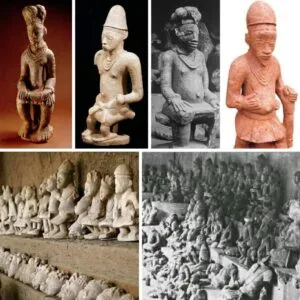
- Location: Esie is a Yoruba town in Irepodun Local Government Area of Kwara State.
- Distance: it is about 40 kilometres from Ilorin, the state capital.
- Quantity: hundreds of figures have been found there.
- Material: the figures are mostly carved from soapstone.
What are the characteristics of Esie art?
- Subjects: figures of men and women, mostly sitting on stools, and some kneeling.
- Hairstyles: most figures wear elaborate coiffures.
- Facial marks: three horizontal lines between the eyes and ears. Some have vertical lines or scarification.
- Dress and ornaments: some wear hats or headdresses, with beads around the neck or waist.
- Material: mostly soapstone.
What is Benin court art?
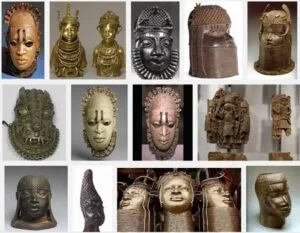
Benin court art is the mainly bronze art made by guild craftsmen for the Oba’s palace in Benin, from about 1300 AD.
- Fame: Benin art is famous for its artistic value.
- Origin of bronze casting: tradition says a caster from Ife taught the art to Benin artists.
How did bronze casting reach Benin?
- Oba Oguola asked the Ooni of Ife for a master caster, in about AD 1280.
- The caster came to Benin to teach the craftsmen to cast ceremonial heads in bronze.
- Benin artists then developed the art into their own style.
Why is Benin art called Court art?
- Guild: the bronze casters formed a guild around the Oba’s palace.
- Patron: they worked mainly for the Oba and his court.
What are the periods of Benin art?
William Fagg, a British scholar of African art, divided the history of Benin art into three periods.
- First or Early period (13th to 16th centuries): thin sculptural heads of reigning Obas.
- Second or Middle period (from about 1501 into the 17th century): style changed from free-standing sculpture to relief plaques for the Oba’s use.
- Third or Last period (17th to 18th centuries): the standard of craftsmanship began to fall, and the decline continued until 1897.
What was the British Punitive Expedition?
The British Punitive Expedition was the 1897 British military attack on Benin, in which the Oba was removed from power.
- Earlier contact: Benin had contact with the Portuguese in 1473.
- Cause: political upheavals led the British government to depose the Oba in 1897.
- Loss: over one thousand art works, mostly bronze, were looted and taken abroad.
What are the characteristics of Benin art works?
- Subjects: memorial heads of Obas, noblemen and warriors. The work is highly technical.
- Collar: the Oba’s head has a high collar of beads reaching the chin.
- Marks: vertical marks on the forehead.
- Proportions: the head is greatly exaggerated and the legs are short.
- Features: the upper lips are slightly open, and the lips and nose are broad and thick.
What are Tsoede bronze arts?
Tsoede bronze arts are cast bronze figures of the Nupe people, found at Jebba, Tada and Giragi along the River Niger.
- Material: mainly bronze.
- Date: from around the late 13th and 14th centuries AD.
- Origin: Tsoede, brother of the Atta of Idah, travelled along the River Niger and founded the Nupe kingdom. The works are linked to him.
- Use: for fertility and good fortune. Villagers bathe the figures in the river to bring this effect.

What are the characteristics of Tsoede bronze arts?
- Subjects: large figures of men and animals.
- Style: naturalistic and life-size.
- Size: among the largest bronze and copper casts from sub-Saharan Africa in ancient times.
What are the main wood carving traditions?
The two main wood carving traditions in this lesson are the Epa masks of Ekiti and the Ekpo masks of the Ibibio.
What are Epa masks?
- Location: Ekiti State, in Yorubaland.
- Material: wood.
- Use in festivals: young men being initiated into adulthood wear them in cult festivals to test their endurance.
- Display: the wearer shows strength and endurance, with an acrobatic display.
- Purpose: the cults use them to honour heroes and ancestors.
- Weight: they weigh up to 30 kilogrammes.
What are Ekpo masks?
Ekpo masks are carved wooden masks of the Ibibio and Anang of Akwa Ibom State.
- Source: the Ibibio belief in deities made them skilled mask carvers.
- Use: the mask appears at the outing of the Ekpo society from Ikot Ekpene.
- Meaning: the masks symbolise a special spirit.
Characteristics of Ekpo masks
- Decoration: abstract lines, cones and cylindrical motifs in wood.
- Face: fiery and bearded.
- Neck: a thick neck attaches the mask to the body.
What are the Ikom monoliths?
The Ikom monoliths are carved stone sculptures, called “Akwanshi”, that represent the ancestors of the Ekoi people.
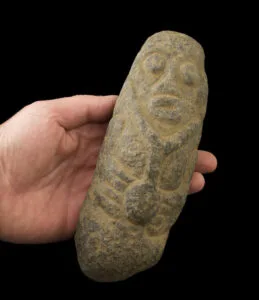
- Location: Ikom Local Government Area of Cross River State.
- Local name: “Akwanshi”.
- Meaning: they represent the ancestors of the Ekoi.
What are the characteristics of the Ikom monoliths?
- Nsibidi: the works carry signs called “Nsibidi”, one of the oldest known forms of writing in sub-Saharan Africa.
- Surface: decoration is carved in relief on basic conical stone shapes.
- Emphasis: only the head and the navel are stressed.
- Chin: a V-shaped chin stands for the pointed, twisted long beard worn by the Ntoons (priest chiefs).
- Material: hard stone, mainly basalt, limestone and sandstone, carved in different villages of Ikom.
How do the art traditions compare?
This table sets the six traditions side by side, using the facts above.
| Tradition | Place | Main material | Key feature or use |
|---|---|---|---|
| Esie | Kwara State | Soapstone | Seated figures with elaborate hair and facial marks |
| Benin | Benin, Edo State | Bronze | Court art: memorial heads and plaques for the Oba |
| Tsoede | Jebba, Tada, Giragi (Nupe) | Bronze | Fertility and good fortune |
| Epa | Ekiti State | Wood | Masks for initiation and honouring ancestors |
| Ekpo | Akwa Ibom State | Wood | Masks for a special spirit, from Ikot Ekpene |
| Ikom | Cross River State | Basalt, limestone, sandstone | Ancestor monoliths with Nsibidi signs |
Evaluation
- State three characteristics of the Esie soapstone figures.
- Why is Benin art called Court art?
- What happened in Benin in 1897?
- Who brought the Tsoede bronzes to the Nupe, and what are they used for?
- What is “Nsibidi”, and where is it found?
Assignment
Draw a table with the headings Tradition, Place, Material and One characteristic. Fill it in for Esie, Benin, Tsoede, Epa, Ekpo and Ikom.
This term's Visual Arts topics
SS1 Third Term · 4 topics
- Introduction to Molding
- Historical Foundation of Nigerian Arts
- Historical Foundation of Nigerian Arts II
- Museums and Art Galleries in Nigeria
Get Visual Arts as PDF and Word
Every week of SS1 Visual Arts, Third Term, formatted and ready to print. Ad-free, and the copy lock comes off.
Get this term Card, bank transfer, USSD or OPay
SS1 Visual Arts Lesson Notes for Other Topics

Introduction To Molding
Read the full lesson note.
Historical Foundation Of Nigerian Arts
Read the full lesson note.
Museums And Art Galleries In Nigeria
Read the full lesson note.

Introduction To Visual Arts
Read the full lesson note.
Visual Sense
Read the full lesson note.

Professions And Job Opportunities
Read the full lesson note.

Drawing Lines
Read the full lesson note.

Drawing Nature And Man-Made Objects
Read the full lesson note.
Drawing And Shading
Read the full lesson note.

Drawing Still-Life Objects
Read the full lesson note.

Drawing Human Figures
Read the full lesson note.
Introduction To Art Appreciation
Read the full lesson note.
Introduction To Graphics
Read the full lesson note.
Textile Designs
Read the full lesson note.

Introduction to Computer Graphics
Read the full lesson note.
Lesson Notes for Other Classes

SS2 Lesson Note
The complete lesson note to guide your studies.

SS3 Lesson Note
The complete lesson note to guide your studies.
