
Drawing Lines – SS1 Visual Arts Lesson Note (First Term)
Download Lesson NoteLesson note at a glance
- Subject
- Visual Arts
- Class
- SS1
- Term
- First Term
- Topic
- Drawing Lines
- Order
- Topic 4 of 9 this term
- Reading time
- 1 min
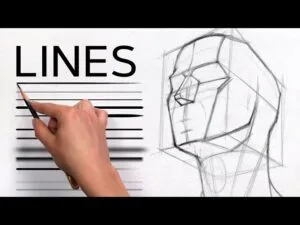
A line is a set of points that extend infinitely in two directions, having no thickness or width, only length.
Properties of lines
- Lines have direction and orientation.
- Lines can be straight or curved
- Lines can intersect or be parallel
- Lines can be defined by two points or by a point and a direction
Types of lines
- Straight Lines: Extend infinitely in two directions.
- Curved Lines: Change direction continuously.
- Horizontal Lines: Parallel to the horizon.
- Vertical Lines: Perpendicular to the horizon.
- Diagonal Lines: Neither horizontal nor vertical.
- Parallel Lines: Never intersect.
- Perpendicular Lines: Intersect at a right angle.
Concepts related to lines include:
- Line segments: A part of a line with a fixed length.
- Rays: A line that extends from a point in one direction.
- Angles: Formed by two lines or line segments.
- Planes: A flat surface defined by two or more lines.
Uses of lines
- In art and design, lines are used to:
- Define shape and form
- Create texture and pattern
- Convey movement and direction
- Separate or connect elements
- Create perspective and depth
- In geometry and mathematics, lines are used to:
- Define geometric shapes and figures
- Calculate distances and angles
- Prove theorems and propositions
- Model real-world phenomena
- In addition to geometry and art, lines are also used in various fields such as:
- Writing: lines of text
- Music: lines of music
- Science: lines of data
- Technology: lines of code
Overall, lines are a fundamental concept that can be used in various ways to create meaning, structure, and beauty.
This term's Visual Arts topics
SS1 First Term · 9 topics
First Term Visual Arts Lesson Notes for Other Topics

Introduction To Visual Arts
Read the full lesson note.
Visual Sense
Read the full lesson note.

Professions And Job Opportunities
Read the full lesson note.
Drawing Nature And Man-Made Objects
Read the full lesson note.
Drawing And Shading
Read the full lesson note.

Drawing Still-Life Objects
Read the full lesson note.

Drawing Human Figures
Read the full lesson note.
Introduction To Art Appreciation
Read the full lesson note.
Lesson Notes for Other Classes

Basic 1 Lesson Note
The complete lesson note to guide your studies.

Basic 2 Lesson Note
The complete lesson note to guide your studies.

Basic 3 Lesson Note
The complete lesson note to guide your studies.

Basic 4 Lesson Note
The complete lesson note to guide your studies.

Basic 5 Lesson Note
The complete lesson note to guide your studies.

Basic 6 Lesson Note
The complete lesson note to guide your studies.

