
Drawing Still-Life Objects – SS1 Visual Arts Lesson Note (First Term)
Download this term · ₦1,000Lesson note at a glance
- Subject
- Visual Arts
- Class
- SS1
- Term
- First Term
- Topic
- Drawing Still-Life Objects
- Order
- Topic 7 of 9 this term
- Reading time
- 5 min
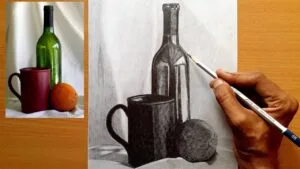
Still-life drawing is the drawing of inanimate (non-living) objects, such as fruit, vases or musical instruments, arranged and studied from real life.
Behavioural objectives
By the end of the lesson, students should be able to:
- define still-life drawing;
- list examples of objects used in still-life drawing;
- name the mediums used for still-life drawing;
- arrange objects and draw them in correct steps;
- state the skills that still-life drawing helps an artist develop.
What is still-life drawing?
Still-life drawing is a type of drawing that represents inanimate objects as they appear in real life.
- Goal: to show the shapes, textures, values and colours of the objects.
- Relationships: the drawing also shows how the objects relate to each other and to the space around them.
- Medium: it can be done in pencil, ink, paint or mixed media.
- Inanimate: means the objects do not move or breathe, so the artist can study them for a long time.
Which objects are used in still-life drawing?
Any non-living object that can be placed in a fixed position can be used as a still-life subject.
- Fruit, vegetables or flowers: for example oranges, pawpaw, tomatoes, yam or hibiscus.
- Household items: vases, bottles, calabashes or containers.
- Vintage or antique objects: old lamps, clay pots or carved stools.
- Table settings: dishes, glasses, cups or utensils.
- Musical instruments: a guitar, a talking drum or a shekere.
- Books, papers or small collectables: notebooks, shells or ornaments.
What materials are needed for still-life drawing?
A student needs simple drawing tools and a set of objects to draw.
- Drawing paper or sketchbook: a smooth, clean surface to draw on.
- Pencils: H pencils are hard and light, B pencils are soft and dark, and HB is in between.
- Eraser: removes guidelines and mistakes.
- Drawing board: holds the paper firm.
- Objects: two or more items placed on a table or cloth.
Which mediums can be used for still-life drawing?
Still-life drawings can be done in four main groups of mediums: pencils, ink, paint and mixed media.
- Pencils: graphite, charcoal or coloured pencils.
- Ink: pen and ink give sharp lines and strong contrast.
- Paint: watercolour, acrylic or oil.
- Mixed media: two or more mediums in one work, such as pencil with watercolour.
What are the elements of a still-life drawing?
The elements of a still-life drawing are the things the artist must observe and show in the objects.
- Line: marks that show the edges (outlines) of the objects.
- Shape: the flat outline of an object, such as a circle for an orange.
- Form: the solid, three-dimensional look of an object, made with shading.
- Texture: how a surface looks or feels, such as smooth glass or rough pineapple skin.
- Value: how light or dark a part is, from white to black.
- Colour: the hue of each object, used when the drawing is in colour.
- Space: the area around and between the objects.
How do you arrange a still-life composition?
Composition is the way the artist places objects so that the picture looks balanced and pleasing.
- Choose objects that differ in size, shape and texture.
- Place the tallest object at the back or to one side.
- Overlap some objects so they look connected.
- Avoid placing objects in a straight line.
- Direct a light source from one side, such as a window or lamp, so shadows are clear.
- Look at the group from your seat and move objects until the view is balanced.
How do you draw a still-life object step by step?
A still-life drawing is built in stages, from light guidelines to dark shading.
- Study the group carefully and note the light direction.
- Lightly sketch the basic shapes, such as circles, ovals, cylinders and boxes.
- Check proportion: compare the height and width of each object with the others.
- Join the shapes into the true outlines of the objects.
- Rub out unwanted guidelines.
- Mark the light areas, mid-tones and dark areas.
- Shade the objects, keeping the lightest parts clean.
- Draw the cast shadows on the table, on the side away from the light.
- Add texture details and correct any outlines.
What are the shading techniques in still-life drawing?
Shading techniques are ways of making dark and light areas with pencil or pen marks.
| Technique | How it is done | Best used for |
|---|---|---|
| Hatching | Parallel lines drawn close together | Simple shaded areas |
| Cross-hatching | Layers of lines crossing each other | Darker shadows |
| Stippling | Many small dots | Rough textures |
| Blending | Smoothing pencil marks with a finger or tissue | Smooth, round forms |
How do light and shadow show form?
Light and shadow make a flat shape look solid, as the parts facing the light are bright and the other parts are dark.
- Highlight: the brightest spot, where light hits the object directly.
- Mid-tone: the area between light and dark.
- Core shadow: the darkest part on the object, away from the light.
- Cast shadow: the shadow the object throws onto the surface beside it.
What skills does still-life drawing develop?
Still-life drawing develops observation, technical and personal skills.
- Observation: looking closely and noticing detail.
- Rendering: showing textures, values and colours correctly.
- Composition: arranging objects well on the page.
- Light and shadow: creating depth and volume.
- Patience and focus: working carefully for a long time.

Why is still-life drawing important?
Still-life drawing is a basic part of art education and has been taught for centuries.
- Training: it helps artists build their skills and style.
- Foundation: the skills carry over to portraits, landscapes and design.
- Creativity: it lets artists relax and express their ideas.
Evaluation
- What is still-life drawing?
- List four objects that can be used as subjects for still-life drawing.
- Name the mediums in which a still-life drawing can be done.
- State three skills that still-life drawing helps an artist develop.
- Name two shading techniques and explain one of them.
Assignment
Arrange a few small household objects, such as a bottle and some fruit. Draw them in pencil, showing their shapes, textures, and light and shadow.
This term's Visual Arts topics
SS1 First Term · 9 topics
Get Visual Arts as PDF and Word
Every week of SS1 Visual Arts, First Term, formatted and ready to print. Ad-free, and the copy lock comes off.
Get this term Card, bank transfer, USSD or OPay
SS1 Visual Arts Lesson Notes for Other Topics

Introduction To Visual Arts
Read the full lesson note.

Visual Sense
Read the full lesson note.

Professions And Job Opportunities
Read the full lesson note.

Drawing Lines
Read the full lesson note.

Drawing Nature And Man-Made Objects
Read the full lesson note.
Drawing And Shading
Read the full lesson note.

Drawing Human Figures
Read the full lesson note.

Introduction To Art Appreciation
Read the full lesson note.
Introduction To Graphics
Read the full lesson note.
Textile Designs
Read the full lesson note.
Introduction to Computer Graphics
Read the full lesson note.
Terminologies In 2 dimensional Art
Read the full lesson note.
Terminologies In 3 dimensional Art
Read the full lesson note.
Introduction To Molding
Read the full lesson note.

Historical Foundation Of Nigerian Arts
Read the full lesson note.
Lesson Notes for Other Classes

SS2 Lesson Note
The complete lesson note to guide your studies.

SS3 Lesson Note
The complete lesson note to guide your studies.
