
Introduction to Graphics – SS1 Visual Arts Lesson Note (Second Term)
Download this term · ₦1,000Lesson note at a glance
- Subject
- Visual Arts
- Class
- SS1
- Term
- Second Term
- Topic
- Introduction to Graphics
- Order
- Topic 1 of 5 this term
- Reading time
- 6 min
Graphic design is the art and practice of visual communication and problem-solving through the use of space, type, images and colour.
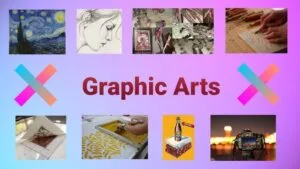
- Branch: graphic design is a branch of applied arts.
- Coverage: this lesson covers lettering, the elements of art and the principles of art.
Behavioural objectives
By the end of the lesson, students should be able to:
- define graphic design and name its two categories;
- explain lettering and the terms kerning, tracking and leading;
- list the seven elements of art and explain each one;
- describe the basic types of lines and their symbolic uses;
- list the six principles of art and explain each one.
What is graphic design?
Graphic design refers to both the process of designing and the finished art product.
There are two categories of graphic design: still graphics and motion graphics.
- Still graphics: related to all printed matter, such as posters, handbills, book covers and labels.
- Motion graphics: has to do with videos and movies, where the images move.
What is lettering?
Lettering, also called typography, is the art and technique of arranging letters so that written language is legible, appealing and readable.
- Display lettering: deals with the letter as seen in the alphabet.
- Arrangement: letters are arranged in different typefaces and varied point sizes, in italics or in block letters.
- Spacing: good spacing builds balance among the letters as they relate to each other.
What are kerning, tracking and leading?
Kerning, tracking and leading are the three spacing adjustments made for adequate construction and arrangement of letters.
- Kerning: the space between two specific letters or characters.
- Tracking: the space between all the letters or characters used.
- Leading: the line spacing used in the layout.
What is block lettering?
Block lettering is lettering with straight, uniform lines and angles, which gives a bold and clear appearance.
What are the elements and principles of art and design?
The elements and principles of art and design are the basic components used as a guide to creating works of art.
- Elements: the visual parts used to build a work of art.
- Principles: the guides for arranging those parts.
- Shared concepts: different art forms share similar concepts. Music, like visual art, can have balance and contrast.
- Communication: cultural and creative messages are shown with beauty, balance and harmony through the elements and principles.
What are the elements of art?

Elements of art are the basic visual components of a work of art: line, shape, form, space, colour, texture and value.
1. What is line?
A line is a mark made on a surface by a moving point or by dots.
- Eye movement: a line lets the eye move within a work of art.
- Direction: the artist uses lines to guide the viewer’s eye around the work.
What are the basic types of lines?
There are five basic types of lines: vertical, horizontal, zig zag, diagonal and curved.
- Vertical line: moves up to down or down to up, perpendicular to the earth, extending towards the sky.
- Horizontal line: moves from right to left or left to right, parallel to the earth.
- Zig zag line: a line in sharp diagonal motion in alternating directions.
- Diagonal line: a line that is neither vertical nor horizontal, slanted at an angle between the two.
- Curved line: a line that bends continuously without an angle.
What are the symbolic uses of line?
Different lines give different feelings to a viewer.
| Line | Feeling or meaning |
|---|---|
| Straight | Different moods |
| Curved | Greater dynamism and flexibility |
| Horizontal | Calm, tranquillity, relaxation and space |
| Vertical | Height, elegance, dignity, formality, stability and strength |
| Diagonal | Action, activity, excitement and movement |
What are the practical uses of lines in everyday life?
- Writing: letters and numbers are made with lines.
- Boundaries: lines create or define boundaries.
- Art: lines form the basis for drawing and painting.
2. What is shape?
Shape is an enclosed space defined by edges or by contrast to its surroundings.
- Geometric shapes: regular shapes such as the circle, square and triangle.
- Organic shapes: irregular, free shapes such as a leaf or a cloud.
3. What is form?
Form is the shape and appearance of any three-dimensional object.
- Examples: a ball, a box and a clay pot.
- Light and dark: form can also be shown by shading or painting.
4. What is space?
Space is the free area between solid objects, or between shapes and other elements in a work of art.
- Everywhere: space is all around us and is a platform for arranging objects and elements.
- Two-dimensional: drawing and painting.
- Three-dimensional: sculpture and architecture.
5. What is colour?
Colour is the effect produced on the eye by light reflected from an object.
- Primary colours: red, yellow and blue, from which other colours are mixed.
- Secondary colours: orange, green and violet, each made by mixing two primary colours.
6. What is texture?
Texture is the perceived surface quality of a shape, form or object.
- Examples: rough, smooth, soft, hard and bumpy surfaces.
7. What is value?
Value, also called tone, is the presence of light and dark shades in a work of art.
- Use: artists use value to create an illusion of depth, mass, form and three-dimensionality on a flat surface.
What are the principles of art?
Principles of art are a mental guide that helps the artist use and distribute the elements of art properly when creating a work.
- Centre of interest: the artist decides what the main focus of the artwork will be.
- Number: the six principles are balance, proportion, movement, unity, variety and emphasis.
1. What is balance?
Balance is the spread or distribution of visual weight in a work of art through the arrangement of the elements of art.
There are three types of balance: symmetrical, asymmetrical and radial.
- Symmetrical balance: an equal distribution of visual weight on both sides.
- Asymmetrical balance: a different visual weight on each side, placed at a distance that keeps the balance.
- Radial balance: a circular balance, spreading out from a central object.
2. What is proportion?
Proportion is the size of one part of a work of art in comparison to its other parts.
- Uses: it can manage space, create distance, show emphasis and achieve balance.
3. What is movement?
Movement is the use of line, colour, value, texture, form, shape and space to lead the viewer’s eye from one part of an art piece to another.
4. What is unity?
Unity is the result produced when the elements and principles of art agree with each other in a work of art.
- Effect: the parts fit together and create an overall message or impression.
5. What is variety?
Variety is the use of different qualities or styles of application in art to create a desired visual effect.
6. What is emphasis?
Emphasis is the visual reinforcement, through the arrangement of the elements of art, of something the artist wants the viewer to notice.
Evaluation
- Define graphic design and name its two categories.
- Explain kerning, tracking and leading.
- List the seven elements of art.
- Describe any three basic types of lines and state what horizontal and vertical lines express.
- Name the three types of balance and explain each one.
Assignment
List the six principles of art and explain any three of them in one or two lines each.
This term's Visual Arts topics
SS1 Second Term · 5 topics
Get Visual Arts as PDF and Word
Every week of SS1 Visual Arts, Second Term, formatted and ready to print. Ad-free, and the copy lock comes off.
Get this term Card, bank transfer, USSD or OPay
SS1 Visual Arts Lesson Notes for Other Topics
Textile Designs
Read the full lesson note.
Introduction to Computer Graphics
Read the full lesson note.
Terminologies In 2 dimensional Art
Read the full lesson note.
Terminologies In 3 dimensional Art
Read the full lesson note.

Introduction To Visual Arts
Read the full lesson note.
Visual Sense
Read the full lesson note.

Professions And Job Opportunities
Read the full lesson note.
Drawing Lines
Read the full lesson note.
Drawing Nature And Man-Made Objects
Read the full lesson note.
Drawing And Shading
Read the full lesson note.

Drawing Still-Life Objects
Read the full lesson note.

Drawing Human Figures
Read the full lesson note.
Introduction To Art Appreciation
Read the full lesson note.
Introduction To Molding
Read the full lesson note.
Historical Foundation Of Nigerian Arts
Read the full lesson note.
Lesson Notes for Other Classes

SS2 Lesson Note
The complete lesson note to guide your studies.

SS3 Lesson Note
The complete lesson note to guide your studies.
