
Professions and Job Opportunities – SS1 Visual Arts Lesson Note (First Term)
Download this term · ₦1,000Lesson note at a glance
- Subject
- Visual Arts
- Class
- SS1
- Term
- First Term
- Topic
- Professions and Job Opportunities
- Order
- Topic 3 of 9 this term
- Reading time
- 4 min
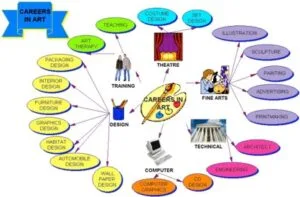
Visual art professions are jobs in which people use visual skills to create, manage, preserve or teach art.
Behavioural objectives
By the end of the lesson, students should be able to:
- list at least ten professions in visual art;
- state what each profession does;
- name the professions that work in film, TV and digital media;
- say which professions suit their own skills and interests.
What are the professions and job opportunities in visual art?
There are fifteen common professions in visual art, and they fall into four groups: fine art, design and illustration, film and digital media, and museum, teaching and writing roles.
Fine art and photography
- Fine Artist: a painter, sculptor, printmaker or photographer who creates original artworks.
- Photographer: captures images for editorial, commercial or fine art purposes.
- Digital Artist: creates digital paintings, illustrations and graphics.
Design and illustration
- Graphic Designer: creates visual communications and designs for websites, magazines and brands.
- Illustrator: creates original illustrations for books, magazines and advertising.
- Art Director: oversees the visual aspects of advertising, magazines and film productions.
- UI/UX Designer: designs user interfaces and user experiences for websites and apps.
Film, TV and digital media
- Animator: creates motion graphics, animations and special effects for film, TV and digital media.
- Visual Effects Artist: creates special effects for film, TV and digital media.
- Concept Artist: creates initial designs and concepts for films, games and animations.
- Storyboard Artist: creates visual storyboards for films, animations and commercials.
Museums, teaching and writing
- Curator: manages and organises art exhibitions and collections for museums and galleries.
- Art Conservator: restores and preserves works of art for museums and private collectors.
- Art Educator: teaches art techniques and history in schools, colleges and workshops.
- Art Writer/Critic: writes reviews, articles and books about art and artists.
These are only a few of the many careers in the visual arts.
Which visual art professions work in film, TV and digital media?
Animators, visual effects artists, concept artists and storyboard artists work in film, TV and digital media.
- Concept Artist: draws the first ideas for characters, settings and props.
- Storyboard Artist: draws the scenes in order, like a comic strip, to plan the shots.
- Animator: makes drawings or models appear to move.
- Visual Effects Artist: adds special effects to the footage.
- Art Director: checks that the look of the whole production stays consistent.
Order of work in a simple animation project
- The concept artist creates the first designs.
- The storyboard artist plans each scene.
- The animator brings the drawings or models to life.
- The visual effects artist adds special effects.
- The art director checks the final look.
What is the difference between an art conservator and an art educator?
An art conservator restores and preserves works of art, while an art educator teaches art techniques and history.
- Art conservator: repairs and protects old or damaged artworks.
- Art educator: helps students learn how to make and understand art.
| Point | Art Conservator | Art Educator |
|---|---|---|
| Main task | Restores and preserves artworks | Teaches art techniques and history |
| Works for | Museums and private collectors | Schools, colleges and workshops |
| Works with | Artworks | Students |
What does a curator do?
A curator manages and organises art exhibitions and collections for museums and galleries.
- Collections: looks after the artworks a museum or gallery owns.
- Exhibitions: plans and arranges displays of art for the public.
How do you choose a visual art profession?
Choose a profession that matches your skills, interests and values.
- Skills: think about what you do well, such as drawing, painting, modelling, photography or computer work.
- Interests: think about what you enjoy, such as books, films, fashion, websites or history.
- Values: think about what matters to you, such as teaching others, protecting heritage or creating new ideas.
| If you enjoy | You may consider |
|---|---|
| Drawing for books and adverts | Illustrator |
| Working with computers and websites | Graphic Designer or UI/UX Designer |
| Making things move | Animator |
| Helping others learn | Art Educator |
| Protecting old artworks | Art Conservator |
| Writing about art | Art Writer/Critic |
Evaluation
- List five professions in visual art.
- What does a curator do?
- State the difference between an art conservator and an art educator.
- Name three professions that create work for film, TV or digital media.
Assignment
Choose one visual art profession that suits your skills and interests. Write four lines to say what the person does and why it suits you.
This term's Visual Arts topics
SS1 First Term · 9 topics
Get Visual Arts as PDF and Word
Every week of SS1 Visual Arts, First Term, formatted and ready to print. Ad-free, and the copy lock comes off.
Get this term Card, bank transfer, USSD or OPay
SS1 Visual Arts Lesson Notes for Other Topics

Introduction To Visual Arts
Read the full lesson note.
Visual Sense
Read the full lesson note.
Drawing Lines
Read the full lesson note.
Drawing Nature And Man-Made Objects
Read the full lesson note.
Drawing And Shading
Read the full lesson note.

Drawing Still-Life Objects
Read the full lesson note.

Drawing Human Figures
Read the full lesson note.
Introduction To Art Appreciation
Read the full lesson note.
Introduction To Graphics
Read the full lesson note.
Textile Designs
Read the full lesson note.
Introduction to Computer Graphics
Read the full lesson note.
Terminologies In 2 dimensional Art
Read the full lesson note.
Terminologies In 3 dimensional Art
Read the full lesson note.
Introduction To Molding
Read the full lesson note.

Historical Foundation Of Nigerian Arts
Read the full lesson note.
Lesson Notes for Other Classes

SS2 Lesson Note
The complete lesson note to guide your studies.

SS3 Lesson Note
The complete lesson note to guide your studies.
