
Drawing Human Figures – SS1 Visual Arts Lesson Note (First Term)
Download this term · ₦1,000Lesson note at a glance
- Subject
- Visual Arts
- Class
- SS1
- Term
- First Term
- Topic
- Drawing Human Figures
- Order
- Topic 8 of 9 this term
- Reading time
- 5 min
Life drawing is the study and drawing of the human form from a live model.
- Observation: the artist studies the figure in different shapes, postures, expressions and moods.
- Recording: the study is drawn on paper, cardboard or canvas.
- Scope: it covers anatomy, proportion and the relationship between the figure and its background.
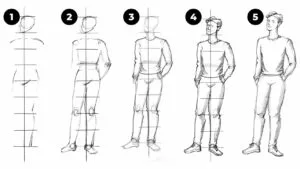
Behavioural objectives
By the end of the lesson, students should be able to:
- explain what life drawing is and state what it is used for;
- list the body parts studied in a live model;
- use the head as the unit of measurement to state the proportions of an average, an ideal and a heroic figure;
- measure a figure with a pencil held at arm’s length;
- transfer measurements onto drawing paper;
- state the differences between the male and female figures.
What does life drawing teach the artist?
Life drawing teaches the artist different ways of rendering what is observed in a live model.
- Drawing technique: the artist defines a method that interprets the shapes and forms made on the model by light and dark shades.
- Skeletal framework: the artist learns to show the skeleton, which gives the figure its structure and shape.
- Male and female frame: the artist shows the defined masculine or feminine frame and the edge lines of a nude model.
- Drapery: the artist learns how cloth falls over the body shapes and frame.
- Geometric shapes: the artist starts with simple geometric shapes and gradually modifies them to resemble the human form.
What is life drawing used for?
Life drawing is used to prepare figure studies for more finished work.
- Figure studies: a range of studies made in preparation for finished work.
- Portraiture: drawing and painting of a person’s face and likeness.
- Gesture illustrations: quick drawings that capture the movement or pose of a figure.
- Medical illustrations: drawings that show parts of the body for study.
- Sculpture: the sculptor studies the body form before modelling or carving.
- Photography: life drawing has influenced the posing and composition of photographs.
What does the artist study in a live model?
The artist studies a live model as a whole and in part.
- As a whole: the entire framework of the figure, with its height and body size.
- In part: the separate body parts listed below.
Which body parts are studied?
- Head: face, eyes, nose, skin texture and complexion.
- Hand: shoulder, muscle, fingers and nails.
- Chest: breast, chest hair and chest muscle.
- Stomach and pelvic region: diameter of the stomach and the male and female pelvic features.
- Leg: framework of the legs, thighs, ankle, foot and toenails.
What is the order of study?
- Study the human anatomy first.
- Develop a relationship between the figure and a harmonious background.
- Aim for compositional balance in an advanced, finished life drawing study.
What is proportion in human figure drawing?
Proportion is the correct size relationship between the parts of the figure and the whole figure.
- Basic unit: the standard technique uses the head as the unit of measurement.
- One head: the distance from the top of the head to the chin.
- Height: the height of the figure is counted in heads.
What are the three standard figure proportions?
There are three standard proportions: average, ideal and heroic.
- Average figure: 7½ heads tall, used for an ordinary person.
- Ideal figure: 8 heads tall, used to give an impression of nobility or grace.
- Heroic figure: 8½ heads tall, used to depict a god or a superhero.
| Type of figure | Height in heads (head included) | Use |
|---|---|---|
| Average | 7½ | An ordinary person |
| Ideal | 8 | Gives an impression of nobility or grace |
| Heroic | 8½ | Depicts a god or a superhero |
- Note: these are basic standard proportions, and a change in pose will affect the height.
How do you measure the human figure?
You measure the figure by finding the length of the model’s head and using it to divide the whole figure.
What are the steps of pencil measurement?
- Stretch your arm straight towards the model with a pencil in your hand.
- Use the pencil to measure the length of the model’s head.
- Apply that length in divisions down the entire length of the figure.
- Note how many head lengths the figure measures.
- Accuracy: the pencil is a rough measure, but it gives reasonable help in getting the proportion down.
What rules should you follow each time you measure?
- Position: stand in the same place.
- Head: keep your head as still as possible.
- Arm: extend your arm fully with the elbow straight.
- Distance: avoid standing too close to the model.
How do you transfer measurements to paper?
You transfer measurements by dividing the drawing paper into equal head units and scaling the observed figure to fit.
- Draw equally spaced horizontal lines down the paper, one for each head unit (seven lines for an average figure).
- Scale the observed information to fit the page.
- Start with the head as your top division.
- Draw the rest of the figure downwards.
- Note where key points or organs fall against the head measurements.
What is the difference between male and female figures?
The male figure is generally broad at the shoulders and narrow at the hips, while the female figure is generally the opposite.
- Male figure: broad shoulders, narrow hips, a flat or muscular chest and flat buttocks.
- Female figure: narrow shoulders, wide hips and raised buttocks.
| Feature | Male figure | Female figure |
|---|---|---|
| Shoulders | Broad | Narrow |
| Hips | Narrow | Wide |
| Chest | Commonly flat or muscular | Shows the breast |
| Buttocks | Commonly flat | Commonly raised |
Evaluation
- What is life drawing?
- List four uses or influences of life drawing.
- What is the basic unit of measurement in human figure drawing, and how many heads make up an average, an ideal and a heroic figure?
- State the points to observe when measuring a figure with a pencil.
- State two differences between the male and female figures.
Assignment
Using the head as your unit of measurement, draw a standing human figure of average proportion. Mark the head divisions on the figure. Label the broad or narrow shoulders and hips to show whether your figure is male or female.
This term's Visual Arts topics
SS1 First Term · 9 topics
Get Visual Arts as PDF and Word
Every week of SS1 Visual Arts, First Term, formatted and ready to print. Ad-free, and the copy lock comes off.
Get this term Card, bank transfer, USSD or OPay
SS1 Visual Arts Lesson Notes for Other Topics

Introduction To Visual Arts
Read the full lesson note.

Visual Sense
Read the full lesson note.

Professions And Job Opportunities
Read the full lesson note.

Drawing Lines
Read the full lesson note.

Drawing Nature And Man-Made Objects
Read the full lesson note.

Drawing And Shading
Read the full lesson note.

Drawing Still-Life Objects
Read the full lesson note.

Introduction To Art Appreciation
Read the full lesson note.

Introduction To Graphics
Read the full lesson note.

Textile Designs
Read the full lesson note.

Introduction to Computer Graphics
Read the full lesson note.

Terminologies In 2 dimensional Art
Read the full lesson note.

Terminologies In 3 dimensional Art
Read the full lesson note.

Introduction To Molding
Read the full lesson note.

Historical Foundation Of Nigerian Arts
Read the full lesson note.
Lesson Notes for Other Classes

SS2 Lesson Note
The complete lesson note to guide your studies.

SS3 Lesson Note
The complete lesson note to guide your studies.
