
Nigeria Vegetation – SS1 Geography Lesson Note (Second Term)
Download this term · ₦1,000Lesson note at a glance
- Subject
- Geography
- Class
- SS1
- Term
- Second Term
- Topic
- Nigeria Vegetation
- Order
- Topic 4 of 7 this term
- Reading time
- 3 min
Nigeria has three major vegetation zones: forest, savanna and montane. Forest vegetation is mainly trees, savanna vegetation is mainly grasses, and montane vegetation grows in highland areas such as Jos and Adamawa. Soil is the thin uppermost layer of the earth’s crust on which plants grow, and Nigerian soils fall into four zones: laterite, sandy, forest and alluvial.
Behavioural objectives
By the end of the lesson, students should be able to:
- name the three major vegetation zones of Nigeria and their subdivisions;
- describe forest, savanna and montane vegetation;
- define soil;
- name the four major soil zones of Nigeria and the places where each is found;
- state the vegetation and features linked with each soil zone.
What are the vegetation zones of Nigeria?
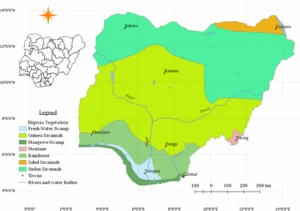
The vegetation of Nigeria can be grouped into three major zones.
1. Forest zone
This zone contains mainly trees. It is subdivided into:
- Mangrove swamp forest: salt and freshwater swamp
- Rainforest
2. Savanna zone
This zone is made up of mainly grasses. It is further subdivided into three:
- Guinea savanna
- Sudan savanna
- Sahel savanna
3. Montane vegetation
This is mainly found in highland areas such as Jos and Adamawa.
What are the soils in Nigeria?
Soil is defined as the thin surface of the uppermost layer of the earth’s crust on which plants grow.
Soils in Nigeria can be grouped into four major zones:
- Zone of laterite soil
- Zone of sandy soil
- Zone of forest soil
- Zone of alluvial soil
1. Zone of laterite soil
These soils are found in the interior zone of Nigeria in places such as Jos, Makurdi, Minna, Enugu and Abuja. They are associated with the Guinea savanna and are heavily leached because of rainfall. They are usually reddish because of the presence of iron.
2. Zone of sandy soil
These soils are found in the extreme northern part of Nigeria, in places like Sokoto, Katsina, Kano, Damaturu and Maiduguri. They are associated with the Sudan and Sahel savanna. They are formed because of dryness and the deposition of sand by wind.
3. Zone of forest soil
This soil is found in the southern belt and southwestern part of Nigeria, in places like Ibadan, Akure, Benin City, Ogun, Anambra and Imo. It is associated with forest vegetation and is rich in humus because of fallen and decayed leaves.
4. Zone of alluvial soil
This soil is found around Ilorin, Lokoja and the Niger Delta areas of Warri, Port-Harcourt and Calabar. It is associated with fine alluvial soil deposits at the lower course of a river.
Evaluation
- Name the three major vegetation zones of Nigeria.
- State the two subdivisions of the forest zone.
- Name the three subdivisions of the savanna zone.
- Why is laterite soil usually reddish?
- Which soil zone is associated with Sudan and Sahel savanna?
Assignment
- The best soil for planting is ____ soil. (a) sandy (b) clayey (c) loamy
- Sandy soil is more dominant in which of the following areas? (a) Warri (b) Lagos (c) Kano
- Laterite soil is more dominant in which of the following areas? (a) Makurdi (b) Lagos (c) Kano
- Savanna vegetation is characterised by (a) trees (b) grasses (c) raffia palms
- Soil porosity is highest in ____ soil. (a) sandy (b) loamy (c) clayey
- Define soil erosion.
- Mention three areas of wind erosion in Nigeria.
This term's Geography topics
SS1 Second Term · 7 topics
Get Geography as PDF and Word
Every week of SS1 Geography, Second Term, formatted and ready to print. Ad-free, and the copy lock comes off.
Get this term Card, bank transfer, USSD or OPay
Second Term Geography Lesson Notes for Other Topics

Map Readings
Read the full lesson note.

Representation of Relief Form
Read the full lesson note.

Principle of Elementary Surveying
Read the full lesson note.

Mining in Africa (Copper, Gold, and Petroleum)
Read the full lesson note.

Bush Fallowing in West Africa
Read the full lesson note.

GIS Application
Read the full lesson note.
Soil
Read the full lesson note.

Geo- Political Issues (Land Reclamation)
Read the full lesson note.

World Population II
Read the full lesson note.

Settlement
Read the full lesson note.

World Population I
Read the full lesson note.
Transportation In Nigeria
Read the full lesson note.

Commercial Activities In Nigeria
Read the full lesson note.

Manufacturing Companies In Nigeria
Read the full lesson note.
Environmental Conservation
Read the full lesson note.
Lesson Notes for Other Classes

Basic 1 Lesson Note
The complete lesson note to guide your studies.

Basic 2 Lesson Note
The complete lesson note to guide your studies.

Basic 3 Lesson Note
The complete lesson note to guide your studies.

Basic 4 Lesson Note
The complete lesson note to guide your studies.

Basic 5 Lesson Note
The complete lesson note to guide your studies.

Basic 6 Lesson Note
The complete lesson note to guide your studies.
