
World Population I – SS2 Geography Lesson Note (Second Term)
Lesson note at a glance
- Class
- SS2
- Subject
- Geography
- Term
- Second Term
- Reading time
- 5 min
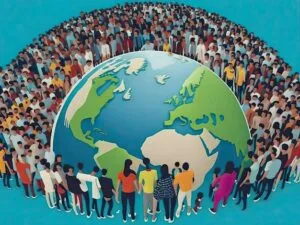
Population is the number of people living in an area at a particular time. It is described using concepts such as overpopulation, underpopulation, optimum population and population density.
Behavioural objectives
- Define population.
- Explain overpopulation, underpopulation and optimum population.
- State the effects of overpopulation and underpopulation.
- Define population density and calculate it.
- List and explain the physical factors that affect population.
- List and explain the human factors that affect population.
Which countries are the most populous?
India and China are the two most populous countries in the world.
- India and China: each has over one billion people.
- Other large countries: the United States and Indonesia are also among the most populous.
- Nigeria: the most populous country in Africa.
What are the population concepts?
The main population concepts are population, overpopulation, underpopulation, optimum population and population density.
- Population: the total number of people living in a place at a given time.
- Overpopulation: the population is too large for the available resources, so people cannot enjoy the highest possible standard of living.
- Underpopulation: the population is too small to use the available resources fully, given the country’s technology.
- Optimum population: the number of people that uses the resources fully and gives the highest possible standard of living.
- Population density: the number of persons per unit area of land, for example per square kilometre.
Comparing the three concepts
| Concept | People and resources | Common signs |
|---|---|---|
| Overpopulation | People are too many for the resources | Unemployment, food shortage, crowded housing, pressure on schools and hospitals |
| Underpopulation | People are too few for the resources | Unused resources, low output, small market for goods |
| Optimum population | People and resources are well balanced | Full use of resources, high standard of living |
Does the optimum population stay the same?
No, the optimum population of a country changes over time.
- Technology: better technology can make the same resources support more people.
- New resources: the discovery of a new resource, such as a mineral, can raise the optimum number.
- Resource loss: soil erosion or the exhaustion of a resource can lower it.
What are the effects of overpopulation and underpopulation?
Overpopulation strains resources, while underpopulation leaves resources unused.
Effects of overpopulation
- Unemployment: there are more job seekers than jobs.
- Food shortage: food production cannot feed everyone.
- Housing problems: overcrowding and the growth of slums.
- Pressure on amenities: schools, hospitals, water and electricity become inadequate.
- Environmental damage: heavy use of land leads to soil exhaustion, deforestation and waste problems.
Effects of underpopulation
- Unused resources: land, minerals and forests are not fully developed.
- Labour shortage: too few workers for farms and industries.
- Low output: total production stays small.
- Small market: few buyers discourage industries.
How is population density calculated?
Population density is total population divided by land area.
- Formula: population density = total population ÷ land area.
- Unit: persons per square kilometre (persons/km²).
Worked example 1
- A town has 600,000 people and covers 300 km².
- Write the formula: density = total population ÷ land area.
- Substitute: density = 600,000 ÷ 300.
- Answer: 2,000 persons per km².
Worked example 2
- A district has 1,200,000 people and covers 400 km².
- Substitute: density = 1,200,000 ÷ 400.
- Answer: 3,000 persons per km².
What are the types of population density?
There are two types of population density: high density and low density.
- High density: many people in a small area, as in big cities such as Lagos and industrial regions.
- Low density: few people in a large area, as in deserts and polar regions.
What factors affect population?
Two groups of factors affect where people live and how many live there: physical factors and human factors.
- Physical factors: natural features of the land and climate.
- Human factors: activities and decisions of people.
What are the physical factors that affect population?
The physical factors are climate, water, relief, soil and mineral resources.
- Climate: favourable climates, as in parts of Europe, the USA and China, attract high populations. Harsh polar and desert climates do not.
- Water: good drinking water and water for farming attract people, as in parts of the USA, India and Java (Indonesia).
- Relief (lowlands): lowlands and river valleys such as the Nile Delta and the Indus and Ganges plains attract high populations.
- Relief (highlands): high mountains and rugged hills such as the Rockies and the Andes have few people.
- Soil: fertile soil supports farming and so attracts people.
- Mineral resources: minerals such as coal, petroleum and iron ore attract workers and settlement.
What are the human factors that affect population?
The human factors are agriculture, beliefs, industry, immigration, transport and social facilities.
- Agriculture: Java, China and India practise intensive farming and support high populations.
- Religious and cultural beliefs: some beliefs favour early marriage and large families, which raises birth rates.
- Industry: industrial regions such as Pittsburgh in the USA and the Ruhr in Germany attract workers.
- Immigration: people move into countries such as the USA, Canada and some European countries for jobs, which raises their populations.
- Good transport network: roads, railways and ports make an area easy to reach and settle.
- Improved social facilities: pipe-borne water, electricity and good medical care attract people.
How do the factors compare in dense and sparse areas?
| Factor | Densely populated areas | Sparsely populated areas |
|---|---|---|
| Climate | Favourable, as in parts of Europe and China | Harsh, as in deserts and polar regions |
| Relief | Lowlands and river valleys | High mountains and rugged hills |
| Soil | Fertile | Poor or thin |
| Economic activity | Industry and intensive farming | Little industry or farming |
Evaluation
- Define population.
- Distinguish between overpopulation and underpopulation.
- Why is optimum population regarded as the best population concept?
- A region has 90,000 people and covers 45 km². Calculate its population density.
- Explain two physical factors and two human factors that affect population.
Assignment
Explain how relief, climate, industry and immigration affect the population of an area, giving one example for each.
This term's Geography topics
SS2 Second Term · 9 topics
SS2 Geography Lesson Notes for Other Topics

Environmental Conservation
Read the full lesson note.

Transportation In Nigeria
Read the full lesson note.

Manufacturing Companies In Nigeria
Read the full lesson note.

Commercial Activities In Nigeria
Read the full lesson note.

World Population II
Read the full lesson note.

Settlement
Read the full lesson note.

Soil
Read the full lesson note.

Geo- Political Issues (Land Reclamation)
Read the full lesson note.

Action Of Running Water
Read the full lesson note.

Action Of Wind
Read the full lesson note.

Glacial Action
Read the full lesson note.

Action Of Wave
Read the full lesson note.

Climate & Climate Classification
Read the full lesson note.

Climate & Climate Classification II
Read the full lesson note.

Vegetation
Read the full lesson note.
Lesson Notes for Other Classes

SS1 Lesson Note
The complete lesson note to guide your studies.

SS3 Lesson Note
The complete lesson note to guide your studies.
