
Manufacturing Companies in Nigeria – SS2 Geography Lesson Note (Second Term)
Lesson note at a glance
- Class
- SS2
- Subject
- Geography
- Term
- Second Term
- Reading time
- 7 min
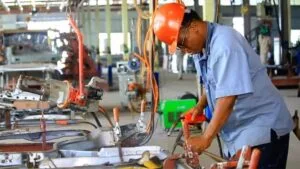
The manufacturing industry is the industry that turns raw materials into new products by mechanical or chemical processes, at home or in the factory.
Behavioural objectives
By the end of the lesson, students should be able to:
- define the manufacturing industry and state its characteristics in Nigeria;
- classify manufacturing industries into light, consumer goods and heavy industries, and into primary, secondary and tertiary industries;
- list the factors that affect the location of industries and the reasons why most industries are sited in urban areas;
- state the advantages and disadvantages of concentrating industries in one area;
- name the local craft industries and the industrial zones of Nigeria, with the towns where they are found;
- give examples of manufacturing companies in Nigeria and state the problems they face.
What are the key terms in manufacturing?
Five terms are used again and again in this topic.
- Raw material: a natural or semi-processed material used to make something else, such as cocoa, cotton, limestone and crude oil.
- Finished goods: products that are ready for the final user, such as cement, soap and shoes.
- Labour intensive: needing a large number of workers rather than machines.
- Small-scale industry: an industry that uses little capital and employs few workers.
- Localisation of industries: the siting of many industries in one area.
What are the characteristics of manufacturing industries in Nigeria?
Manufacturing industries in Nigeria have seven main characteristics.
- Foreign skilled labour: most industries rely on skilled workers from other countries.
- Imported raw materials: most industries also depend on foreign countries for their raw materials.
- Concentration: industries are found in a few locations, especially urban centres.
- Light industries: most manufacturing industries are light industries.
- Labour intensive: they need a large labour force.
- Local market: their products are mainly consumed in Nigeria.
- Small scale: most of them are small-scale.
What are examples of manufacturing companies in Nigeria?
Manufacturing companies in Nigeria make goods such as cement, drinks, food, soap and vehicles.
| Company | Main products |
|---|---|
| Dangote Cement | Cement |
| Lafarge Africa | Cement |
| Nigerian Breweries | Beer and malt drinks |
| Nestlé Nigeria | Food and beverages |
| Cadbury Nigeria | Chocolate drinks and beverages |
| Unilever Nigeria | Soaps and household products |
| Flour Mills of Nigeria | Flour and other food products |
| Innoson Vehicle Manufacturing | Vehicles |
How are manufacturing industries classified?
Industries are classified in two ways: by the type of goods they make and by their function.
Classification by goods: light, consumer goods and heavy industries
There are three groups of manufacturing industry by goods: light, consumer goods and heavy industries.
Light industries
- Products: relatively lightweight goods such as matches, television sets, electric fans and books.
- Workers: they employ mainly women.
- Goods: they produce final or consumable goods.
Consumer goods industries
- Products: they turn raw materials into goods that people use directly.
- Location: they are normally located in cities.
Heavy industries
- Products: heavy or bulky goods.
- Workers: they employ mainly men.
- Examples: metallurgical industries, petroleum industries and shipbuilding industries.
| Feature | Light industries | Heavy industries |
|---|---|---|
| Goods | Lightweight, final goods | Heavy, bulky goods |
| Main workers | Women | Men |
| Examples | Matches, electric fans, books | Metal works, petroleum, shipbuilding |
Classification by function: primary, secondary and tertiary industries
There are three types of industry by function: primary, secondary and tertiary.
Primary industries
- Activity: extraction of raw materials provided by nature.
- Other name: extractive industries.
- Examples: mining, fishing, lumbering, farming and livestock production.
Secondary industries
- Activity: turning raw materials into finished goods.
- Examples: construction, building and chemical industries.
Tertiary industries
- Activity: rendering of services.
- Direct services: trading, banking, teaching and medical services.
- Indirect services: the police, customs and soldiers.
What factors affect the location of industries?
Eight main factors affect where an industry is sited.
- Raw materials: industries that use bulky raw materials are sited near their source.
- Market: nearness to buyers reduces the cost of moving goods.
- Power: industries need electricity, gas or fuel to run machines.
- Labour: there must be enough workers, skilled and unskilled.
- Capital: money is needed to build factories and buy machines.
- Transport: good roads, railways, ports and airports move materials and goods.
- Government policies: taxes, incentives and industrial laws can attract or discourage industries.
- Political stability: investors build factories where there is peace and security.
Why are most manufacturing industries sited in urban areas?
Most industries are sited in urban areas because cities offer six advantages that industries need.
- Large market: many people live in cities and buy the goods.
- Labour: cities have many skilled and unskilled workers.
- Transport network: roads and rail link the city to other places.
- Seaports and airports: they make import and export easy.
- Finance: banks and other lenders are found in cities.
- Infrastructure: cities have electricity, water, telecommunications and other facilities.
What is localisation of industries?
Localisation of industries is the siting of industries in a particular area, that is, the concentration of industries in one area.
What are the advantages of concentration of industries?
- Interdependence: one industry uses the products or waste of another.
- Employment: many jobs are created.
- Mobility of labour: workers can move easily from one firm to another.
- Social amenities: schools, hospitals and roads are provided.
- Healthy competition: firms try to make better goods at lower prices.
- Organised markets: examples are cooperative societies.
- Subsidiary industries: smaller industries that supply or serve the main ones are attracted to the area.
- Inventions and innovations: competition among industries encourages new ideas.
What are the disadvantages of concentration of industries?
- Congestion: traffic, industries and housing become overcrowded.
- Shortage of amenities: facilities cannot serve the growing population.
- Higher crime rate: examples are armed robbery and car snatching.
- Pollution: many industries pollute the air, water and land.
- Wartime target: the area becomes a target of attack during war.
- Rural-urban migration: people leave villages to look for jobs in the area.
What are local craft (cottage) industries in Nigeria?
Local craft or cottage industries are small industries that depend mainly on raw materials from their immediate locality.
- Raw materials: obtained from the local area.
- Tools: simple tools are used.
- Quality: the work is of high artistic quality.
There are six main local crafts in Nigeria, and the towns where they are found are shown below.
| Craft | Examples of products | Towns |
|---|---|---|
| Leather works | Sandals, cushions, handbags | Kano, Bida, Sokoto |
| Wood carving | Carved wooden objects | Ikot Ekpene, Uyo, Oyo, Benin City |
| Pottery and glass making | Pots, glass items | Ikot Ekpene, Bida, Ilorin, Calabar |
| Rope and mat making | Ropes, mats | Ikot Ekpene, Warri, Kano |
| Brass and silver works | Brass and silver objects | Bida, Benin, Kano |
| Textile and cloth weaving | Woven cloth | Akwette, Okene, Kano, Iseyin |
What are the modern industrial zones in Nigeria?
There are four modern industrial zones in Nigeria: western, South-East, North-Central and Midwest.
| Zone | Industrial towns |
|---|---|
| Western | Lagos, Ibadan, Sango Ota, Abeokuta, Epe, Apapa, Ewekoro, Oshogbo |
| South-East | Nkalagu, Onitsha, Port Harcourt, Enugu, Aba, Owerri, Calabar |
| North-Central | Kano, Kaduna, Jos, Zaria |
| Midwest | Warri, Benin, Sapele, Ughelli |
Why is manufacturing important to Nigeria?
Manufacturing turns local resources into goods and brings several benefits to the economy.
- Employment: factories give jobs to many people.
- Value added: raw materials become more valuable as finished goods.
- Fewer imports: goods made at home reduce the need to buy from abroad.
- Foreign exchange: manufactured goods that are exported earn money from other countries.
- Development: factories lead to new roads, power supply and towns.
What problems do manufacturing industries face in Nigeria?
Manufacturing industries in Nigeria face problems that limit how much they produce.
- Power supply: electricity is often irregular.
- Raw materials: many are imported, which raises costs.
- Capital: money to start or expand is hard to get.
- Skilled labour: there is a shortage of trained workers.
- Transport: poor roads delay and raise the cost of moving goods.
- Small local market: many people have low buying power.
Evaluation
- Define the manufacturing industry.
- State four characteristics of manufacturing industries in Nigeria.
- Distinguish between primary, secondary and tertiary industries, giving one example of each.
- State three advantages and three disadvantages of the concentration of industries.
- Name two local craft industries and one town where each is found.
Assignment
Draw a sketch map of Nigeria and complete the tasks below.
- Show and name one industrial zone in the west and one in the east.
- State two reasons why most manufacturing industries are sited in cities.
This term's Geography topics
SS2 Second Term · 9 topics
SS2 Geography Lesson Notes for Other Topics

Environmental Conservation
Read the full lesson note.

Transportation In Nigeria
Read the full lesson note.

Commercial Activities In Nigeria
Read the full lesson note.

World Population I
Read the full lesson note.

World Population II
Read the full lesson note.

Settlement
Read the full lesson note.

Soil
Read the full lesson note.

Geo- Political Issues (Land Reclamation)
Read the full lesson note.

Action Of Running Water
Read the full lesson note.

Action Of Wind
Read the full lesson note.

Glacial Action
Read the full lesson note.

Action Of Wave
Read the full lesson note.

Climate & Climate Classification
Read the full lesson note.

Climate & Climate Classification II
Read the full lesson note.

Vegetation
Read the full lesson note.
Lesson Notes for Other Classes

SS1 Lesson Note
The complete lesson note to guide your studies.

SS3 Lesson Note
The complete lesson note to guide your studies.
