
The Nigerian Climate – SS1 Geography Lesson Note (Second Term)
Lesson note at a glance
- Class
- SS1
- Subject
- Geography
- Term
- Second Term
- Reading time
- 6 min
Climate is the average weather condition of the atmosphere of a place over a long period of about 30 to 35 years.
Behavioural objectives
By the end of the lesson, students should be able to:
- define climate and distinguish it from weather;
- list the factors that affect climate and the elements of climate;
- describe the characteristics of temperature in Nigeria;
- name the four types of wind in Nigeria and state their effects;
- describe the distribution of rainfall, insolation and relative humidity in Nigeria.
What is the difference between weather and climate?
Weather is the condition of the atmosphere of a place at a particular time, while climate is the average of that weather over many years.
| Point | Weather | Climate |
|---|---|---|
| Time covered | A short period, such as an hour or a day | A long period of about 30 to 35 years |
| Nature | Changes quickly | Changes very slowly |
| Example | It rained in Lagos this morning. | Lagos has a wet climate with a long rainy season. |
What are the factors affecting climate?
The main factors affecting climate are latitude, altitude, distance from the sea, ocean currents, prevailing winds and relief.
- Latitude: distance of a place north or south of the equator. Places near the equator are generally hotter.
- Altitude: height above sea level. Temperature falls as height increases, so highlands are cooler than lowlands.
- Distance from the sea: coastal places are cooler and wetter. Places far inland are hotter and drier.
- Ocean currents: warm currents raise the temperature of nearby land. Cold currents lower it.
- Prevailing winds: winds from the sea bring moisture and rain. Winds from the desert bring dry air.
- Relief: mountains and plateaux affect temperature and the amount of rain a place receives.
What are the elements of climate?
The elements of climate are the measurable conditions of the atmosphere: temperature, rainfall, wind, relative humidity, pressure, cloud cover and sunshine.
- Temperature: degree of hotness or coldness of the air, measured with a thermometer.
- Rainfall: amount of water that falls from the atmosphere, measured with a rain gauge.
- Wind: air in motion. Direction is shown by a wind vane and speed by an anemometer.
- Relative humidity: amount of water vapour in the air compared with the most it can hold, measured with a hygrometer.
- Pressure: weight of the air on the earth’s surface, measured with a barometer.
- Cloud cover: part of the sky covered by cloud.
- Sunshine: number of hours of bright sun in a day, measured with a sunshine recorder.
What are the characteristics of temperature in Nigeria?
Temperature is the degree of hotness and coldness of a place, and in Nigeria it is not uniform.
- It varies from place to place. Temperature is lower in the south, with an average of about 24°C, because of the cooling effect of the Atlantic Ocean. It is higher in the north because of the effect of the Sahara Desert and distance from the sea.
- It varies with altitude (height). High places like the Jos Plateau and Obudu have lower temperatures (about 20°C). The surrounding lowlands have high temperatures (over 27°C).
- It varies with seasons. Temperatures are lower in the rainy season because of cloud cover and rain. In the dry season, harmattan makes mornings and nights cold, especially in the north.
- The annual range varies. Annual range is the difference between the hottest and coldest months. It is 2 to 3°C in the south and about 9°C in the north.
What are the types of wind in Nigeria?
Wind is air in motion, and there are four types of wind in Nigeria: the tropical maritime air mass, the tropical continental air mass, the equatorial easterlies and the land and sea breeze.
Tropical Maritime Air Mass (south-west trade wind)
- Source: the Atlantic Ocean, so it is warm and moist.
- Effect: it brings the rainy season to Nigeria, especially the south.
- Coast: places like Warri and Port Harcourt have rain for almost the whole year.
- South generally: the rainy season runs from March to October.
- August break: a short dry spell in August during the rainy season in the south.
Tropical Continental Air Mass (north-east trade wind)
- Source: the Sahara Desert, so it is dry and dusty.
- Effect: it brings the dry season and no rain.
- Harmattan: a cold, dusty and dry weather that starts in November and ends around February.
Equatorial Easterlies
- Direction: blows around the equator from the east.
- Effect: it has some influence on the north-east and south-west trade winds when they meet.
Land and sea breeze
- Type: local winds restricted to the coast, for example Lagos, Warri and Port Harcourt.
- Sea breeze: blows from the sea to the land during the day.
- Land breeze: blows from the land to the sea at night.
How do the two main air masses compare?
| Point | Tropical maritime | Tropical continental |
|---|---|---|
| Direction | South-west | North-east |
| Source | Atlantic Ocean | Sahara Desert |
| Nature | Warm and moist | Dry and dusty |
| Season brought | Rainy (wet) season | Dry season (harmattan) |
What are the seasons in Nigeria?
There are two seasons in Nigeria: the wet season and the dry season.
- Wet season: the tropical maritime air mass (south-westerly wind) influences most parts of the country.
- Dry season: the tropical continental air mass influences most parts of the country.
How is rainfall distributed in Nigeria?
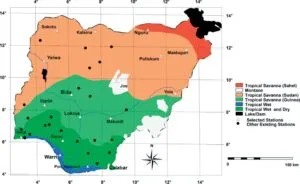
Rainfall in Nigeria is unevenly distributed and generally decreases from the coast inland.
- Coast: rain falls for about 8 to 12 months of the year.
- Further inland: the period of rainfall decreases to less than six months.
- North-west and north-east: the shortest rainfall periods, with rain for less than four months of the year.
- Mean annual rainfall: about 2000 mm along the coast and less than 600 mm in the northern part of the country.

How are insolation and sunshine distributed in Nigeria?
Insolation is the solar energy received from the sun at the earth’s surface, and it is generally high throughout the year in Nigeria.
- South: less insolation is received because cloud cover is thicker.
- North: the highest insolation is received because there are fewer clouds.
- Seasons: sunshine hours are fewer in the rainy season than in the dry season.
How is relative humidity distributed in Nigeria?
Relative humidity decreases towards the north, so it is higher in the south than in the north.
- Place: the south is nearer the Atlantic Ocean and has more moisture in the air.
- Season: humidity is higher in the rainy season than in the dry season.
How does the climate of southern Nigeria differ from the north?
Southern Nigeria is cooler, wetter and more humid than the north, which is hotter and drier with a wider temperature range.
| Element | South | North |
|---|---|---|
| Temperature | Lower, cooled by the Atlantic Ocean | Higher, under the influence of the Sahara |
| Annual range of temperature | 2 to 3°C | About 9°C |
| Length of rainfall | About 8 to 12 months at the coast | Less than six months, and less than four in the north-west and north-east |
| Annual rainfall | About 2000 mm at the coast | Less than 600 mm |
| Insolation | Less, because of thicker cloud | More, because of fewer clouds |
| Relative humidity | Higher | Lower |
Evaluation
- Define climate.
- List four factors that affect climate.
- State the characteristics of temperature in Nigeria.
- Name the four types of wind in Nigeria.
- Describe how rainfall is distributed in Nigeria.
Assignment
Describe the tropical maritime air mass and the tropical continental air mass, state the season each one brings to Nigeria, and explain why relative humidity is higher in the south than in the north.
This term's Geography topics
SS1 Second Term · 7 topics
SS1 Geography Lesson Notes for Other Topics
Nigeria: Location And Position
Read the full lesson note.
Physical Setting Of Nigeria: Relief And Drainage
Read the full lesson note.
Nigeria Vegetation
Read the full lesson note.
Nigerian Population
Read the full lesson note.
Nigeria Resources
Read the full lesson note.

Agriculture in Nigeria
Read the full lesson note.

Geography: An Introduction
Read the full lesson note.

The Earth's Rotation
Read the full lesson note.

The Earth's Revolution
Read the full lesson note.

Latitude & Longitude
Read the full lesson note.

The Earth's Structure
Read the full lesson note.

Rocks
Read the full lesson note.

Mountains
Read the full lesson note.

Lowlands
Read the full lesson note.

The Environment - Ecosystem & Its Component
Read the full lesson note.
Lesson Notes for Other Classes

SS2 Lesson Note
The complete lesson note to guide your studies.

SS3 Lesson Note
The complete lesson note to guide your studies.
