
Plant Nutrient and Nutrient Cycle – SS2 Agricultural Science Lesson Note (First Term)
Download Lesson NoteLesson note at a glance
- Subject
- Agricultural Science
- Class
- SS2
- Term
- First Term
- Topic
- Plant Nutrient and Nutrient Cycle
- Order
- Topic 6 of 7 this term
- Reading time
- 5 min
Plant nutrients are classified into two, these include macronutrients and micronutrients.
- MACRONUTRIENTS
These are mineral elements or nutrients required by crops in large quantities. Examples are nitrogen, phosphorus, potassium, magnesium, calcium and sulfur.
- MICRONUTRIENTS OR TRACE ELEMENTS
These are mineral elements or nutrients required by crops in small quantities. Examples are Zinc, Copper, boron, molybdenum, Iron, Chlorine and Manganese.
Functions and deficiency symptoms of plant nutrients
| SN | ELEMENT | FUNCTION | DEFICIENCY SYMPTOMS |
| 1 | Nitrogen | i. Aids plant’s growth and reproduction
ii. Promotes vegetative and short-system growth iii. Excess Nitrogen delay maturation and fruiting iv. Promotes chlorophyll formation v. Necessary for synthesis of plant hormones |
i. Stunted growth
ii. Yellowing of leaves iii. Leaves tend to drop iv. Poor formation of fruits and flowers |
| 2 | Phosphorus | i. It aids enzyme reactions
ii. It is a constituent of cell division iii. Increases soil resistance to diseases iv. Helps in ripening of fruits v. Help in root development and seed germination vi. Aids seed germination |
i. Logging results in cereal crops
ii. Stunted growth iii. Leaves turn purple and brownish iv. Poor root development Immature fruit drop |
| 3 | Potassium | i. Important constituent of plant tissues
ii. Aids synthesis of carbohydrates iii. Activates various plant enzyme reactions iv. Promotes development of young plants v. Helps in nitrate uptake in the soil |
i. Weak slender stems
ii. Delayed growth iii. Premature loss of leaves iv. Brown colour at the margin of leaves |
| 4 | Calcium | i. Strengthens plant cells with calcium pectate.
ii. Helps in translocation and storage of carbohydrates and proteins in seeds and tubers. iii. Necessary for normal growth of root tips. iv. It controls the toxicity of aluminium, manganese and sodium ions. v. It improves soil PH. |
i. Causes stunting of the root system
ii. Weak slender plants iii. Pale yellow colour of leaves |
| 5 | Magnesium | i. It is important in the synthesis of carbohydrates as it is a constituent of chlorophyll
ii. It assists in the transportation of phosphate for fruit seed development iii. It enhances plant growth iv. It is required for normal cell division v. Necessary for synthesis of soil in plants |
i. Chlorosis along leaf veins
ii. Stunted growth Premature leaf fall |
Nitrogen cycles
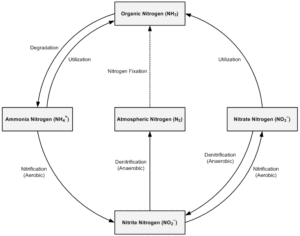
Nitrogen cycles refer to the circulation of certain nutrients like nitrogen, carbon and water in nature.
The nitrogen cycle is a natural way of regulating the amount of Nitrogen in the soil and air
Ways By Which Nitrogen Is Added To The Soil in Nitrogen Cycle
- Direct fixation by lightning during rainfall.
- Incorporation into the soil by free-living bacteria or non-symbiotic bacteria.
- Nitrogen-fixing bacteria in the root nodules.
- Decomposition of organic matter.
- Application of Nitrogen fertilizer.
- Ammonification.
- Nitrification.
Soil can gain Nitrogen in the following ways:
- Symbiotic Nitrogen Fixation
- Electrical discharge
- Non-symbiotic Nitrogen Fixation
- Ammonification and Nitrification
- Application or organic manure and 6. Nitrogen fertilizers
Ways by which nitrogen is lost from the soil are:
- By Denitrification
- Soil erosion
- Leaching
- Soil PH
- Bush burning
- Crop removal
- Volatilisation
- Oxidation reaction
- Reduction reaction
Processes that lead to the formation of nitrate from organic matter in nitrogen cycle
- Putrefaction: Delay of plant and animal remains into similar nitrogenous compounds by microorganisms
- : Products from putrefaction reactions converted to simple amino compounds and animal
- Immunization: Conversion of amino compounds and amines into ammonium compounds
- Nitrification: Oxidation of ammonium compounds into nitrites and Nitrates
Carbon cycle
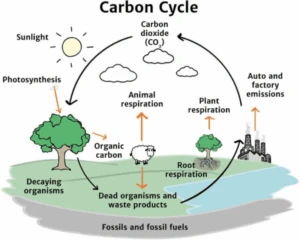
This involves the series of processes which contribute to the circulation of carbon in nature.
Explanation
- Carbon Dioxide is removed from the air mainly by photosynthesis
- Carbon is lost in the form of carbonates of calcium and magnesium through leaching and drainage.
- The atmosphere gains carbon dioxide through
- Burning of fuel like coal and wood
- The action of volcanoes which releases carbon dioxide
- The respiration of plants and animals
- Death and decay and putrefaction of plants and animals
- Diffusion of carbon dioxide from seas and other bodies of water
Importance of carbon cycle
- Plant use carbon dioxide obtained from the air to manufacture their food during photosynthesis
- Provision of carbon which is the essential building block of all organic matters
- Organic matter which is made from carbon helps to replenish soil nutrients.
Water cycle
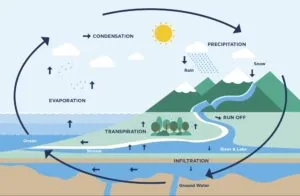 This is the continuous movement of water from the atmosphere to the earth and from the earth to the atmosphere.
The atmosphere receives water through:
- Evaporation from oceans and land
- Transpiration from plants
- Breathing and respiration by plants and animals
Land receives water through:
- Rainfall and precipitation
- Infiltration and percolation
Forms in which water exists in the soil
- Hygroscopic water
- Capillary water
- Gravitational water
Ways of conserving water in the soil
- Stoppage or reduction of water-run-off
- Addition of humus or organic mature
- Removal of weeds to reduce transpiration and water loss
- Mulching
- Cover cropping
- Contour ridging
- Appropriate tillage
- Strip cropping
Importance of water to crops
- Water provides the medium for the absorption of minerals salts
- It facilitates the transfer of nutrients to other parts of plants
- It is an essential raw material during photosynthesis
- Facilities enzymatic activities occurring in crop plant protoplasm
- It is a constituent of protoplasm
- It has a cooling effect on crops
- It helps to sustain life
- It helps in seed germination
- It helps to maintain plant turgor or turgidity
ASSIGNMENT
- The conversion of nitrates to nitrogen gas by certain bacteria is ___ (a) oxidation (b) reduction (c) nitrification (d) de-nitrification
- Microbial delay of plant and animal remains into simpler nitrogenous compound is ___ (a) nitrification (b) putrefaction (c) leaching (d) burning
- The washing away of soil nutrients down beyond the reach of the root is called ___ (a) erosion (b) mulching (c) leading (d) fertilization
- The following are macronutrients except (a) boron (b) nitrogen (c) magnesium (d) calcium
- Which of these is not a micro-element? (a) copper (b) zinc (c) boron (d) potassium
6(a) Differentiate between macro and micronutrients
(b) List three factors influencing nutrient availability in the soil
7(a) State three functions of Nitrogen to plants
(b) State three importance of organic matter in Agricultural
This term's Agricultural Science topics
SS2 First Term · 7 topics
First Term Agricultural Science Lesson Notes for Other Topics
Preservation of Farm Produce
Read the full lesson note.

Factors that may Hinder Preservation
Read the full lesson note.
Methods of Preserving the Farm Produce; Sun Drying, Smoking
Read the full lesson note.
Preservation of Grains and Cereals Crops
Read the full lesson note.
Preservation of Roots and Tubers Crops
Read the full lesson note.
Preservation of Fruits: Orange, Banana, Tomatoes, Pawpaw...
Read the full lesson note.

Conservation of Oil Crops: Soya Bean, Oil Palm, Groundnut
Read the full lesson note.
Preservation of Vegetables
Read the full lesson note.

Health And Safety
Read the full lesson note.
Procedures For Crop Production
Read the full lesson note.

Crop Production
Read the full lesson note.
Planting Activities
Read the full lesson note.
Post-Planting Activities
Read the full lesson note.

Post-Harvesting Activities; Sorting, Grading, And Storage
Read the full lesson note.

Harvesting Activities
Read the full lesson note.
Lesson Notes for Other Classes

Basic 1 Lesson Note
The complete lesson note to guide your studies.

Basic 2 Lesson Note
The complete lesson note to guide your studies.

Basic 3 Lesson Note
The complete lesson note to guide your studies.

Basic 4 Lesson Note
The complete lesson note to guide your studies.

Basic 5 Lesson Note
The complete lesson note to guide your studies.

Basic 6 Lesson Note
The complete lesson note to guide your studies.

