
Terminologies in 2 Dimensional Art – SS1 Visual Arts Lesson Note (Second Term)
Download this term · ₦1,000Lesson note at a glance
- Subject
- Visual Arts
- Class
- SS1
- Term
- Second Term
- Topic
- Terminologies in 2 Dimensional Art
- Order
- Topic 4 of 5 this term
- Reading time
- 4 min
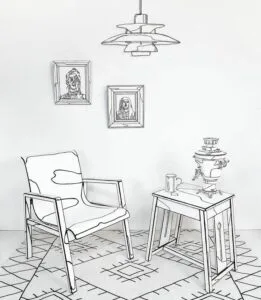
2-dimensional art, also called 2D art, is artwork that has only height and width, so its surface is flat.
- Contrast with 3D art: 3-dimensional art, such as sculpture, also has depth.
- Common forms: drawing, painting, printmaking and collage.
Behavioural objectives
By the end of the lesson, students should be able to:
- explain what 2-dimensional art is;
- define the eight key terminologies in 2D art: line, shape, form, colour, texture, value, perspective and composition;
- give examples of primary, secondary and tertiary colours;
- state the difference between shape and form;
- name and describe four forms of 2D art.
What are the key terminologies in 2-dimensional art?
There are eight key terminologies in 2D art: line, shape, form, colour, texture, value, perspective and composition.
1. Line
- Meaning: a mark made by a tool such as a pencil or pen on a surface.
- Appearance: it can be straight, curved, thick or thin.
- Use: lines create shapes and patterns.
- Effect: lines can show movement and emotion.
2. Shape
- Meaning: a closed space created by lines.
- Geometric shapes: regular shapes such as squares, triangles and circles.
- Organic shapes: natural, irregular shapes such as a leaf or a cloud.
3. Form
- Meaning: the look of depth or thickness in an object.
- Common use: it is more common in 3D art.
- In 2D art: shading or perspective gives the illusion of depth or thickness.
4. Colour
- Meaning: the hues we see in art.
- Use: artists use colour to express feelings or highlight parts of their art.
5. Texture
- Meaning: how something feels, or looks as if it would feel if touched.
- In 2D art: texture is implied. It gives the illusion of texture while the surface stays smooth.
- How it is made: artists use different techniques to make a surface look rough, smooth or bumpy.
6. Value
- Meaning: the lightness or darkness of a colour.
- Use: different values create depth and dimension.
- Effect: objects can look closer or farther away.
7. Perspective
- Meaning: a technique for representing 3D objects on a 2D surface.
- Effect: it creates the illusion of depth.
- Rule: objects that are closer appear larger, and objects farther away appear smaller.
8. Composition
- Meaning: how lines, shapes, colours and textures are arranged in an artwork.
- Effect: a good composition guides the viewer’s eye through the artwork.
- Result: it creates balance.
What are the kinds of line in 2D art?
Lines are named by their direction and shape.
- Horizontal line: runs flat from left to right, like the horizon.
- Vertical line: runs straight up and down, like a tall pole.
- Diagonal line: slants, and often suggests movement.
- Curved line: bends smoothly, as in the outline of a pot.
- Zigzag line: changes direction sharply, as in some Nigerian cloth patterns.
What are the types of colour?
There are three types of colour: primary, secondary and tertiary.
| Type | How it is made | Examples |
|---|---|---|
| Primary | Cannot be made by mixing other colours | Red, blue, yellow |
| Secondary | Mixing two primary colours | Green, orange, purple |
| Tertiary | Mixing a primary colour and a secondary colour | Yellow-green, blue-green, red-orange |
- Green: blue mixed with yellow.
- Orange: red mixed with yellow.
- Purple: red mixed with blue.
What is the difference between shape and form?
A shape is a flat, closed space made by lines. A form is an object that looks as if it has depth as well as height and width.
| Point | Shape | Form |
|---|---|---|
| Dimensions | Two: height and width | Three, or the illusion of three |
| Made by | Lines enclosing a space | Shading, value or perspective in 2D art |
| Example | A circle | A shaded sphere (ball) |
How do artists create depth on a flat surface?
Artists create depth by using value, shading and perspective.
- Draw objects that are closer larger, and objects farther away smaller.
- Use shading to make shapes look rounded and thick.
- Use lighter values for distant objects and darker values for near ones.
What are examples of 2D art forms?
Four common forms of 2D art are drawing, painting, printmaking and collage.
- Drawing: sketches or detailed pictures made with pencils, pens or crayons on paper.
- Painting: using watercolours, oil paints or acrylics to create colourful pictures on surfaces like paper or canvas.
- Printmaking: creating pictures by printing from a surface such as a woodblock or a metal plate.
- Collage: artwork made by sticking materials like paper, fabric or photographs onto a surface.

Evaluation
- What is 2-dimensional art?
- Name four forms of 2D art.
- What does value mean in art?
- What is composition?
- List three things a line can be used to show or create.
Assignment
Write short answers to all four questions below.
- What is the difference between shape and form?
- Explain what texture means in 2D art.
- Give examples of primary and secondary colours.
- Why is perspective important in drawing?
This term's Visual Arts topics
SS1 Second Term · 5 topics
- Introduction to Graphics
- Textile Designs
- Introduction to Computer Graphics
- Terminologies in 2 Dimensional Art
- Terminologies in 3 Dimensional Art
Get Visual Arts as PDF and Word
Every week of SS1 Visual Arts, Second Term, formatted and ready to print. Ad-free, and the copy lock comes off.
Get this term Card, bank transfer, USSD or OPay
SS1 Visual Arts Lesson Notes for Other Topics
Introduction To Graphics
Read the full lesson note.
Textile Designs
Read the full lesson note.

Introduction to Computer Graphics
Read the full lesson note.
Terminologies In 3 dimensional Art
Read the full lesson note.

Introduction To Visual Arts
Read the full lesson note.
Visual Sense
Read the full lesson note.

Professions And Job Opportunities
Read the full lesson note.
Drawing Lines
Read the full lesson note.
Drawing Nature And Man-Made Objects
Read the full lesson note.
Drawing And Shading
Read the full lesson note.

Drawing Still-Life Objects
Read the full lesson note.

Drawing Human Figures
Read the full lesson note.
Introduction To Art Appreciation
Read the full lesson note.
Introduction To Molding
Read the full lesson note.

Historical Foundation Of Nigerian Arts
Read the full lesson note.
Lesson Notes for Other Classes

SS2 Lesson Note
The complete lesson note to guide your studies.

SS3 Lesson Note
The complete lesson note to guide your studies.
