
Parts & Functions of Plant Parts – JSS1 Agricultural Science Lesson Note (First Term)
Download Lesson NoteLesson note at a glance
- Subject
- Agricultural Science
- Class
- JSS1
- Term
- First Term
- Topic
- Parts & Functions of Plant Parts
- Order
- Topic 4 of 5 this term
- Reading time
- 2 min
A plant is made up of many parts. The three main parts are the roots, the stem and the leaves. The roots absorb water and minerals and anchor the plant. The stem supports the plant and carries water and minerals to the leaves. The leaves make food for the plant by photosynthesis.
Behavioural objectives
By the end of the lesson, students should be able to:
- Name the three main parts of a plant.
- State the function of the roots, the stem and the leaves.
- Define aquatic plants and give examples.
- Define terrestrial plants.
What are the parts of a plant and what do they do?
Each part of a plant has a set of jobs to do to keep the plant healthy.
| Plant part | Functions |
|---|---|
| Roots | Absorb water and minerals from the soil. Anchor the plant in the ground. |
| Stem | Supports the plant above ground. Carries water and minerals to the leaves. |
| Leaves | Collect energy from the Sun and make food for the plant through a process called photosynthesis. |
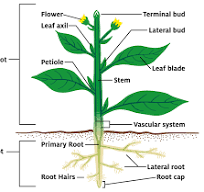
Parts of a plant
What are the forms of plants?
Aquatic plants
Aquatic plants are plants that have adapted to living in aquatic environments (saltwater or freshwater). They are also called hydrophytes or macrophytes. These plants need special adaptations for living submerged in water or at the water’s surface.
The principal factor controlling the distribution of aquatic plants is the depth and duration of flooding. Other factors may also control their distribution, abundance and growth form, including nutrients, disturbance from waves, grazing and salinity.
One of the largest aquatic plants in the world is the Amazon water lily, and one of the smallest is the minute duckweed. Many small aquatic animals use plants like duckweed for a home or for protection from predators, but areas with more vegetation are likely to have more predators. Familiar examples of aquatic plants include floating hearts, water lilies, lotus and water hyacinths.
Terrestrial plants
Terrestrial plants are plants that grow on, in or from land.
Evaluation
- Name the three main parts of a plant.
- State two functions of the roots.
- What is the function of the stem?
- What is photosynthesis, and which part of the plant carries it out?
- What are aquatic plants? Give two examples.
Assignment
- Draw a plant and label the roots, the stem and the leaves.
- Write one function beside each part you labelled.
- Write the meaning of terrestrial plants and aquatic plants.
This term's Agricultural Science topics
JSS1 First Term · 5 topics
First Term Agricultural Science Lesson Notes for Other Topics
Preservation of Farm Produce
Read the full lesson note.

Factors that may Hinder Preservation
Read the full lesson note.
Methods of Preserving the Farm Produce; Sun Drying, Smoking
Read the full lesson note.
Preservation of Grains and Cereals Crops
Read the full lesson note.
Preservation of Roots and Tubers Crops
Read the full lesson note.
Preservation of Fruits: Orange, Banana, Tomatoes, Pawpaw...
Read the full lesson note.

Conservation of Oil Crops: Soya Bean, Oil Palm, Groundnut
Read the full lesson note.
Preservation of Vegetables
Read the full lesson note.

Health And Safety
Read the full lesson note.
Procedures For Crop Production
Read the full lesson note.

Crop Production
Read the full lesson note.
Planting Activities
Read the full lesson note.
Post-Planting Activities
Read the full lesson note.
Post-Harvesting Activities; Sorting, Grading, And Storage
Read the full lesson note.
Harvesting Activities
Read the full lesson note.
Lesson Notes for Other Classes

Basic 1 Lesson Note
The complete lesson note to guide your studies.

Basic 2 Lesson Note
The complete lesson note to guide your studies.

Basic 3 Lesson Note
The complete lesson note to guide your studies.

Basic 4 Lesson Note
The complete lesson note to guide your studies.

Basic 5 Lesson Note
The complete lesson note to guide your studies.

Basic 6 Lesson Note
The complete lesson note to guide your studies.

