
Süratul Fīl (Quran 105) – Basic 4 Islamic Studies Lesson Note (First Term)
Download Lesson NoteLesson note at a glance
- Subject
- Islamic Studies
- Class
- Basic 4
- Term
- First Term
- Topic
- Süratul Fīl (Quran 105)
- Order
- Topic 1 of 9 this term
- Reading time
- 6 min
Recitation and Translation
Arabic Text and Pronunciation
Verse 1: أَلَمْ تَرَ كَيْفَ فَعَلَ رَبُّكَ بِأَصْحَابِ الْفِيلِ Alam tara kayfa fa’ala rabbuka bi-as-hābi’l-fīl
Verse 2: أَلَمْ يَجْعَلْ كَيْدَهُمْ فِي تَضْلِيلٍ Alam yaj’al kaydahum fī tadlīl
Verse 3: وَأَرْسَلَ عَلَيْهِمْ طَيْرًا أَبَابِيلَ Wa arsala ‘alayhim tayran abābīl
Verse 4: تَرْمِيهِم بِحِجَارَةٍ مِّن سِجِّيلٍ Tarmīhim bi-hijāratin min sijjīl
Verse 5: فَجَعَلَهُمْ كَعَصْفٍ مَّأْكُولٍ Fa-ja’alahum ka-‘asfin ma’kūl
English Translation
Verse 1: “Have you not seen how your Lord dealt with the companions of the elephant?”
Verse 2: “Did He not make their plan go astray?”
Verse 3: “And He sent against them birds in flocks,”
Verse 4: “Striking them with stones of clay,”
Verse 5: “And He made them like eaten straw.”
Simple Translation for Children
- Verse 1: Haven’t you heard what Allah did to the people with the elephant?
- Verse 2: Allah made their evil plan fail.
- Verse 3: Allah sent many birds against them.
- Verse 4: The birds threw small stones at them.
- Verse 5: Allah destroyed them completely, like crushed leaves.
Key Arabic Words and Meanings
- Fīl (فِيل) = Elephant
- As-hāb (أَصْحَاب) = Companions/People
- Rabbuka (رَبُّك) = Your Lord
- Tayran (طَيْر) = Birds
- Hijāra (حِجَارَة) = Stones
- Abābīl (أَبَابِيل) = Flocks/Groups
Reasons for Revelation (Asbāb al-Nuzūl)
Historical Background
The Year of the Elephant:
- This event happened in the year Prophet Muhammad (peace be upon him) was born
- It was called “Ām al-Fīl” (The Year of the Elephant)
- This was around 570 CE (Christian Era)
- It was a miraculous event that protected the Ka’bah
Who Were the People of the Elephant?
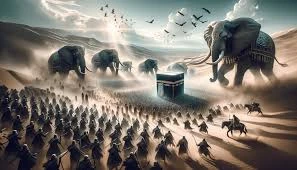
Abraha al-Ashram:
- He was the ruler of Yemen
- He was appointed by the king of Abyssinia (Ethiopia)
- He was a Christian who wanted to destroy Islam’s holy places
- He built a big church in Yemen and wanted people to visit it instead of Makkah
His Army:
- Abraha brought a large army to attack Makkah
- The army included soldiers, horses, and elephants
- The main elephant was very big and strong
- The elephant was trained for war and destruction
The Story of What Happened
Abraha’s Plan:
- Abraha wanted to destroy the Ka’bah in Makkah
- He thought this would make people come to his church instead
- He gathered a powerful army with elephants
- He marched toward Makkah to attack the holy city
The Journey to Makkah:
- Abraha’s army traveled from Yemen toward Makkah
- They captured camels and property along the way
- Among the captured camels were 200 camels belonging to Abdul-Muttalib (Prophet Muhammad’s grandfather)
- The people of Makkah were afraid and didn’t know how to fight such a strong army
Abdul-Muttalib’s Response:
- Abdul-Muttalib was the leader of Makkah at that time
- Abraha met with him and offered to return his camels
- Abdul-Muttalib said: “I am the owner of the camels, but the Ka’bah has its own Lord who will protect it”
- He showed complete trust in Allah’s protection
The Miracle of Allah:
- When the army reached the outskirts of Makkah, something amazing happened
- The main elephant refused to move toward the Ka’bah
- No matter how much they tried, the elephant would not go forward
- But when they turned it in any other direction, it would move easily
Allah’s Punishment:
- Suddenly, flocks of birds appeared in the sky
- These were special birds sent by Allah
- Each bird carried small stones in its beak and claws
- The birds threw these stones at Abraha’s army
The Destruction:
- The stones were not ordinary stones
- They were like small pebbles but very deadly
- Anyone hit by these stones was destroyed
- The army was completely defeated and destroyed
The Outcome:
- Abraha and his army were destroyed
- The Ka’bah was protected by Allah’s miracle
- This event showed Allah’s power to protect His house
- It prepared the way for Prophet Muhammad’s birth in the same year
Lessons from the Story
- Allah protects what is sacred to Him
- No one can destroy what Allah wants to preserve
- Pride and arrogance lead to destruction
- Allah’s power is greater than any human army
- Even animals obey Allah’s commands
Uses of the Chapter
Spiritual Uses
Remembering Allah’s Power:
- This surah reminds us that Allah is all-powerful
- It shows that Allah protects what is sacred
- It teaches us to trust in Allah’s protection
- It demonstrates that Allah controls everything in creation
Strengthening Faith:
- Reading this surah increases our belief in Allah
- It shows us real examples of Allah’s miracles
- It helps us trust Allah when we face difficulties
- It reminds us that Allah always wins against evil
Protection from Enemies:
- Many Muslims recite this surah when they feel threatened
- It reminds us that Allah can defeat any enemy
- It gives comfort to those who are afraid
- It shows that Allah protects His faithful servants
Educational Uses
Teaching History:
- This surah teaches us about important Islamic history
- It tells us about the time before Prophet Muhammad was born
- It shows how Allah prepared the world for Islam
- It connects us to the holy city of Makkah
Learning Arabic:
- Children can learn new Arabic vocabulary
- It helps with Arabic pronunciation practice
- Students learn about Arabic grammar structures
- It improves Arabic reading skills
Understanding Allah’s Names:
- The surah shows Allah as “Rabb” (Lord and Master)
- It demonstrates Allah’s attribute of protection
- It reveals Allah’s power over all creation
- It shows Allah’s wisdom in planning events
Practical Daily Uses
In Daily Prayers:
- Some Muslims recite this surah in their daily prayers
- It can be recited in Sunnah (voluntary) prayers
- It’s good for teaching children short surahs
- It’s easy to memorize for new Muslims
For Protection:
- Parents recite it to protect their children
- Travelers recite it for safe journeys
- Students recite it before exams for Allah’s help
- It’s recited when facing any kind of danger
Teaching Children:
- This surah is perfect for children to memorize
- The story is exciting and easy to understand
- It teaches important moral lessons
- Children learn about Allah’s power through the story
Special Occasions
During Hajj and Umrah:
- Pilgrims recite this surah when they see the Ka’bah
- It reminds them of Allah’s protection of the holy house
- It increases their appreciation for the sacred places
- It connects them to the history of Makkah
When Facing Difficulties:
- This surah gives hope during hard times
- It reminds us that Allah can solve any problem
- It shows that no enemy can succeed against Allah’s will
- It brings comfort and peace to worried hearts
In Islamic Education:
- Teachers use this surah to teach Islamic history
- It’s used to explain Allah’s attributes and power
- Students learn about pre-Islamic Arabian history
- It connects Quranic stories to real historical events
Benefits of Regular Recitation
Spiritual Benefits:
- Increases faith and trust in Allah
- Brings peace and tranquility to the heart
- Strengthens connection with Islamic history
- Develops love for the Holy Quran
Educational Benefits:
- Improves Arabic language skills
- Enhances memory through regular recitation
- Teaches historical and moral lessons
- Develops understanding of Quranic stories
Personal Benefits:
- Provides comfort during difficult times
- Increases sense of Allah’s protection
- Builds confidence in Allah’s power
- Creates awareness of Allah’s constant care
Exercises
Exercise 1: Fill in the Blanks
- Süratul Fīl means “The Chapter of the _______.”
- The elephant army was led by _______.
- Allah sent _______ to destroy the army.
- This event happened in the year Prophet _______ was born.
Exercise 2: True or False
- Abraha wanted to destroy the Ka’bah. _____
- The elephant moved easily toward the Ka’bah. _____
- The birds threw ordinary stones at the army. _____
- This surah has 5 verses. _____
This term's Islamic Studies topics
Basic 4 First Term · 9 topics
First Term Islamic Studies Lesson Notes for Other Topics

Süratul-Fātihah
Read the full lesson note.

Belief in the Existence of Shaytan
Read the full lesson note.
Belief In Jinn
Read the full lesson note.

Prophet Muhammad's Hijrah and his Persecution
Read the full lesson note.

Arabic letters (Alif to Yäw) with Fätihah
Read the full lesson note.
Süratul Kawthar (Q108)
Read the full lesson note.
Asmäullahhil Husnä
Read the full lesson note.
Asmäullahhil Husnä II
Read the full lesson note.

Belief in Angels of Allah and their Functions
Read the full lesson note.
Süratul-Mulk
Read the full lesson note.
Süratun-Nür Chapter 24 v 27-28
Read the full lesson note.
Suratuz-Zilzalah & Süratul'Adiyät (Chapters 99 & 100)
Read the full lesson note.
Difference between Zakåh and Sadaqah
Read the full lesson note.
Sujüdus-Sahw (Prostration of Forgetfulness)
Read the full lesson note.
Salätul-Qasr (Shortened Saläh)
Read the full lesson note.
Lesson Notes for Other Classes

Basic 1 Lesson Note
The complete lesson note to guide your studies.

Basic 2 Lesson Note
The complete lesson note to guide your studies.

Basic 3 Lesson Note
The complete lesson note to guide your studies.

Basic 5 Lesson Note
The complete lesson note to guide your studies.

Basic 6 Lesson Note
The complete lesson note to guide your studies.

JSS1 Lesson Note
The complete lesson note to guide your studies.

