
Climate and Vegetation – SS2 Geography Lesson Note (Third Term)
Lesson note at a glance
- Class
- SS2
- Subject
- Geography
- Term
- Third Term
- Reading time
- 5 min
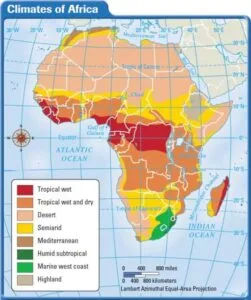
Climate is the average condition of the atmosphere of a place over a long period, usually about thirty years or more.
Behavioural objectives
- Define climate, weather and vegetation.
- List the factors that affect the climate of Africa.
- Name the types of climate found in Africa and state where each occurs.
- List the types of vegetation found in Africa.
- Match each vegetation type with the climate that produces it.
What are climate, weather and vegetation?
Climate is the long-term average of weather in a place, while vegetation is the plant cover of an area.
- Climate: the average condition of temperature, rainfall, wind and humidity of a place over many years.
- Weather: the condition of the atmosphere of a place over a short time, such as today or this week.
- Vegetation: the plant cover of an area, such as forest, grass or shrubs.
- Link between them: climate is the main factor that decides the type of vegetation in a region.
What is the difference between weather and climate?
| Point | Weather | Climate |
|---|---|---|
| Time covered | Short period (hours, days, weeks) | Long period (about thirty years or more) |
| Nature | Changes often | Fairly steady average |
| Example | It rained heavily in Lagos this morning. | Lagos has a wet season and a dry season each year. |
What factors affect the climate of Africa?
Eight main factors affect the climate of Africa: latitude, altitude, distance from the sea, ocean currents, winds, slope, cloud cover and vegetation.
- Latitude: places near the equator receive more direct sunlight and are hotter than places far from it.
- Altitude: temperature falls as height above sea level increases, so highlands are cooler than lowlands.
- Distance from the sea or ocean: coastal places have a smaller temperature range and more rain than places far inland.
- Ocean currents: warm currents raise temperature and rainfall on nearby coasts, while cold currents lower them.
- Planetary winds and pressure belts: winds bring moisture or dryness, as with the moist south-west winds and the dry, dusty Harmattan in West Africa.
- Slope and aspect: the side of a hill facing the wind or the sun receives different rainfall and heat from the sheltered side.
- Cloud cover: thick cloud reduces daytime heat and keeps nights warmer, while clear skies give hot days and cool nights.
- Vegetation: forests keep the air humid and cool, while bare land heats up and loses moisture quickly.
What are the types of climate in Africa?
There are six main types of climate in Africa: equatorial, tropical continental, Mediterranean, hot desert, warm temperate eastern margin and temperate continental (Steppe).
Summary table of African climates
| Climate type | Where it is found | Main features |
|---|---|---|
| Equatorial hot climate | Congo (Zaire) Basin of Central Africa; coast of West Africa (except Ghana) | Hot and wet all year |
| Tropical continental (Sudan) climate | West Africa, curving southwards into East Africa and Southern Africa | Distinct wet and dry seasons |
| Mediterranean climate | South-western South Africa (Cape Town); north-western Africa (Morocco, Algeria, Tunisia) | Hot, dry summers and mild, wet winters |
| Hot desert climate | Sahara in the north; Namib and Kalahari in the south-west | Very little rain, hot days, cool nights |
| Warm temperate eastern margin | Eastern side of Southern Africa | Warm, with rain in most months |
| Temperate continental (Steppe) climate | Interior plateau of South Africa (the Highveld) | Moderate rainfall, warm summers, cool winters |
What is the Equatorial Hot Climate?
- Location: the Congo (Zaire) Basin of Central Africa and the coast of West Africa (except Ghana).
- Temperature: high all year, with a small yearly range.
- Rainfall: heavy and spread through the year.
- Humidity: high, so the air feels warm and sticky.
What is the Tropical Continental (Sudan) Climate?
- Location: West Africa, curving southwards into East Africa and Southern Africa.
- Seasons: a clear wet season and a clear dry season.
- Dry season: in West Africa, the dry Harmattan wind blows.
- Rainfall pattern: amount generally falls as one moves away from the coast.
What is the Mediterranean Climate?
- Location: the horns or tips of Africa, in south-western South Africa (Cape Town) and north-western Africa (Morocco, Algeria and Tunisia).
- Summer: hot and dry.
- Winter: mild and wet.
What is the Hot Desert Climate?
- Location: the Sahara in the north and the Namib and Kalahari in the south-west.
- Rainfall: very low, while evaporation is high.
- Temperature: very hot days and cool nights, because clear skies let heat escape quickly.
What is the Warm Temperate Eastern Margin Climate?
- Location: the eastern side of Southern Africa.
- Cause of rain: moist winds from the Indian Ocean.
- Features: warm weather with rain in most months.
What is the Temperate Continental (Steppe) Climate?
- Location: the inland high plateau of South Africa (the Highveld).
- Cause: it lies away from the influence of the sea and is high above sea level.
- Features: moderate rainfall, warm summers and cool winters.
What are the vegetation types of Africa?
There are six main vegetation types in Africa: tropical rainforest, tropical savanna, Mediterranean vegetation, desert vegetation, temperate grassland and montane vegetation.
Which vegetation goes with which climate?
| Vegetation | Related climate | Features and examples |
|---|---|---|
| Tropical rainforest | Equatorial | Tall evergreen trees in layers, such as mahogany and iroko |
| Tropical savanna (grassland) | Tropical continental | Tall grass with scattered trees, such as baobab and acacia |
| Mediterranean vegetation | Mediterranean | Evergreen trees and shrubs with thick, waxy leaves, such as olive and cork oak |
| Desert vegetation | Hot desert | Sparse thorny shrubs, tufts of grass and date palms at oases |
| Temperate grassland | Temperate continental (Steppe) | Short grass with few trees, called the veld in South Africa |
| Montane vegetation | Highland areas | Changes with height, from forest on lower slopes to grass and shrubs near the top |
What are the features of the tropical rainforest?
- Trees: tall, evergreen and close together, so the forest stays green all year.
- Layers: the plants grow in layers, with tall trees above and shrubs and herbs below.
- Examples: mahogany and iroko.
What are the features of the tropical savanna?
- Cover: tall grass with scattered trees.
- Examples: baobab and acacia.
- Nigerian belts: Guinea savanna, Sudan savanna and Sahel savanna, with trees becoming fewer and grass shorter towards the north.
Why does vegetation differ from place to place?
- Rainfall: heavy, well-spread rain supports forest, while little rain supports grass or desert shrubs.
- Temperature: heat and moisture together give fast plant growth.
- Altitude: cooler highlands carry different plants from the lowlands around them.
- Soil: deep, fertile soils support dense plant cover.
Evaluation
- Define climate.
- List five factors that affect the climate of Africa.
- Where is the Equatorial Hot Climate found?
- Name the six types of climate in Africa.
- List the types of vegetation found in Africa.
Assignment
On a map of Africa, locate and label the different climatic types.
This term's Geography topics
SS2 Third Term · 8 topics
SS2 Geography Lesson Notes for Other Topics

Geographic Information System (GIS)
Read the full lesson note.
Location, Size, Position And Political Division Of Africa
Read the full lesson note.
Africa: Relief And Drainage
Read the full lesson note.
Irrigation Agriculture In Nile Basin And The Niger Basin
Read the full lesson note.
Fruit Farming In The Mediterranean Regions Of Africa
Read the full lesson note.

Hydrosphere (Oceanic Basins)
Read the full lesson note.
Earthquakes
Read the full lesson note.

Action Of Running Water
Read the full lesson note.
Action Of Wind
Read the full lesson note.
Glacial Action
Read the full lesson note.
Action Of Wave
Read the full lesson note.
Climate & Climate Classification
Read the full lesson note.
Climate & Climate Classification II
Read the full lesson note.

Vegetation
Read the full lesson note.
Environmental Resources
Read the full lesson note.
Lesson Notes for Other Classes

SS1 Lesson Note
The complete lesson note to guide your studies.

SS3 Lesson Note
The complete lesson note to guide your studies.
