
Action of Wind – SS2 Geography Lesson Note (First Term)
Lesson note at a glance
- Class
- SS2
- Subject
- Geography
- Term
- First Term
- Reading time
- 7 min
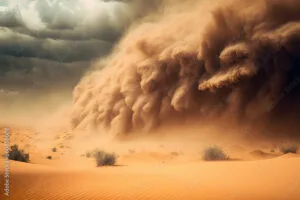
The action of wind is the way wind wears away, carries and deposits rock and sand materials.
Behavioural objectives
By the end of the lesson, students should be able to:
- state the characteristics and types of deserts;
- name examples of deserts and where they are found;
- explain deflation, abrasion and attrition;
- describe how wind transports materials;
- describe the features formed by wind erosion in deserts;
- describe the features formed by wind deposition, including barchans, seifs and loess.
Where is the action of wind dominant?
The action of wind is dominant in deserts and other semi-arid regions of the world.
- Reason: these places have little or no vegetation to hold the soil and sand in place.
- Erosion: wind erodes by deflation, abrasion and attrition.
- Deposition: wind builds landforms such as dunes.
- Aridity: dryness caused by low rainfall, high temperature, cold currents and high evaporation rates.
What are examples of deserts?
Deserts are found on most continents.
- Sahara: North Africa.
- Kalahari and Namib: Southern Africa.
- Arabian and Iranian: Middle East.
- Thar: India and Pakistan.
- Australian desert: Australia.
- Atacama: South America.
- Mohave: U.S.A.
What are the characteristics of deserts?
A desert is a dry region with little rainfall and little or no vegetation.
- Temperature: extremes of temperature.
- Rainfall: low rainfall.
- Vegetation: absence of vegetation cover.
- Evaporation: high evaporation rate.
- Wind: wind action is dominant.
- Currents: presence of cold currents.
What are the types of deserts?
There are five types of desert: erg, hamada, reg, badlands and mountain deserts.
- Erg (sandy desert): a desert covered mainly by sand and dunes.
- Hamada (rocky desert): a desert with a bare rock surface.
- Reg (stony desert): a desert with a surface of pebbles and stones.
- Badlands: dry land cut into gullies and ridges by erosion.
- Mountain deserts: dry highland areas with bare rock and little vegetation.
How does wind erode the land?
Wind erodes the land in three ways: deflation, abrasion and attrition.
- Deflation: the lifting and blowing away of loose sand and pebbles by wind.
- Abrasion: sand particles carried by wind blast and wear away rock surfaces.
- Attrition: materials carried by wind collide and wear each other away.
Deflation lowers the land surface and forms large depressions called deflation hollows.
What are the differences between deflation and abrasion?
Deflation is the blowing away of loose material. Abrasion is the wearing of rock by wind-carried particles.
| Deflation | Abrasion |
|---|---|
| Involves blowing. | Involves wind-carried particles striking against the rock surface. |
| Involves the rolling of loose materials along the ground. | Rock surfaces are polished, scratched and worn away. |
| Usually results in the lowering of the land surface. | Most effective at the base of rocks. |
| Is associated with wind only. | Can be caused by wind, water and waves. |
How does wind transport materials?
Wind transports materials by suspension, saltation and surface creep.
- Suspension: fine dust is carried high in the air over long distances.
- Saltation: sand grains bounce along the ground in short jumps.
- Surface creep: larger grains are pushed or rolled along the surface.
What features does wind erosion form in deserts?
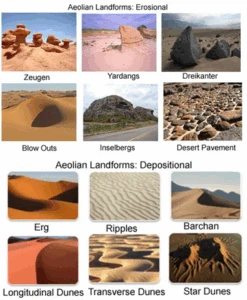
The main features of wind erosion are rock pedestals, zeugen, yardangs, mesas and buttes, inselbergs, ventifacts and deflation hollows.
What are rock pedestals?
Rock pedestals are pillar-like desert landforms formed by wind abrasion on alternate layers of hard and soft rock.
- Shape: irregular, for example mushroom-shaped.
- Structure: alternate horizontal layers of hard and soft rocks.
- Height: about 10 to 15 metres.
Formation:
- Wind abrasion acts on alternate horizontal layers of hard and soft rock.
- Abrasion is greater at ground level, where most sand is carried.
- Serious undercutting follows.
- The irregular pedestal shape is left.
What are zeugen?
Zeugen are tabular rock masses with a layer of soft rock beneath a surface layer of hard rock.
- Landscape: a long ridge and furrow pattern.
- Agent: wind abrasion in deserts.
Formation:
- A horizontal tabular mass has soft rock under more resistant hard rock.
- The mass lies in the direction of the wind.
- Mechanical weathering opens up joints on the surface of the hard rock.
- Wind abrasion wears the mass into ridges and furrows.
- The remaining ridges are the zeugen.
What are yardangs?
Yardangs are steep-sided ridges of hard rock separated by narrow corridors worn out of soft rock.
- Structure: vertical bands of hard and soft rocks.
- Appearance: ridges and furrows about 10 to 15 metres long.
Formation:
- Vertical bands of hard and soft rock lie in the direction of the prevailing wind.
- Wind abrasion wears away the softer rocks.
- Long narrow corridors form between the hard rock ridges.
- The steep-sided hard rock ridges are the yardangs.
What are mesas and buttes?
A mesa is a flat, table-like landmass with a hard top layer and steep sides.
- Mesa: made up of soft and hard layers, with a resistant horizontal top layer.
- Butte: an isolated flat-topped hill left when a mesa is reduced by denudation.
Formation:
- The hard top layer resists the agents of denudation.
- It protects the softer layers below from being eroded.
- Denudation wears back the sides, which become steep.
- Further denudation reduces a mesa to a butte.
Mesas may occur in canyon regions.
What is an inselberg?
An inselberg is an isolated rocky outcrop with steep sides and a round top, found in arid regions.
- Rock: usually granite.
- Height: may rise to over 500 metres.
- Occurrence: singly or in groups.
- Examples: Northern Nigeria, the Kalahari desert and Western Australia.
Formation:
- Inselbergs form from extensive old plateaus.
- Weathering breaks up the rock.
- Water and wind remove the weathered materials.
- The resistant rock is left standing as an exposed outcrop.
What are ventifacts and dreikanters?
Ventifacts are pebbles sharpened or faceted by sandblasting.
- Ventifact: wind abrasion shapes and polishes the pebble.
- New facets: develop when the wind direction changes.
- Dreikanter: a ventifact with three wind-faceted surfaces.
What are deflation hollows?
Deflation hollows are basin-shaped depressions formed when wind deflation scoops away loose sand.
- Shape: basin or saucer shape.
- Size: very extensive, with varying depth.
- Dunes: may be present on the leeward side.
- Oasis: a hollow can form an oasis in the desert.
Formation:
- Wind blows away loose sand from an area.
- A large depression forms, sometimes below the water table.
- Water seeps out into the hollow.
- Oases or swamps are formed.
What features does wind deposition form in deserts?
The main features of wind deposition are dunes (barchans and seifs) and loess.
What are dunes?
Dunes are hills or ridges of sand formed by the piling up of sand by the action of wind.
- An obstacle prevents the free movement of the wind.
- Sand builds up against the obstacle.
- The sand covers the obstacle and falls over to the other side.
There are two main types of dunes: barchans and seifs.
What is a barchan?
A barchan is a crescent-shaped (moon-shaped) sand dune formed by wind deposition.
- Occurrence: in groups or singly.
- Windward side: convex and gentle.
- Leeward side: concave, steep and sheltered.
- Horns: 15 to 30 metres long.
Formation:
- An obstacle such as a rock impedes the movement of wind.
- Sand accumulates against the obstacle.
- Sand then begins to accumulate on the other side of the obstacle.
- A crescent or moon-shaped structure with horns develops.
What are seifs?
Seifs are long, narrow, sword-shaped ridges of sand that lie parallel to the prevailing wind.
- Length: very long, often many kilometres.
- Agent: wind deposition in deserts.
- Example: the Sahara desert.
Formation:
- The prevailing wind clears the corridors between the dunes of sand.
- Eddies blow towards the side of each corridor.
- Sand builds up along the sides to form the seif dunes.
What is loess?
Loess is fine soil material carried by wind and deposited outside the desert.
- Texture: a fine loam.
- Fertility: very fertile.
- Porosity: porous.
Evaluation
- Define deflation and abrasion.
- List four characteristics of deserts.
- Name the five types of deserts.
- State two differences between deflation and abrasion.
- Describe how a barchan is formed.
Assignment
With the aid of a diagram, describe how yardangs are formed, and state two differences between yardangs and zeugen.
This term's Geography topics
SS2 First Term · 10 topics
SS2 Geography Lesson Notes for Other Topics

Action Of Running Water
Read the full lesson note.

Glacial Action
Read the full lesson note.

Action Of Wave
Read the full lesson note.

Climate & Climate Classification
Read the full lesson note.

Climate & Climate Classification II
Read the full lesson note.

Vegetation
Read the full lesson note.
Environmental Resources
Read the full lesson note.

Renewable And Non-Refundable Resources
Read the full lesson note.
Environmental Problems
Read the full lesson note.

Environmental Conservation
Read the full lesson note.
Transportation In Nigeria
Read the full lesson note.

Manufacturing Companies In Nigeria
Read the full lesson note.

Commercial Activities In Nigeria
Read the full lesson note.

World Population I
Read the full lesson note.

World Population II
Read the full lesson note.
Lesson Notes for Other Classes

SS1 Lesson Note
The complete lesson note to guide your studies.

SS3 Lesson Note
The complete lesson note to guide your studies.
