
Hydrosphere (Oceanic Basins) – SS2 Geography Lesson Note (Third Term)
Lesson note at a glance
- Class
- SS2
- Subject
- Geography
- Term
- Third Term
- Reading time
- 4 min
An ocean basin is a large, low-lying area of the Earth’s surface that is filled with seawater.
- Coverage: ocean basins hold the world’s oceans, which cover about 71% of the Earth’s surface.
- Extent: a basin includes the whole ocean floor, from the coast to the deepest trench.
- Features: continental shelves, slopes, abyssal plains, mid-ocean ridges and ocean trenches.
Behavioural objectives
By the end of the lesson, students should be able to:
- describe the major parts of an ocean basin;
- define ocean salinity and state the factors that influence it;
- state the causes and types of ocean currents;
- explain the effects of ocean currents on adjacent coastlands;
- list the importance of oceans to man.
What are the major parts of an ocean basin?
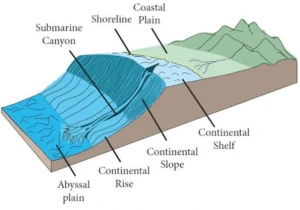
An ocean basin has five major parts: the continental shelf, continental slope, abyssal plain, mid-ocean ridge and ocean trench.
- Continental shelf: the shallow, gently sloping area that extends from the coast into the sea.
- Continental slope: the steeper region beyond the shelf, leading down to deeper water.
- Abyssal plain: the broad, flat part of the deep ocean floor.
- Mid-ocean ridge: an underwater mountain range formed by tectonic activity, often with volcanic activity.
- Ocean trench: a deep, narrow depression in the ocean floor, usually found in subduction zones.
What is ocean salinity?
Ocean salinity is the concentration of dissolved salts in seawater, measured in parts per thousand (ppt).
- Average value: the average salinity of the world’s oceans is about 35 ppt.
- Meaning: 35 ppt means about 35 g of salt in every 1000 g of seawater.
What factors influence ocean salinity?
Five factors influence ocean salinity: evaporation, precipitation, ice melting, river input and ocean currents.
- Evaporation: water vapour leaves and the salts stay behind, so salinity rises. It is high in hot, dry subtropical areas.
- Precipitation: rain and snow add freshwater and lower salinity. Rainy areas near the equator have lower salinity.
- Ice melting: melting polar ice adds freshwater and lowers salinity.
- River input: rivers pour freshwater into the sea, so salinity is lower near river mouths.
- Ocean currents: currents carry water of one salinity into another area and mix it.
What are ocean currents?
Ocean currents are continuous, directed movements of seawater in the oceans.
- Climate: they redistribute heat around the Earth and shape climate.
- Marine life: they move nutrients and influence marine ecosystems.
What causes ocean currents?
Ocean currents are caused mainly by wind, differences in water density and the Earth’s rotation.
- Wind: surface winds push the water and form surface currents.
- Temperature and salinity: they change water density, and dense water sinks to form deep currents.
- Coriolis effect: the Earth’s rotation deflects moving water, which produces circular patterns called gyres.
- Landmasses: continents block and turn currents, which changes their direction.
What are the types of ocean currents?
There are two types of ocean currents: surface currents and deep ocean currents.
- Surface currents: they flow in the upper layer of the ocean and are driven mainly by wind, as in the Gulf Stream.
- Deep ocean currents: they flow in the deeper layers and are driven by differences in temperature and salinity. Thermohaline circulation is an example.
What is the difference between warm and cold currents?
A warm current carries warmer water into cooler regions. A cold current carries cooler water into warmer regions.
| Feature | Warm current | Cold current |
|---|---|---|
| Origin | Usually from low latitudes | Usually from high latitudes |
| Effect on coast temperature | Raises temperature | Lowers temperature |
| Effect on rainfall | Tends to bring rain to the coast | Tends to keep the coast dry |
| Examples | Gulf Stream, Guinea Current | Benguela Current, Canary Current, Labrador Current |
What are the effects of ocean currents on adjacent coastlands?
Ocean currents change the temperature, rainfall, coastline and marine life of the land beside them.
- Temperature regulation: warm currents raise coastal temperatures, while cold currents cool the coast.
- Climate influence: currents change local rainfall and weather. Cold currents are linked with dry coasts, such as the Namib Desert beside the Benguela Current.
- Erosion and deposition: strong currents wear away the coast in some places and deposit sediment in others.
- Fishing: currents spread nutrients, which supports marine life and fisheries.
- Navigation and trade: ships have long used predictable currents to save time and fuel.
Why are oceans important to man?
Oceans give man climate control, food, resources, transport, recreation and oxygen.
- Climate regulation: oceans absorb and store large amounts of heat, which moderates temperature and weather.
- Food: oceans support marine life, and fisheries feed millions of people.
- Resources: oceans supply fish, shellfish and algae. They also hold minerals, oil and natural gas.
- Transport: oceans are highways for international trade, linked by ports and shipping routes.
- Recreation and tourism: beaches, coastal resorts and water sports attract visitors.
- Oxygen: phytoplankton produce a large share of the Earth’s oxygen by photosynthesis.
- Carbon dioxide storage: oceans absorb carbon dioxide, which slows its build-up in the air. This also causes ocean acidification, which harms marine life.
Evaluation
- Define an ocean basin.
- List the five major parts of an ocean basin.
- State three factors that influence ocean salinity.
- Explain how warm and cold currents affect adjacent coastlands.
- State four ways in which oceans are important to man.
Assignment
Name the three major forces that cause ocean currents. Then state the two types of ocean currents, giving one example of each.
This term's Geography topics
SS2 Third Term · 8 topics
SS2 Geography Lesson Notes for Other Topics

Geographic Information System (GIS)
Read the full lesson note.
Location, Size, Position And Political Division Of Africa
Read the full lesson note.
Africa: Relief And Drainage
Read the full lesson note.
Climate And Vegetation
Read the full lesson note.
Irrigation Agriculture In Nile Basin And The Niger Basin
Read the full lesson note.
Fruit Farming In The Mediterranean Regions Of Africa
Read the full lesson note.
Earthquakes
Read the full lesson note.

Action Of Running Water
Read the full lesson note.
Action Of Wind
Read the full lesson note.
Glacial Action
Read the full lesson note.
Action Of Wave
Read the full lesson note.
Climate & Climate Classification
Read the full lesson note.
Climate & Climate Classification II
Read the full lesson note.

Vegetation
Read the full lesson note.
Environmental Resources
Read the full lesson note.
Lesson Notes for Other Classes

SS1 Lesson Note
The complete lesson note to guide your studies.

SS3 Lesson Note
The complete lesson note to guide your studies.
