
Action of Wave – SS2 Geography Lesson Note (First Term)
Lesson note at a glance
- Class
- SS2
- Subject
- Geography
- Term
- First Term
- Reading time
- 6 min
Wave action is the work of sea and ocean waves in eroding, transporting and depositing material along the coast.
Behavioural objectives
By the end of the lesson, students should be able to:
- Define the terms associated with waves, such as wave, tide, current, coast, shore, beach, swash, backwash and undertow.
- State the factors that affect the rate of marine erosion.
- Describe the four processes of wave erosion.
- Describe the features produced by wave erosion, such as cliffs, caves, arches, stacks and stumps.
- Describe the features of coastal deposition, such as beaches, spits, bars and marine dunes.
What is wave action?
Wave action is the erosion, transportation and deposition of material along the coast by sea and ocean waves.
- Where it works: only along the coasts of seas and oceans.
- How waves form: wind blowing over the surface of the water.
- Erosion: waves wear away cliffs and rocks on the coast.
- Transportation: waves and currents carry sand, gravel and pebbles along the coast.
- Deposition: waves drop their load to build beaches, spits, bars and dunes.
What are the terms associated with waves?
The terms below are used to describe waves and the coast.
- Wave: the turbulent movement of water as a result of wind moving over the water.
- Tide: the alternate rise and fall of the surface of the sea, about two times a day.
- Current: the movement of water in the ocean in a particular direction.
- Coast: the meeting point between the land and the sea.
- Shore: the part of the land that lies between high water and low water.
- Beach: the material deposited on the shore by the action of waves.
- Swash: water thrown up the beach by breaking waves.
- Backwash: the water that runs back down the beach after the swash.
- Undertow: water which flows near the bottom away from the shore.
- Longshore drift: the movement of sand and pebbles along the coast by swash and backwash.
What factors affect the rate of marine erosion?
The rate of marine erosion depends on the rocks, the exposure of the coast, tides and currents, wave strength and human action.
- Nature of the rocks: soft rocks erode quickly, while hard rocks resist erosion for longer.
- Amount of rock exposed to the sea: the more rock the waves reach, the more erosion takes place.
- Tides and currents: they carry away eroded material and bring fresh waves against the coast.
- Strength of the waves: large, powerful waves erode more than small, weak waves.
- Human interference in coast protection: sea walls and similar works slow erosion, while their absence leaves the coast open to attack.
What are the types of waves?
There are two types of waves: constructive waves and destructive waves.
- Constructive waves: low, gentle waves with a strong swash and a weak backwash, so they build up beaches.
- Destructive waves: high, steep waves with a weak swash and a strong backwash, so they wear away the coast.
| Feature | Constructive waves | Destructive waves |
|---|---|---|
| Height | Low | High |
| Swash | Strong | Weak |
| Backwash | Weak | Strong |
| Main effect | Deposition, beach building | Erosion, beach removal |
What are the processes of wave erosion?
There are four processes of wave erosion: corrasion, attrition, hydraulic action and solvent action.
- Corrasion (abrasion): sand, pebbles and boulders hurled by waves against the cliff wear down its base. Some textbooks spell it corrosion.
- Attrition: pebbles and boulders knock against each other and against the cliff, and break into smaller, rounder pieces.
- Hydraulic action: fast-moving waves force air and water under pressure into cracks at the base of the cliff and enlarge them.
- Solvent action: the chemical action of sea water dissolves rocks such as limestone on the coast.
What features are produced by wave erosion?
Wave erosion produces capes, bays, cliffs, caves, arches, stacks, stumps, geos and blowholes.
How does a headland change from cliff to stump?
- Waves attack the base of the headland and cut it backwards to form a cliff.
- Hydraulic action and corrasion enlarge cracks at the base into caves.
- Caves on either side of the headland deepen until they meet and form an arch.
- The roof of the arch collapses and leaves a stack.
- Waves wear the stack down until only a stump shows above sea level.
What are the features of marine erosion?
- Capes and bays: a cape is a headland of hard rock, and a bay forms where soft rock is worn back. A bay holds calm water and can be used as a harbour.
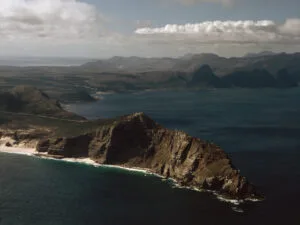
- Cliff: a steep rock face adjoining the coast. It forms when waves attack the base of a headland and cut it backwards.
- Wave-cut platform: a gently sloping rock surface left at the foot of a cliff as the cliff retreats.
- Coastal cave: a hollow cut into the base of a cliff by waves. It may contain blowholes or geos.
- Arch: when two caves approach each other from either side of a headland, they meet to form an arch.
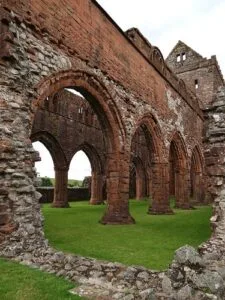
- Stack: continuous wave action makes an arch collapse. The seaward part of the headland that remains is a stack.
- Stump: when a stack is eroded until only a small part is visible above sea level, it becomes a stump.
- Geo: a narrow, steep-sided inlet in a cliff, formed when the roof of a cave collapses.
- Gloup or blowhole: hydraulic action cuts a hole in the roof of a cave. Water may be forced up through the hole as spray.
What is longshore drift?
Longshore drift is the movement of sand and pebbles along a coast by swash and backwash.
- Waves reach the coast at an angle.
- The swash carries sand and pebbles up the beach at that same angle.
- The backwash pulls the material straight back down the slope of the beach.
- The material moves along the coast in a zigzag path.
What features are produced by coastal deposition?
Coastal deposition produces beaches, spits, bars and marine dunes.
- Beaches: deposits of sand and gravel along the shore. They form when material loosened from the land is moved by waves and dropped.
- Spits: ridges of sand and gravel built by longshore drift across the entrance to a coastal inlet. A spit is joined to the land at one end and extends into the water at the other.
- Bar: a ridge, usually of sand or rock debris, formed by deposition across the mouth of a river or the entrance of a bay.
- Marine dunes and dune belts: strong onshore winds blow large amounts of coastal sand into mounds called marine dunes. The dunes later stretch into dune belts.
Evaluation
- Define swash and backwash.
- List the four processes of wave erosion.
- Describe how an arch, a stack and a stump are formed.
- State the factors that affect the rate of marine erosion.
- Name two features of coastal deposition and describe one of them.
Assignment
- Draw and label the stages by which a headland changes from a cliff to a stump, and write one sentence on each stage.
This term's Geography topics
SS2 First Term · 10 topics
SS2 Geography Lesson Notes for Other Topics

Action Of Running Water
Read the full lesson note.

Action Of Wind
Read the full lesson note.

Glacial Action
Read the full lesson note.

Climate & Climate Classification
Read the full lesson note.

Climate & Climate Classification II
Read the full lesson note.

Vegetation
Read the full lesson note.
Environmental Resources
Read the full lesson note.

Renewable And Non-Refundable Resources
Read the full lesson note.

Environmental Problems
Read the full lesson note.

Environmental Conservation
Read the full lesson note.

Transportation In Nigeria
Read the full lesson note.

Manufacturing Companies In Nigeria
Read the full lesson note.

Commercial Activities In Nigeria
Read the full lesson note.

World Population I
Read the full lesson note.

World Population II
Read the full lesson note.
Lesson Notes for Other Classes

SS1 Lesson Note
The complete lesson note to guide your studies.

SS3 Lesson Note
The complete lesson note to guide your studies.
