
Simple Harmonic Motion – SS2 Physics Lesson Note (First Term)
Lesson note at a glance
- Class
- SS2
- Subject
- Physics
- Term
- First Term
- Reading time
- 7 min
Simple harmonic motion (SHM) is the to-and-fro motion of a body along a straight line in which its acceleration is directly proportional to its displacement from a fixed point and is always directed towards that point.
Behavioural objectives
By the end of the lesson, students should be able to:
- define simple harmonic motion and give examples;
- define angular velocity and relate linear velocity to it using v = rω;
- state where the velocity of a body in SHM is maximum and where it is minimum;
- show that the acceleration in SHM is a = -ω2x;
- calculate the period, frequency, total energy, maximum velocity and maximum acceleration of a mass on a spring;
- explain forced vibration and resonance.
What are the features of simple harmonic motion?
SHM is motion in which a restoring force always pulls the body back to its equilibrium position.
- Restoring force: the force acts towards the equilibrium position and is proportional to the displacement.
- Acceleration: it is proportional to the displacement and opposite in direction to it.
- Periodic: the motion repeats itself after equal intervals of time.
- Energy: the total energy stays constant while it changes between kinetic and potential energy.
What are examples of simple harmonic motion?
Three common examples of SHM are a loaded test tube in a liquid, a mass on a spring and the simple pendulum.
- A loaded test tube in a liquid: a test tube with some sand or lead shots floats upright. When pushed down slightly and released, it bobs up and down.
- A mass on a spring: a mass hung from a spiral spring, pulled down and released, oscillates about its rest position.
- The simple pendulum: a small bob on a light thread swings in SHM when the angle of swing is small.
What are the key terms used in SHM?
The key terms describe how far, how fast and how often a body oscillates.
| Term | Meaning | Unit |
|---|---|---|
| Displacement (x) | Distance of the body from the equilibrium position | m |
| Amplitude (A) | Maximum displacement from the equilibrium position | m |
| Period (T) | Time taken for one complete oscillation | s |
| Frequency (f) | Number of oscillations per second, f = 1/T | Hz |
| Angular velocity (ω) | Angle turned per second, ω = 2πf = 2π/T | rad/s |
How are angular velocity and linear velocity related in SHM?
Angular velocity (ω) is the angle turned through by a body divided by the time taken.
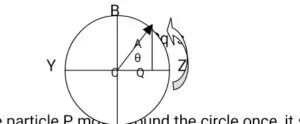
- One revolution: as the particle P moves once round the circle, it sweeps through θ = 360° (or 2π radians) in the period T.
- Formula: ω = θ/t (rad/s), so θ = ωt.
- Comparison: this is similar to s = vt for uniform motion in a straight line.
Steps to show that v = rω
- The angle changes with time, so the arc length s also changes with time.
- By definition, θ (in radians) = s/r, so s = rθ.
- Here r is the radius of the circle, and r = A (the amplitude).
- Divide both sides by t: s/t = rθ/t.
- Since s/t is the linear velocity v and θ/t = ω, then v = rω.
What is the velocity of a body at any point in SHM?
The velocity at a point a distance x from the centre C is v = ω√(A2 – x2).
- Maximum velocity: at the centre, x = 0, so vm = ωA.
- Minimum velocity: at the extreme positions, x = ±A, the velocity is zero.
The velocity is maximum at the centre of the motion and zero at the extreme positions.
What is the relationship between acceleration and displacement in SHM?
In SHM the acceleration is a = -ω2x, which is proportional to the displacement and opposite to it.
Steps to show that a = -ω2x
- The displacement is x = A cos θ, and θ = ωt, so x = A cos ωt.
- Differentiate to get the velocity: dx/dt = -ωA sin ωt.
- Differentiate again to get the acceleration: dv/dt = -ω2A cos ωt.
- Replace A cos ωt with x: dv/dt = -ω2x.
- Negative sign: the acceleration is always directed inwards towards C, while the displacement is measured outwards from C.
- Maximum acceleration: it occurs at the extreme positions, where x = ±A, and equals ω2A.
- Zero acceleration: it occurs at the centre, where x = 0.
What is the energy of simple harmonic motion?
The total energy of a body in SHM is the sum of its kinetic energy (KE) and potential energy (PE), and it stays constant.
- Work and energy: force and displacement are involved, so work and energy are involved in SHM.
- Energy changes form: energy passes between PE and KE as the body moves, but the total is conserved.
Energy at the centre and at the extremes
| Position | Velocity | Acceleration | KE | PE |
|---|---|---|---|---|
| Centre (x = 0) | Maximum (ωA) | Zero | Maximum, ½mvm2 | Zero |
| Extreme (x = ±A) | Zero | Maximum (ω2A) | Zero | Maximum, ½kA2 |
- Total energy: E = ½kA2 for a mass on a spring of force constant k.
- At displacement x: KE = ½k(A2 – x2) and PE = ½kx2.

A mass hung from a vertical spring, pulled downwards and released, oscillates in SHM.
- Restoring force: the elastic force that returns the spring to equilibrium is F = -ky.
- k: the force constant of the spring, in N m-1.
- y: the displacement from the equilibrium position.
What are the formulae for the period of SHM?
The period of a mass on a spring is T = 2π√(m/k), and that of a simple pendulum is T = 2π√(l/g).
- Mass on a spring: T = 2π√(m/k), where m is the mass and k is the force constant.
- Simple pendulum: T = 2π√(l/g), where l is the length and g is the acceleration due to gravity. It applies to small angles of swing.
- Frequency: f = 1/T.
- Angular velocity: ω = 2πf.
How do you solve a problem on a mass on a spiral spring?
List the data, convert units to SI, then apply the formulae for T, f, ω, energy, velocity and acceleration.
A body of mass 20 g is suspended from a spiral spring of force constant 0.4 N m-1. It is set into SHM with an amplitude of 0.2 m. Calculate:
- The period of the motion
- The frequency of the motion
- The angular speed
- The total energy
- The maximum velocity of the motion
- The maximum acceleration
Solution
Data: m = 20 g = 0.02 kg, k = 0.4 N m-1, A = 0.2 m.
- T = 2π√(m/k) = 2π√(0.02/0.4) = 0.447π s = 1.41 s
- f = 1/T = 1/1.41 = 0.71 Hz
- ω = 2πf = 2π × 0.71 = 4.46 rad s-1
- Total energy = ½kA2 = ½ (0.4)(0.2)2 = 0.008 J
- At the centre, all the energy is kinetic, so ½mvm2 = ½kA2.
vm2 = (0.008 × 2)/0.02 = 0.8, so vm = 0.89 m/s.
Or vm = ωA = 4.46 × 0.2 = 0.89 m/s. - Maximum acceleration = ω2A = (4.46)2 × 0.2 = 3.98 m/s2
What are forced vibration and resonance?
A forced vibration is a vibration caused by an external periodic force acting on an oscillating body.
- Natural frequency (fo): the frequency at which an object oscillates when left undisturbed after being set into vibration.
- Examples of forced vibration: the sounding board of a piano and the diaphragm of a loudspeaker.
Resonance is the large-amplitude vibration produced when the frequency of an external periodic force equals the natural frequency of the system.
- Condition: the driving frequency must coincide with the natural frequency fo.
- Result: the system vibrates with a relatively large amplitude.
- Everyday example: pushing a swing in step with its natural motion makes it swing higher.
- Everyday example: tuning a radio to a station makes its circuit resonate with that station’s frequency.
Evaluation
- Define simple harmonic motion.
- State the expression for the velocity of a particle in SHM at a distance x from the centre. Where is the velocity maximum?
- What does the negative sign in a = -ω2x mean?
- What is the natural frequency of a vibrating object?
- Define resonance.
Assignment
Write a short note on simple harmonic motion that does the following:
- Starting from x = A cos ωt, show that the acceleration of a body in SHM is -ω2x.
- Gives three examples of simple harmonic motion.
- Explains forced vibration and resonance, and states one use of forced vibration.
This term's Physics topics
SS2 First Term · 8 topics
SS2 Physics Lesson Notes for Other Topics

Concept Of Position, Distance, And Displacement In Relation To X-Y Plane
Read the full lesson note.

Scalar And Vector Quantities
Read the full lesson note.
Derivation of Equations of Linear Motions
Read the full lesson note.

Projectile And Its Implications
Read the full lesson note.
Newton's Law Of Motion
Read the full lesson note.

Equilibrium Of Forces
Read the full lesson note.

Machines
Read the full lesson note.

Heat Energy
Read the full lesson note.

Heat Capacity And Specific Heat Capacity
Read the full lesson note.

Evaporation
Read the full lesson note.

Latent Heat
Read the full lesson note.
Vapour Pressure
Read the full lesson note.
Gas Laws
Read the full lesson note.
Production And Propagation Of Waves
Read the full lesson note.

Properties Of Waves
Read the full lesson note.
Lesson Notes for Other Classes

SS1 Lesson Note
The complete lesson note to guide your studies.

SS3 Lesson Note
The complete lesson note to guide your studies.
