
Scalar and Vector Quantities – SS2 Physics Lesson Note (First Term)
Lesson note at a glance
- Subject
- Physics
- Class
- SS2
- Term
- First Term
- Topic
- Scalar and Vector Quantities
- Order
- Topic 2 of 8 this term
- Reading time
- 5 min
A scalar quantity has magnitude only, while a vector quantity has both magnitude and direction.
Behavioural objectives
- Distinguish between scalar and vector quantities and give examples of each.
- Represent a vector graphically.
- Find the resultant of two vectors acting in the same direction, in opposite directions and at 90° to each other.
- State the parallelogram law of vector addition.
- Resolve a vector into two components.
- Find the resultant of more than two vectors.
What are scalar and vector quantities?
A scalar quantity has magnitude only, and a vector quantity has magnitude and direction.
- Physical quantity: anything that can be measured, such as length, time or force.
- Magnitude: the size of a quantity, given as a number and a unit.
- Direction: the line and sense along which a quantity acts, such as north or upwards.
What is a scalar quantity?
A scalar is a quantity with magnitude (size) only.
- Direction: a scalar needs no direction.
- Examples: distance, speed, temperature, volume, work, energy, power and mass.
- Adding scalars: use ordinary arithmetic. 2 kg of rice and 3 kg of rice make 5 kg.
What is a vector quantity?
A vector is a quantity with both magnitude and direction.
- Examples: force, weight, displacement, velocity, acceleration, momentum, electric field strength and gravitational field strength.
- Adding vectors: direction must be considered, so ordinary arithmetic does not always work.
What is the difference between scalar and vector quantities?
| Point | Scalar | Vector |
|---|---|---|
| Described by | Magnitude only | Magnitude and direction |
| Addition | Ordinary arithmetic | Direction must be considered |
| Examples | Mass, time, energy | Force, velocity, momentum |
What are common scalar and vector pairs?
Some scalars have a matching vector that includes direction.
| Scalar | Vector | Difference |
|---|---|---|
| Distance | Displacement | Displacement is the distance moved in a stated direction. |
| Speed | Velocity | Velocity is speed in a stated direction. |
| Mass | Weight | Weight is a force and acts towards the centre of the Earth. |
How is a vector represented?
A vector is represented by a straight line with an arrowhead, drawn to scale.
- Line: a vector is drawn as a straight line.
- Length: the length of the line shows the magnitude, drawn to a chosen scale.
- Arrowhead: the arrowhead shows the direction of the vector.
- Scale example: if 1 cm stands for 1 N, a 4 N force is drawn 4 cm long.
How are vectors added?
Vectors are added by finding their resultant, which is a single vector with the same effect as all of them together.
- Resultant: two or more vectors acting on a body can be replaced by one vector with the same effect.
- Method used: it depends on the angle between the vectors.
How do we add vectors in the same direction?
- Rule: add the magnitudes (the algebraic sum).
- Example: forces Y = 3 N and X = 4 N act along the same direction.
- Resultant: 3 N + 4 N = 7 N, in the same direction as both forces.
How do we add vectors in opposite directions?
- Rule: subtract the smaller magnitude from the larger.
- Example: Y = 3 N and X = 4 N act in opposite directions.
- Resultant: 4 N − 3 N = 1 N, in the direction of the larger force (X).
How do we add vectors inclined at 90° to each other?
- Rule: use Pythagoras’ theorem, R2 = X2 + Y2.
- Example: X = 4 N and Y = 3 N at right angles.
Finding the magnitude
- R2 = X2 + Y2
- R2 = 42 + 32
- R2 = 16 + 9 = 25
- R = √25 = 5 N
Finding the direction
- tan θ = Y/X
- θ = tan-1(Y/X)
- θ = tan-1(3/4) = tan-1(0.75)
- θ = 36.9°, measured from the 4 N force (X).
How do we add vectors inclined at other angles?
Vectors at any angle other than 0°, 90° or 180° are added using the parallelogram law.
- When to use: the angle between the vectors is any angle other than 0°, 90° or 180°.
- Method: use the parallelogram law of vector addition.
- Parallelogram law: if two vectors are represented in magnitude and direction by adjacent sides of a parallelogram, the resultant is represented in magnitude and direction by the diagonal drawn from the common point.
- Calculation: R2 = P2 + Q2 + 2PQ cos θ, where θ is the angle between the two vectors P and Q.
- Example: P = 3 N and Q = 4 N at 60° give R2 = 9 + 16 + 2(3)(4)(0.5) = 37, so R = 6.1 N.
Steps for the scale drawing
- Choose a scale, such as 1 cm to 1 N.
- Draw the two vectors from the same point, at the given angle.
- Complete the parallelogram by drawing lines parallel to each vector.
- Draw the diagonal from the common point. This is the resultant.
- Measure its length for the magnitude and use a protractor for its direction.
What is resolution of vectors?
Resolution is the splitting of a single vector into two components that together have the same effect.
- Components: a vector F drawn as the diagonal of a parallelogram has components along the adjacent sides.
- Perpendicular components: the two components are usually taken at 90° to each other, horizontal and vertical.
- Horizontal component: F cos θ, where θ is the angle between F and the horizontal.
- Vertical component: F sin θ, with θ measured the same way.
- Example: a 10 N force at 30° to the horizontal has a horizontal component of 10 cos 30° = 8.7 N.
- Example (continued): its vertical component is 10 sin 30° = 5 N.
How do we find the resultant of more than two vectors?
The resultant of more than two vectors is found by resolving each vector, adding the components, then combining them.
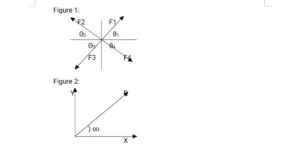
Four forces acting on a body are shown below.
What are the steps?
- Resolve each vector in two perpendicular directions, horizontal and vertical.
- Add all the horizontal components to get X. Give a negative sign to components pointing the opposite way.
- Add all the vertical components to get Y, using signs in the same way.
- Find the resultant from X and Y using Pythagoras’ theorem.
- Find the direction from the tangent of the angle.
What are the formulae for the four forces?
- Horizontal sum (Figure 1): X = F1 cos θ1 + (−F2 cos θ2) + (−F3 cos θ3) + F4 cos θ4
- Vertical sum (Figure 1): Y = F1 sin θ1 + F2 sin θ2 + (−F3 sin θ3) + (−F4 sin θ4)
- Resultant (Figure 2): R2 = X2 + Y2, so R = √(X2 + Y2)
- Direction: tan α = Y/X, where α is the angle of the resultant.
Evaluation
- What is the difference between a scalar quantity and a vector quantity?
- Two forces of 3 N and 4 N act in opposite directions. What is the resultant?
- State the parallelogram law of vector addition.
- Describe how to find the resultant of more than two vectors.
- A force F acts at an angle θ to the horizontal. Write expressions for its horizontal and vertical components.
Assignment
Two forces of 6 N and 8 N act at 90° to each other. Calculate the magnitude of the resultant and its direction, measured from the 8 N force.
This term's Physics topics
SS2 First Term · 8 topics
SS2 Physics Lesson Notes for Other Topics
Concept Of Position, Distance, And Displacement In Relation To X-Y Plane
Read the full lesson note.
Derivation of Equations of Linear Motions
Read the full lesson note.
Projectile And Its Implications
Read the full lesson note.
Newton's Law Of Motion
Read the full lesson note.
Equilibrium Of Forces
Read the full lesson note.
Simple Harmonic Motion
Read the full lesson note.
Machines
Read the full lesson note.
Heat Energy
Read the full lesson note.
Heat Capacity And Specific Heat Capacity
Read the full lesson note.

Evaporation
Read the full lesson note.

Latent Heat
Read the full lesson note.
Vapour Pressure
Read the full lesson note.
Gas Laws
Read the full lesson note.
Production And Propagation Of Waves
Read the full lesson note.
Properties Of Waves
Read the full lesson note.
Lesson Notes for Other Classes

SS1 Lesson Note
The complete lesson note to guide your studies.

SS3 Lesson Note
The complete lesson note to guide your studies.
