
Derivation of Equations of Linear Motions – SS2 Physics Lesson Note (First Term)
Lesson note at a glance
- Class
- SS2
- Subject
- Physics
- Term
- First Term
- Reading time
- 6 min
Equations of linear motion are formulae that relate velocity, acceleration, time and distance for a body moving in a straight line with constant acceleration.
| Equation | Quantity it leaves out | Use it when |
|---|---|---|
| v = u + at | s | distance is not given or not asked |
| s = ut + ½at² | v | final velocity is not given or not asked |
| v² = u² + 2as | t | time is not given or not asked |
Behavioural objectives
- Define displacement, distance, speed, velocity and acceleration, and state whether each is a scalar or a vector.
- Derive the three equations of linear motion.
- Use the equations to solve problems on bodies moving in a straight line.
- Apply the equations to bodies moving vertically under gravity.
What are the basic definitions used in linear motion?
Linear motion is the movement of a body along a straight line.
- Scalar quantity: has magnitude (size) only, such as distance and speed.
- Vector quantity: has magnitude and direction, such as displacement, velocity and acceleration.
- Distance: the length of path covered between two points. It is a scalar. Unit: metre (m).
- Displacement: the distance covered in a stated direction. It is a vector. Unit: metre (m).
- Speed: the rate of change of distance with time. Speed = distance ÷ time. It is a scalar. Unit: m/s.
- Velocity: the rate of change of displacement with time. Velocity = displacement ÷ time. It is a vector. Unit: m/s.
- Acceleration: the rate of change of velocity with time. Acceleration = change in velocity ÷ time. It is a vector. Unit: m/s².
- Retardation (deceleration): a negative acceleration, where the body slows down.
| Quantity | Type | SI unit |
|---|---|---|
| Distance | Scalar | m |
| Displacement | Vector | m |
| Speed | Scalar | m/s |
| Velocity | Vector | m/s |
| Acceleration | Vector | m/s² |
How are the equations of linear motion derived?
The equations are derived from the definition of acceleration and the area under a velocity-time graph.
What do the symbols mean?
- u: initial velocity (m/s).
- v: final velocity (m/s).
- a: constant acceleration (m/s²).
- t: time taken (s).
- s: distance covered in a straight line (m).
How do we derive v = u + at?
- Acceleration is change in velocity ÷ time, so a = (v – u) ÷ t.
- Multiply both sides by t: at = v – u.
- Make v the subject: v = u + at ………… (1)
How do we derive s = ½(u + v)t?
- When acceleration is constant, average velocity = (u + v) ÷ 2.
- Distance = average velocity × time.
- So s = ½(u + v)t ………… (2)
- This is also the area of the trapezium under the velocity-time graph.
How do we derive s = ut + ½at²?
- Start with equation (2): s = ½(u + v)t.
- Replace v with u + at from equation (1): s = ½(u + u + at)t.
- Simplify: s = ½(2u + at)t.
- Expand: s = ut + ½at² ………… (3)
How do we derive v² = u² + 2as?
- From equation (1), make t the subject: t = (v – u) ÷ a.
- Replace t in equation (2): s = ½(u + v) × (v – u) ÷ a.
- Multiply out (u + v)(v – u) = v² – u², so s = (v² – u²) ÷ 2a.
- Cross-multiply: 2as = v² – u².
- Make v² the subject: v² = u² + 2as ………… (4)
How do we solve problems with the equations of motion?
To solve a problem, list the known quantities, pick the equation that contains them and the unknown, then substitute.
Example 1
A car moves from rest with an acceleration of 0.2 m/s². Find its velocity when it has covered a distance of 50 m.
- u = 0 m/s; a = 0.2 m/s²; s = 50 m; v = ?
- v² = u² + 2as
- v² = 0² + 2(0.2 × 50) = 20
- v = √20 = 2√5 m/s (about 4.5 m/s)
Example 2
A car travels with a uniform velocity of 108 km/h. How far does it travel in ½ a minute?
- Convert the speed: 108 km/h = (108 × 1000) ÷ 3600 = 30 m/s.
- Convert the time: ½ × 60 = 30 s.
- Distance = speed × time.
- s = 30 × 30 = 900 m
Example 3
A particle starts from rest and moves with a constant acceleration of 0.5 m/s². Find the time taken to cover 25 m.
- u = 0; a = 0.5 m/s²; s = 25 m; t = ?
- s = ut + ½at²
- 25 = 0 + ½ × 0.5 × t² = 0.25t²
- t² = 100, so t = 10 s
Example 4
A car takes off from rest and covers 80 m on a straight road in 10 s. Find its acceleration.
- u = 0; s = 80 m; t = 10 s; a = ?
- s = ut + ½at²
- 80 = ½ × a × 10² = 50a
- a = 80 ÷ 50 = 1.6 m/s²
How does motion under gravity work?
Motion under gravity is the free movement of a body near the Earth’s surface with constant acceleration g, taken here as 10 m/s².
- Downward motion: a = +g.
- Upward motion: a = -g, because gravity slows the body.
- Maximum height: v = 0 for a body thrown vertically upwards.
- Dropped from rest: u = 0.
- Back at the ground: the height above the ground is zero, as for a re-bouncing body.
- Time up and down: time to rise equals time to fall back to the starting level (air resistance ignored).
What is the time of fall of a body?
The time of fall depends on the height and g, and not on the mass of the body.
- Start with s = ut + ½gt².
- For a body dropped from rest, u = 0, so s = ½gt².
- Make t the subject: t = √(2s ÷ g).
- Mass: it does not appear in the formula, so heavy and light bodies fall together.
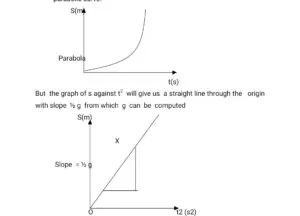
- Finding g: g = 2s ÷ t², from measured height and time of fall.
- Graph: a plot of s against t is a parabola.
- Straight-line graph: a plot of s against t² is a straight line with gradient g ÷ 2.
Example 5
A ball is thrown vertically into the air with an initial velocity u. What is the greatest height reached?
- u = u; a = -g; v = 0; s = ?
- v² = u² + 2as
- 0² = u² + 2(-g)s
- 2gs = u²
- s = u² ÷ 2g
Example 6
A ball thrown vertically upwards from the ground hits the ground after 4 s. Find the maximum height reached.
- Time to reach the top = 4 ÷ 2 = 2 s.
- At the top, v = 0 and a = -10 m/s². Use v = u + at: 0 = u – 10 × 2.
- u = 20 m/s.
- Height: s = u² ÷ 2g = 400 ÷ 20 = 20 m.
Example 7
A ball is released from a height of 20 m. Calculate (i) the time it takes to fall and (ii) the velocity with which it hits the ground.
- a = +g = 10 m/s²; u = 0; s = 20 m.
- (i) t = √(2s ÷ g) = √(2 × 20 ÷ 10) = √4 = 2 s.
- (ii) v = u + gt = gt, since u = 0.
- v = 10 × 2 = 20 m/s.
Evaluation
- Define velocity and acceleration, and state the unit of each.
- State one difference between distance and displacement.
- Starting from s = ((u + v) ÷ 2) × t and a = (v – u) ÷ t, derive v² = u² + 2as.
- State the value of the velocity at maximum height for a ball thrown vertically upwards, and the value of the initial velocity for a body dropped from rest.
- Show that the time of fall of a body released from rest does not depend on its mass.
Assignment
- A particle accelerates uniformly from rest at 6 m/s² for 8 s and then decelerates uniformly to rest in the next 7 s. Determine the magnitude of the deceleration.
This term's Physics topics
SS2 First Term · 8 topics
SS2 Physics Lesson Notes for Other Topics
Concept Of Position, Distance, And Displacement In Relation To X-Y Plane
Read the full lesson note.

Scalar And Vector Quantities
Read the full lesson note.

Projectile And Its Implications
Read the full lesson note.
Newton's Law Of Motion
Read the full lesson note.

Equilibrium Of Forces
Read the full lesson note.
Simple Harmonic Motion
Read the full lesson note.

Machines
Read the full lesson note.

Heat Energy
Read the full lesson note.
Heat Capacity And Specific Heat Capacity
Read the full lesson note.

Evaporation
Read the full lesson note.

Latent Heat
Read the full lesson note.
Vapour Pressure
Read the full lesson note.
Gas Laws
Read the full lesson note.
Production And Propagation Of Waves
Read the full lesson note.

Properties Of Waves
Read the full lesson note.
Lesson Notes for Other Classes

SS1 Lesson Note
The complete lesson note to guide your studies.

SS3 Lesson Note
The complete lesson note to guide your studies.
