
Machines – SS2 Physics Lesson Note (First Term)
Lesson note at a glance
- Class
- SS2
- Subject
- Physics
- Term
- First Term
- Reading time
- 7 min
A machine is a device in which a small applied force, called the effort, overcomes a large force, called the load.
Behavioural objectives
By the end of the lesson, students should be able to:
- define a machine, effort and load;
- define and calculate mechanical advantage, velocity ratio and efficiency;
- state the relationship between efficiency, M.A and V.R;
- describe the main types of machines and give examples of each;
- explain the effects of friction on a machine.
What are effort and load?
Effort is the force applied to a machine, and load is the resistance the machine overcomes.
- Effort (E): the force you apply, for example the push of your hand on a wheelbarrow handle.
- Load (L): the force the machine overcomes, for example the weight of sand in the wheelbarrow.
- Purpose of a machine: it makes work easier by letting a small effort move a large load.
What terms are used to describe machines?
The performance of a machine is described by three terms: mechanical advantage, velocity ratio and efficiency.
- Mechanical advantage (M.A): also called the force ratio.
- Velocity ratio (V.R): compares the distances moved by effort and load.
- Efficiency (Ef): compares useful work out with work put in.
What is mechanical advantage (M.A)?
Mechanical advantage is the ratio of the load to the effort.
- Formula: M.A = Load ÷ Effort.
- Unit: none, because it is a ratio of two forces.
- Effect of friction: friction in the moving parts lowers the M.A of a machine.
What is velocity ratio (V.R)?
Velocity ratio is the ratio of the distance moved by the effort to the distance moved by the load in the same time.
- Formula: V.R = Distance moved by effort ÷ Distance moved by load.
- Unit: none, because it is a ratio of two distances.
- Depends on: the geometry (size and shape) of the machine, not on friction.
What is efficiency (Ef)?
Efficiency is the percentage of the work put into a machine that comes out as useful work.
- Formula: Ef = (Useful work done by the machine ÷ Work put into the machine) × 100%.
- Work: work = force × distance, measured in joules (J).
How is Ef = (M.A ÷ V.R) × 100% obtained?
- Write Ef = (Work output ÷ Work input) × 100%.
- Use work = force × distance: Ef = (Load × distance moved by load) ÷ (Effort × distance moved by effort) × 100%.
- Rearrange: Ef = (Load ÷ Effort) ÷ (Distance moved by effort ÷ Distance moved by load) × 100%.
- Replace each part: Ef = (M.A ÷ V.R) × 100%.
Worked example
- A machine lifts a load of 450 N with an effort of 150 N.
- The effort moves 8 m while the load moves 2 m.
- M.A = 450 ÷ 150 = 3.
- V.R = 8 ÷ 2 = 4.
- Ef = (3 ÷ 4) × 100% = 75%.
What are the types of machines?
There are six common types of machine in this topic: lever, wheel and axle, gear wheels, hydraulic press, wedge and pulley.
What is a lever?
A lever is a rigid rod pivoted about a fixed point called the fulcrum (F).
- Use: a small effort at one point overcomes a large load at another point.
- Classes: the class depends on the positions of the load, effort and fulcrum.

What is the principle of moments for a lever?
- Let a be the distance from the fulcrum to the effort, and b the distance from the fulcrum to the load.
- Taking moments about F: E × a = L × b.
- Rearrange: L ÷ E = a ÷ b, so M.A = a ÷ b.
- The distances moved are in the same ratio as a and b, so V.R = a ÷ b.
- For a lever with no friction, M.A = V.R.
What are the classes of lever?
There are three classes of lever: first-class, second-class and third-class.
| Class | Arrangement | Examples |
|---|---|---|
| First-class | Fulcrum is between the effort and the load. | Crowbar, scissors, pincers, claw hammer, see-saw, pliers |
| Second-class | Load is between the fulcrum and the effort. | Wheelbarrow, nutcracker, trap door, oar |
| Third-class | Effort is between the fulcrum and the load. | Human forearm, laboratory tongs |
What is a wheel and axle?
A wheel and axle is a large wheel fixed to a smaller axle so that both turn together.
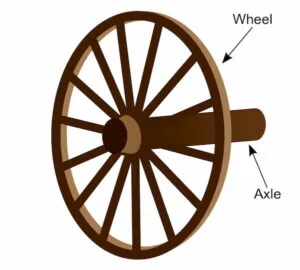
- Wheel rope: a rope is attached to the large wheel, and the effort is applied at its free end.
- Axle rope: a rope is wound around the axle in the opposite direction, and the load hangs from its free end.
- One rotation: the effort moves a distance equal to the circumference of the wheel, and the load moves a distance equal to the circumference of the axle.
- Velocity ratio: V.R = R ÷ r, where R is the radius of the wheel and r is the radius of the axle.
- Uses: the brace, screwdriver, spanner, windlass and gearbox.
What are gear wheels?
Gear wheels are toothed wheels of different sizes that interlock to pass on turning motion.

- Driver: the gear wheel that receives the effort and turns the other.
- Driven wheel: the gear wheel that is turned by the driver.
- Effect: a larger driven wheel gives more turning force at a lower speed.
- Velocity ratio: V.R = Number of teeth on the driven wheel ÷ Number of teeth on the driving wheel.
- Example: a driver with 20 teeth turning a driven wheel with 40 teeth gives V.R = 40 ÷ 20 = 2.
What is a hydraulic press?
A hydraulic press is a machine that uses a liquid, usually oil, to transmit pressure from a small piston to a large piston.

- Principle: Pascal’s principle states that pressure applied to an enclosed fluid is transmitted equally through the fluid.
- Uses: compressing waste paper and cotton into compact bales, and forging alloys into desired shapes.
- Velocity ratio: V.R = R2 ÷ r2, where R and r are the radii of the large and small pistons.
What is a wedge?
A wedge is a combination of two inclined planes.
- Use: it separates bodies that are held together by a large force.
- Examples: axes, chisels and knives.
What is a pulley?
A simple pulley is a fixed wheel hung on a support, with a rope passing around its groove.

- Fixed pulley: it changes the direction of the effort, and its V.R is 1.
- Block and tackle: a more practical system in which one or more pulleys share an axle, with one continuous rope passing round all the pulleys.
- Velocity ratio of a block and tackle: it equals the number of rope sections supporting the load.
What is the velocity ratio formula for each machine?
Each machine has its own formula for velocity ratio, as shown below.
| Machine | V.R |
|---|---|
| Lever | a ÷ b (effort arm ÷ load arm) |
| Wheel and axle | R ÷ r |
| Gear wheels | Teeth on driven wheel ÷ teeth on driving wheel |
| Hydraulic press | R2 ÷ r2 |
| Block and tackle | Number of rope sections supporting the load |
What are the effects of friction on a machine?
Friction wastes part of the work put into a machine, so the efficiency is always less than 100%.
- Wasted work: work is used to overcome friction between moving parts and to lift moving parts of the machine.
- Effort: the greater the friction, the greater the effort needed.
- M.A: the greater the friction, the smaller the M.A.
- V.R: it is independent of friction and depends on the geometry of the moving parts.
- Efficiency: in practical machines it is less than 100% because of friction.
- Load: the efficiency of nearly all machines varies with the load.
What is the linear law of a machine?
The linear law states that the effort E and the load L are related by E = aL + b, where a and b are constants.
- Meaning: E varies linearly with L, so a graph of E against L is a straight line.
- Constant b: the effort needed to operate the moving parts when there is no load.
- Constant a: a measure of the friction present.
Evaluation
- (a) What is a machine? (b) Explain why a machine can never be 100% efficient.
- Define the following terms as applicable to a machine: (a) velocity ratio, (b) mechanical advantage, (c) efficiency.
- A pulley with a velocity ratio of 5 is used to lift a load of 400 N through a vertical height of 8 m by exerting an effort of 100 N. Calculate: (a) the work done by the effort and (b) the efficiency of the pulley system.
- A wheel and axle has a wheel of radius 40 cm and an axle of radius 10 cm. Calculate its velocity ratio. If an effort of 100 N lifts a load of 320 N, calculate its efficiency.
Assignment
In your notebook, state the relationship between efficiency, mechanical advantage and velocity ratio. Name the three classes of lever with one example of each. State Pascal’s principle and name one use of the hydraulic press.
This term's Physics topics
SS2 First Term · 8 topics
SS2 Physics Lesson Notes for Other Topics
Concept Of Position, Distance, And Displacement In Relation To X-Y Plane
Read the full lesson note.

Scalar And Vector Quantities
Read the full lesson note.
Derivation of Equations of Linear Motions
Read the full lesson note.

Projectile And Its Implications
Read the full lesson note.
Newton's Law Of Motion
Read the full lesson note.
Equilibrium Of Forces
Read the full lesson note.
Simple Harmonic Motion
Read the full lesson note.
Heat Energy
Read the full lesson note.
Heat Capacity And Specific Heat Capacity
Read the full lesson note.

Evaporation
Read the full lesson note.

Latent Heat
Read the full lesson note.
Vapour Pressure
Read the full lesson note.
Gas Laws
Read the full lesson note.
Production And Propagation Of Waves
Read the full lesson note.
Properties Of Waves
Read the full lesson note.
Lesson Notes for Other Classes

SS1 Lesson Note
The complete lesson note to guide your studies.

SS3 Lesson Note
The complete lesson note to guide your studies.
