
Gas Laws – SS2 Physics Lesson Note (Second Term)
Lesson note at a glance
- Subject
- Physics
- Class
- SS2
- Term
- Second Term
- Topic
- Gas Laws
- Order
- Topic 6 of 9 this term
- Reading time
- 6 min
Gas laws describe how the volume, pressure and temperature of a fixed mass of gas are related.
- Three simple laws: Boyle’s law, Charles’ law and the pressure law each keep one quantity constant.
- One combined law: the general gas law joins all three into one equation.
Behavioural objectives
By the end of the lesson, students should be able to:
- State Boyle’s law, Charles’ law and the pressure law.
- Write the equation for each law.
- Explain what absolute zero of temperature means.
- State the general gas law and write it as PV = nRT.
- Use the gas laws to solve simple problems.
What conditions are used to study the behaviour of gases?
A gas is studied using its mass, volume, pressure and temperature, with the mass always fixed.
- Fixed mass: the amount of gas stays the same, so no gas enters or leaves the container.
- Volume (V): the space the gas fills, measured in m3, dm3 or cm3.
- Pressure (P): the force the gas exerts on each unit area of the container, measured in Pa, kPa or cmHg.
- Temperature (T): how hot the gas is, measured in kelvin (K) in all gas law calculations.
Two of the three quantities are studied at a time, while the third is kept constant.
| Law | Quantities varied | Kept constant | Relationship |
|---|---|---|---|
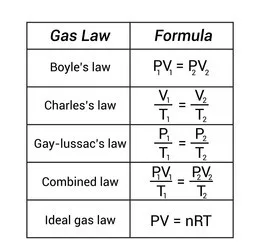
| Boyle’s law | Pressure and volume | Temperature | PV = constant |
| Charles’ law | Volume and temperature | Pressure | V ÷ T = constant |
| Pressure law | Pressure and temperature | Volume | P ÷ T = constant |
How do we change Celsius to kelvin?
To change °C to K, add 273 to the Celsius temperature.
- Kelvin scale: the absolute temperature scale, which starts at absolute zero (0 K).
- Conversion: T (in K) = θ (in °C) + 273.
- Reverse conversion: θ (in °C) = T (in K) − 273.
- Example 1: 27°C = 27 + 273 = 300 K.
- Example 2: 100°C = 100 + 273 = 373 K.
- Rule: always change °C to K before using Charles’ law, the pressure law or the general gas law.
What is Boyle’s law?
Boyle’s law states that the pressure of a fixed mass of gas varies inversely as its volume, at constant temperature.
- Meaning: if the volume is halved, the pressure doubles.
- Everyday example: pressing the plunger of a bicycle pump with the outlet closed raises the air pressure inside.
Equations for Boyle’s law
- P ∝ 1/V
- P = K/V
- PV = K
- P1V1 = P2V2
Worked example
- Question: a gas of volume 600 cm3 is at a pressure of 100 kPa. Find its volume at 200 kPa, temperature constant.
- Working: P1V1 = P2V2, so 100 × 600 = 200 × V2.
- Answer: V2 = 60 000 ÷ 200 = 300 cm3.
What is Charles’ law?
Charles’ law states that for a fixed mass of gas at constant pressure, the volume is proportional to its absolute temperature.
- Meaning: if the kelvin temperature doubles, the volume doubles.
- Everyday example: a sealed, partly inflated balloon swells when placed in warm sunlight.
Equations for Charles’ law
- V ∝ T
- V/T = constant
- V1/T1 = V2/T2
Worked example
- Question: a gas has volume 2 dm3 at 300 K. Find its volume at 450 K, pressure constant.
- Working: V1/T1 = V2/T2, so 2/300 = V2/450.
- Answer: V2 = (2 × 450) ÷ 300 = 3 dm3.
What is the pressure law?
The pressure law states that the pressure of a fixed mass of gas at constant volume is proportional to its absolute temperature.
- Other name: it is also called Gay-Lussac’s law.
- Meaning: if the kelvin temperature doubles, the pressure doubles.
- Everyday example: the pressure in a sealed gas cylinder rises when it is left in strong heat.
Equations for the pressure law
- P ∝ T
- P/T = constant
- P1/T1 = P2/T2
Worked example
- Question: a gas in a sealed container has pressure 120 kPa at 300 K. Find its pressure at 400 K, volume constant.
- Working: P1/T1 = P2/T2, so 120/300 = P2/400.
- Answer: P2 = (120 × 400) ÷ 300 = 160 kPa.
How does the kinetic theory explain the gas laws?
The kinetic theory explains gas pressure as the result of gas molecules hitting the walls of the container.
- Boyle’s law: a smaller volume makes molecules hit the walls more often, so pressure rises.
- Charles’ law: a higher temperature makes molecules faster, so the gas must expand to keep the pressure constant.
- Pressure law: a higher temperature makes molecules hit the walls harder and more often, so pressure rises in a fixed volume.
What is the absolute zero of temperature?
Absolute zero is the lowest possible temperature, -273°C or 0 K.
- Graph method: a graph of volume against temperature (°C) is a straight line.
- Extrapolation: when the line is extended backwards, it cuts the temperature axis at -273°C.
- Same result: a graph of pressure against temperature gives the same intercept.
- Meaning: it is the temperature at which the volume of the gas would theoretically become zero.
- Molecules: in theory, the molecules would have no kinetic energy at this temperature.
- Why it is an assumption: real gases liquefy before this temperature is reached, so the line cannot be followed all the way.
What is the general gas law?
The general gas law states that PV/T is constant for a fixed mass of gas, combining Boyle’s law, Charles’ law and the pressure law.
How the three laws combine
- From Boyle’s law: PV = K
- From Charles’ law: V/T = K
- From the pressure law: P/T = K
The general gas equation
- Combined form: PV/T = constant.
- For two states of the same gas: P1V1/T1 = P2V2/T2.
- For n moles of gas: PV = nRT.
What are the symbols in PV = nRT?
| Symbol | Meaning | Unit |
|---|---|---|
| P | Pressure of the gas | Pa |
| V | Volume of the gas | m3 |
| n | Number of moles of gas | mol |
| R | Universal molar gas constant, 8.31 | J mol-1 K-1 |
| T | Absolute temperature | K |
Worked example 1: two states of a gas
- Question: a gas has V = 2 L, P = 100 kPa and T = 27°C. Find its pressure when V = 3 L and T = 87°C.
- Step 1: change to kelvin: T1 = 300 K and T2 = 360 K.
- Step 2: write P1V1/T1 = P2V2/T2.
- Step 3: substitute: (100 × 2)/300 = (P2 × 3)/360.
- Answer: P2 = (100 × 2 × 360) ÷ (300 × 3) = 80 kPa.
Worked example 2: using PV = nRT
- Question: find the volume of 0.5 mol of gas at 300 K and a pressure of 100 000 Pa. Take R = 8.31 J mol-1 K-1.
- Working: V = nRT ÷ P = (0.5 × 8.31 × 300) ÷ 100 000.
- Answer: V = 1246.5 ÷ 100 000 = 0.0125 m3 (about 12.5 dm3).
Evaluation
- State Boyle’s law and write its equation.
- State Charles’ law and write its equation.
- What is absolute zero of temperature, and why is it only an assumption?
- Write the general gas law as an equation relating P1, V1, T1, P2, V2 and T2.
- In PV = nRT, what do n and R stand for?
Assignment
A vessel is filled with a gas at a temperature of 50°C and a pressure of 76 cmHg. Calculate the final pressure if the volume of the gas is doubled while it is heated to 90°C.
This term's Physics topics
SS2 Second Term · 9 topics
SS2 Physics Lesson Notes for Other Topics

Heat Energy
Read the full lesson note.
Heat Capacity And Specific Heat Capacity
Read the full lesson note.

Evaporation
Read the full lesson note.

Latent Heat
Read the full lesson note.
Vapour Pressure
Read the full lesson note.
Production And Propagation Of Waves
Read the full lesson note.

Properties Of Waves
Read the full lesson note.

Light Wave
Read the full lesson note.

Concept Of Position, Distance, And Displacement In Relation To X-Y Plane
Read the full lesson note.

Scalar And Vector Quantities
Read the full lesson note.

Derivation of Equations of Linear Motions
Read the full lesson note.

Projectile And Its Implications
Read the full lesson note.
Newton's Law Of Motion
Read the full lesson note.

Equilibrium Of Forces
Read the full lesson note.

Simple Harmonic Motion
Read the full lesson note.
Lesson Notes for Other Classes

SS1 Lesson Note
The complete lesson note to guide your studies.

SS3 Lesson Note
The complete lesson note to guide your studies.
