
Properties of Waves – SS2 Physics Lesson Note (Second Term)
Lesson note at a glance
- Class
- SS2
- Subject
- Physics
- Term
- Second Term
- Reading time
- 6 min
Waves show five properties: reflection, refraction, diffraction, interference and polarisation. The first four are shown by all waves, while polarisation is shown by transverse waves only.
Behavioural objectives
- List the properties of waves.
- State the laws of reflection.
- Explain refraction and use the refractive index, sin i / sin r = v1 / v2.
- Describe diffraction and say when it is noticeable.
- Distinguish between constructive and destructive interference.
- Explain polarisation and state one use of a Polaroid.
What are the properties of waves?
The properties of waves are reflection, refraction, diffraction, interference and polarisation.
| Property | Meaning | Shown by |
|---|---|---|
| Reflection | A wave bounces back from a surface. | All waves |
| Refraction | A wave changes speed and direction between media. | All waves |
| Diffraction | A wave spreads out after passing a gap or edge. | All waves |
| Interference | Two waves meet and combine. | All waves |
| Polarisation | Vibration is restricted to one plane. | Transverse waves only |
- Ripple tank: a shallow tray of water used in class to show the first four properties with water waves.
- Transverse wave: a wave whose particles vibrate at right angles to the direction of travel, as in light and water waves.
What is reflection?
Reflection is the bouncing back of a wave when it strikes a surface.
- Incident wave: the wave that travels towards the surface.
- Reflected wave: the wave that bounces back from the surface.
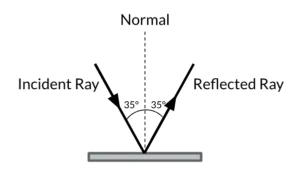
- Normal: a line drawn at right angles to the surface at the point where the wave strikes.
- Angle of incidence: the angle between the incident ray and the normal.
- Angle of reflection: the angle between the reflected ray and the normal.
Reflection of the plane parallel wave from a plane surface.
What happens in a ripple tank?
- Normal incidence: waves that strike a plane strip head-on are reflected along their original course.
- Oblique incidence: waves that strike at an angle are reflected so that the angle of incidence equals the angle of reflection.
- Everyday example: an echo is the reflection of sound from a wall or hill.
What are the laws of reflection?
There are two laws of reflection.
- The incident ray, the reflected ray and the normal, at the point of incidence, all lie on the same plane.
- The angle of incidence is equal to the angle of reflection.
What is refraction?
Refraction is the change in the speed and direction of waves as they pass from one medium to another.
What happens when waves go from deep to shallow water?
- Speed: the waves slow down.
- Wavelength: the wavelength becomes shorter.
- Direction: the waves bend towards the normal when they cross the boundary at an angle.
- Frequency: the frequency stays constant, so the change in speed is matched by a change in wavelength (v = fλ).
- Shallow to deep: the reverse happens, and the waves speed up and bend away from the normal.
What is the refractive index?
The refractive index is the ratio of the sine of the angle of incidence (i) to the sine of the angle of refraction (r).
- Speed form: it also equals the ratio of the wave speed in the first medium (v1) to the speed in the second medium (v2).
- For light: refractive index = velocity in air / velocity in the medium.
- Unit: it is a ratio, so it has no unit.
Refractive index = sin i / sin r = v1 / v2
Worked example
Waves travel at 15 m/s in deep water and meet a shallow water boundary. The angles of incidence and refraction are 45° and 30°. Find the speed in shallow water.
- Write the formula: sin i / sin r = v1 / v2.
- Substitute: sin 45° / sin 30° = 15 / v2.
- Rearrange: v2 = 15 × sin 30° / sin 45°.
- Calculate: v2 = 15 × 0.5 / 0.7071 = 10.6 m/s (to 1 decimal place).
What is diffraction?
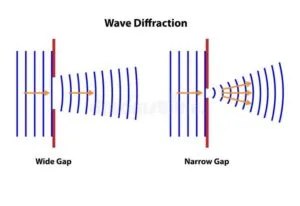
Diffraction is the spreading out of a wave as it passes through a narrow opening or round an obstacle.
- Wide gap: if the gap is large compared with the wavelength, the waves pass through with only slightly bent edges.
- Narrow gap: if the barriers are close together, the waves spread out as circular wavefronts after the slit.
- When it is noticeable: diffraction is greatest when the gap or obstacle is about the same size as the wavelength, or smaller.
- Everyday example: you can hear someone speaking round a corner because sound waves bend round the edge of the wall.
What is interference?
Interference is the combining of two similar waves that travel in the same direction and cross each other.
There are two types of interference: constructive and destructive.
What is constructive interference?
Constructive interference is the addition of two waves that are in phase to give a bigger wave.
- Condition: the crests (or the troughs) of the two waves arrive together.
- Whole wavelength: one wave may also be a complete wavelength ahead of the other.
- Result: for two equal waves, the resultant has twice the amplitude of each wave.
What is destructive interference?
Destructive interference is the cancelling of two waves that are out of phase.
- Condition: the crest of one wave arrives with the trough of the other.
- Result: for two equal waves, the resultant is zero.
How do the two types differ?
| Feature | Constructive | Destructive |
|---|---|---|
| Phase | Waves in phase | Waves out of phase |
| Meeting of waves | Crest meets crest, trough meets trough | Crest meets trough |
| Resultant amplitude | Larger (twice, for equal waves) | Zero (for equal waves) |
| Other name | Additive interference | Cancelling interference |
What is polarisation?
Polarisation is the restriction of the vibration of a transverse wave to one plane only.
- Plane-polarised wave: a transverse wave that vibrates in only one plane.
- Who shows it: only transverse waves, such as light. Longitudinal waves, such as sound, cannot be polarised.
- Polariser: a material that lets light vibrating in one plane pass through, such as a Polaroid or a crystal of calcite, tourmaline or quartz.
- How it works: the arrangement of molecules in the polariser passes light in one plane and absorbs light vibrating in other planes.
- Result: unpolarised light passing through a polariser emerges vibrating in one plane only.
What is a use of a Polaroid?
A Polaroid is used in sunglasses to reduce the intensity of incident light and to remove glare from reflected light.
Evaluation
- State the two laws of reflection.
- What happens to the speed and the wavelength of a wave that passes from deep to shallow water?
- Distinguish between constructive and destructive interference.
- Define polarisation.
- State one use of a Polaroid.
Assignment
Surface waves travel in deep water at 12 m/s and meet a shallow water boundary. The angles of incidence and refraction are 60° and 30°. Calculate the speed of the waves in the shallow water, showing every step. (sin 60° = 0.866, sin 30° = 0.5)
This term's Physics topics
SS2 Second Term · 9 topics
SS2 Physics Lesson Notes for Other Topics
Heat Energy
Read the full lesson note.
Heat Capacity And Specific Heat Capacity
Read the full lesson note.

Evaporation
Read the full lesson note.

Latent Heat
Read the full lesson note.
Vapour Pressure
Read the full lesson note.
Gas Laws
Read the full lesson note.
Production And Propagation Of Waves
Read the full lesson note.
Light Wave
Read the full lesson note.
Concept Of Position, Distance, And Displacement In Relation To X-Y Plane
Read the full lesson note.

Scalar And Vector Quantities
Read the full lesson note.
Derivation of Equations of Linear Motions
Read the full lesson note.
Projectile And Its Implications
Read the full lesson note.
Newton's Law Of Motion
Read the full lesson note.
Equilibrium Of Forces
Read the full lesson note.
Simple Harmonic Motion
Read the full lesson note.
Lesson Notes for Other Classes

SS1 Lesson Note
The complete lesson note to guide your studies.

SS3 Lesson Note
The complete lesson note to guide your studies.
