
Vapour Pressure – SS2 Physics Lesson Note (Second Term)
Download this term · ₦1,000Lesson note at a glance
- Subject
- Physics
- Class
- SS2
- Term
- Second Term
- Topic
- Vapour Pressure
- Order
- Topic 5 of 9 this term
- Reading time
- 4 min
Vapour pressure is the pressure exerted by the vapour above a liquid that is evaporating in a closed container. The vapour molecules move constantly and exert pressure like gas molecules. Saturated vapour pressure is the pressure exerted when the space can hold no more vapour, and it increases with temperature.
Behavioural objectives
By the end of the lesson, students should be able to:
- define vapour pressure;
- distinguish between saturated and unsaturated vapour;
- define humidity and relative humidity, and name the instrument used to measure relative humidity;
- define dew point;
- describe mist and fog and state how they differ.
What is vapour pressure?
When a liquid evaporates in a closed container, the vapour formed above the liquid exerts pressure. According to kinetic molecular theory, the molecules of the vapour are in constant motion and so exert pressure just like the molecules of a gas. This pressure is called the vapour pressure of the liquid.
What are saturated and unsaturated vapour pressure?
Saturated vapour pressure
A saturated vapour is a vapour that is in contact with its liquid within a confined space. When the enclosed space above a liquid is saturated with vapour molecules and can hold no more molecules, the pressure exerted by this saturated vapour is called the saturated vapour pressure (s.v.p) of the liquid.
The vapour is said to be saturated when the number of molecules escaping from the liquid per unit time is equal to the number returning to the liquid per unit time. The saturated vapour is thus in a state of dynamic equilibrium with its liquid. Saturated vapour pressure increases with temperature.
Unsaturated vapour pressure
An unsaturated vapour is a vapour which is not in contact with its liquid in a confined space. It is not in dynamic equilibrium with its liquid. The rate at which the liquid evaporates is greater than the rate at which the vapour condenses. The pressure exerted by such a vapour is called the unsaturated vapour pressure.
What is humidity?
Humidity is the measure of the wetness of the atmosphere. The exact amount of water vapour in the atmosphere at a given temperature is called absolute humidity. At higher temperatures, the atmosphere contains more water vapour than it does at low temperatures.
Relative humidity
Relative humidity is defined as the ratio of the mass of water vapour per unit volume present in the atmosphere to the mass per unit volume of the water vapour needed to saturate the atmosphere.
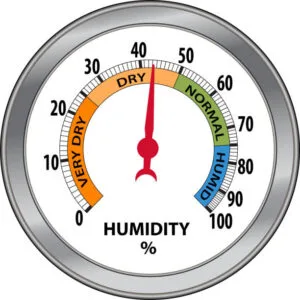
Analog Humidity hygrometer – Vector Illustration
Relative humidity = (s.v.p at dew point ÷ s.v.p at room temp) × 100%
An instrument known as the hygrometer is used to measure the relative humidity of air.
What is dew point and how does it relate to weather?
The dew point is the temperature at which the water vapour present in the air is just sufficient to saturate it. It is also defined as the temperature at which the pressure of the water vapour is equal to the saturation vapour pressure.
- Mist: mist occurs in wet air with a high relative humidity, above 75, when water vapour in the air is cooled below its dew point. Mist limits visibility to about 1000 m or less.
- Fog: fog is formed when water vapour in the air is cooled down to its dew point. Fog has a greater effect on the weather than mist, as it can reduce visibility to less than 200 m.
Evaluation
- What is a saturated vapour?
- State two differences between a saturated vapour and an unsaturated vapour.
- Define relative humidity and write its formula.
- What is the dew point?
- State how mist differs from fog.
Assignment
- The temperature at which the saturated vapour pressure of a liquid is equal to the atmospheric pressure gives rise to a phenomenon called
(a) boiling point (b) melting point (c) evaporation (d) freezing point (e) no answer - The instrument used to measure the relative humidity of an environment is
(a) hydrometer (b) hygrometer (c) humid-meter (d) hygroscope (e) none of the above - Which of these statements is/are correct?
- (i) The atmosphere above is cooler than the ones below.
- (ii) For unsaturated vapour, the rate at which the liquid evaporates is greater than the rate at which the liquid condenses.
- (iii) Mist has less weather effect than fog.
(a) all of the above (b) (i) and (ii) only (c) (i) and (iii) only (d) (ii) and (iii) only (e) none of the above
- Which of these is true of saturated vapour pressure?
- (i) The saturated vapour pressure of a liquid increases with temperature.
- (ii) The saturated vapour pressure of a liquid does not have contact with the liquid.
- (iii) Saturated vapour pressure is in a state of dynamic equilibrium with its liquid.
(a) all of the above (b) (i) and (ii) only (c) (i) and (iii) only (d) (ii) and (iii) only (e) none of the above
- The temperature at which the water vapour present in the air is just sufficient to saturate it is referred to as
(a) relative humidity (b) vaporization (c) dew point (d) condensation point (e) no answer
This term's Physics topics
SS2 Second Term · 9 topics
Get Physics as PDF and Word
Every week of SS2 Physics, Second Term, formatted and ready to print. Ad-free, and the copy lock comes off.
Get this term Card, bank transfer, USSD or OPay
Second Term Physics Lesson Notes for Other Topics
Energy Quantization
Read the full lesson note.
Nucleus & Radioactivity, Nuclear Reaction.
Read the full lesson note.

Models of an Atom
Read the full lesson note.

Simple AC Circuit
Read the full lesson note.
Electromagnetic Induction
Read the full lesson note.
Electromagnetic Field
Read the full lesson note.
Heat Capacity And Specific Heat Capacity
Read the full lesson note.
Heat Energy
Read the full lesson note.

Evaporation
Read the full lesson note.

Latent Heat
Read the full lesson note.
Gas Laws
Read the full lesson note.
Production And Propagation Of Waves
Read the full lesson note.
Properties Of Waves
Read the full lesson note.
Light Wave
Read the full lesson note.
Heat Energy
Read the full lesson note.
Lesson Notes for Other Classes

Basic 1 Lesson Note
The complete lesson note to guide your studies.

Basic 2 Lesson Note
The complete lesson note to guide your studies.

Basic 3 Lesson Note
The complete lesson note to guide your studies.

Basic 4 Lesson Note
The complete lesson note to guide your studies.

Basic 5 Lesson Note
The complete lesson note to guide your studies.

Basic 6 Lesson Note
The complete lesson note to guide your studies.
