
Projectile and its Implications – SS2 Physics Lesson Note (First Term)
Lesson note at a glance
- Class
- SS2
- Subject
- Physics
- Term
- First Term
- Reading time
- 6 min
A projectile is an object thrown or launched into the air that then moves under the force of gravity alone.
Behavioural objectives
By the end of the lesson, students should be able to:
- describe projectile motion and give examples
- resolve the initial velocity into horizontal and vertical components
- derive and use the formulae for time of flight, maximum height and range
- state the angle of projection that gives the maximum range
- state some uses of projectiles
- solve numerical problems on projectiles
What is projectile motion?
Projectile motion is the curved, parabolic path followed by an object moving under gravity after it has been projected.
- Path: a curve called a parabola.
- Cause: two independent motions at right angles to each other.
- Depends on: the initial velocity U and the angle of projection θ.
- Assumption: air resistance is ignored, and g is taken as 10 m/s² in calculations.
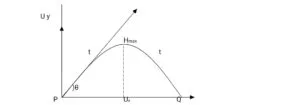
What are the two independent motions of a projectile?
A projectile has a horizontal motion and a vertical motion, and each one does not affect the other.
| Feature | Horizontal motion | Vertical motion |
|---|---|---|
| Type of motion | Constant velocity | Free fall under gravity |
| Acceleration | Zero | g = 10 m/s² downwards |
| Velocity | Ux = U cos θ, never changes | Uy = U sin θ at the start, changes with time |
What are examples of projectile motion?
- Stone from a catapult: the stone follows a curve after release.
- Bullet fired from a gun: the bullet drops below the line of aim as it travels.
- High jump: the athlete’s centre of mass follows a parabola after take-off.
- Thrown rubber ball: each flight of the ball between bounces off a wall is a projectile path.
- Cricket ball: a ball thrown against a vertical wall travels along a curve.
- Javelin, shot put and kicked football: each moves along a curved path in the air.
How do we resolve the initial velocity of a projectile?
Resolving the initial velocity means splitting U into a horizontal component Ux and a vertical component Uy.
- Vertical component: Uy = U sin θ (equation 1).
- Horizontal component: Ux = U cos θ (equation 2).
- Angle θ: the angle between the direction of projection and the horizontal.
What happens at the highest point?
- Vertical velocity: zero for an instant.
- Horizontal velocity: still U cos θ.
- Acceleration: still g, downwards.
- Time: the projectile reaches this point at half the time of flight.
What terms are associated with projectiles?
The three main terms are time of flight (T), maximum height (H) and range (R).
| Term | Symbol | Meaning |
|---|---|---|
| Time of flight | T | Time taken to return to the level of projection |
| Maximum height | H | Highest vertical distance above the projection plane |
| Range | R | Horizontal distance from the point of projection to where it lands |
What is the time of flight (T)?
The time of flight is the time a projectile takes to return to the same level from which it was projected.
Let t be the time to reach the greatest height. Use v = u + at, with v = 0 and a = -g.
- 0 = U sin θ – gt
- t = U sin θ / g (equation 3)
- The upward and downward journeys take equal time, so T = 2t.
- T = 2U sin θ / g (equation 4)
What is the maximum height (H)?
The maximum height is the highest vertical distance reached, measured from the horizontal projection plane.
- Use v² = u² – 2gH for the vertical motion, so V² = U² sin²θ – 2gH.
- At maximum height, V = 0.
- So 2gH = U² sin²θ.
- H = U² sin²θ / 2g (equation 5)
What is the range (R)?
The range is the horizontal distance from the point of projection to the point where the projectile hits the projection plane again.
- Horizontal acceleration is zero, so R = Ux × T (distance = velocity × time).
- R = U cos θ × (2U sin θ / g)
- R = 2U² sin θ cos θ / g
- From trigonometry, 2 sin θ cos θ = sin 2θ.
- R = U² sin 2θ / g (equation 6)
Which angle of projection gives the maximum range?
The range is greatest when θ = 45°, because sin 2θ is then sin 90° = 1.
- Maximum range: Rmax = U² / g.
- Condition: the projectile lands at the same level as the launch point.
- Complementary angles: angles that add up to 90° give the same range, for example 30° and 60°.
| θ | 2θ | sin 2θ |
|---|---|---|
| 15° | 30° | 0.5 |
| 30° | 60° | 0.866 |
| 45° | 90° | 1 |
| 60° | 120° | 0.866 |
| 75° | 150° | 0.5 |
What are the formulae for projectiles?
| Quantity | Formula |
|---|---|
| Vertical component | Uy = U sin θ |
| Horizontal component | Ux = U cos θ |
| Time of flight | T = 2U sin θ / g |
| Maximum height | H = U² sin²θ / 2g |
| Range | R = U² sin 2θ / g |
| Maximum range (θ = 45°) | Rmax = U² / g |
What are the uses and implications of projectile motion?
Knowing projectile motion helps people choose the speed and angle needed to hit a target or cover a distance.
- Missiles: projectile principles are used to launch missiles in modern warfare.
- Sports: athletes in javelin, shot put and long jump choose a launch speed and angle to cover the greatest distance.
- Artillery: to hit a specified target, the bomb must be released when the target appears at the angle of depression φ, given by tan φ = (1/u)√(gh/2).
- Air resistance: in real life it shortens the range and height compared with the formulae.
How do we solve problems on projectiles?
Example 1: bomb released from a bomber
A bomber is flying horizontally at a height of 3000 m above the ground at 60 km min⁻¹. It drops a bomb on a target on the ground. Find the acute angle between the vertical and the line joining the bomber and the target at the instant the bomb is released.
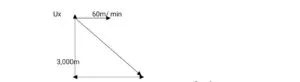
- Horizontal velocity of the bomber = 60 km/min = 10³ m s⁻¹ = 1000 m/s.
- The bomb leaves with the same horizontal velocity, 1000 m/s, and falls with g = 10 m/s².
- For the vertical motion, h = ut + ½gt², with u = 0, so h = ½gt².
- 3000 = ½ × 10 × t², so t² = 600.
- t = 10√6 s.
- Horizontal distance s = horizontal velocity × time = 1000 × 10√6.
- s = 2.449 × 10⁴ m.
- tan θ = s / 3000 = 2.449 × 10⁴ / 3000.
- θ = 83.02°.
Example 2: stone shot from a catapult
A stone is shot from a catapult with an initial velocity of 30 m/s at an elevation of 60°. Find the time of flight, the maximum height and the range. Take g = 10 m/s².
i. The time of flight
- T = 2U sin θ / g
- T = (2 × 30 × sin 60°) / 10
- T = 5.2 s
ii. The maximum height
- H = U² sin²θ / 2g
- H = 30² × sin²(60°) / 20
- H = 33.75 m
iii. The range
- R = U² sin 2θ / g
- R = 30² × sin 120° / 10
- R = 90 × sin 120°
- R = 77.9 m
Evaluation
- Name the two independent motions that make up projectile motion.
- Define time of flight, maximum height and range.
- Show that the range of a projectile is R = U² sin 2θ / g.
- At what angle of projection is the range greatest, and what is the maximum range in terms of U and g?
- A ball is kicked at 20 m/s at 45° to the ground. Taking g = 10 m/s², find its range.
Assignment
A stone is shot from a catapult with an initial velocity of 20 m/s at an elevation of 30°. Taking g = 10 m/s², find the time of flight, the maximum height attained and the range.
This term's Physics topics
SS2 First Term · 8 topics
SS2 Physics Lesson Notes for Other Topics
Concept Of Position, Distance, And Displacement In Relation To X-Y Plane
Read the full lesson note.

Scalar And Vector Quantities
Read the full lesson note.
Derivation of Equations of Linear Motions
Read the full lesson note.
Newton's Law Of Motion
Read the full lesson note.
Equilibrium Of Forces
Read the full lesson note.
Simple Harmonic Motion
Read the full lesson note.
Machines
Read the full lesson note.

Heat Energy
Read the full lesson note.
Heat Capacity And Specific Heat Capacity
Read the full lesson note.

Evaporation
Read the full lesson note.

Latent Heat
Read the full lesson note.
Vapour Pressure
Read the full lesson note.
Gas Laws
Read the full lesson note.
Production And Propagation Of Waves
Read the full lesson note.
Properties Of Waves
Read the full lesson note.
Lesson Notes for Other Classes

SS1 Lesson Note
The complete lesson note to guide your studies.

SS3 Lesson Note
The complete lesson note to guide your studies.
