
Plant Nutrient and Nutrient Cycle – SS2 Agricultural Science Lesson Note (First Term)
Download this term · ₦1,000Lesson note at a glance
- Subject
- Agricultural Science
- Class
- SS2
- Term
- First Term
- Topic
- Plant Nutrient and Nutrient Cycle
- Order
- Topic 6 of 7 this term
- Reading time
- 7 min
Plant nutrients are the mineral elements that crops take from the soil to grow, and they are grouped into macronutrients and micronutrients. Nutrient cycles (nitrogen, carbon and water) show how these materials move between air, soil and living things.
Behavioural objectives
By the end of the lesson, students should be able to:
- state the two groups of plant nutrients and give examples of each;
- describe the functions and deficiency symptoms of nitrogen, phosphorus, potassium, calcium and magnesium;
- explain how nitrogen is gained and lost in the soil;
- describe the carbon cycle and the water cycle;
- list ways of conserving water in the soil and state the importance of water to crops.
What are the types of plant nutrients?
There are two types of plant nutrients: macronutrients and micronutrients.
Macronutrients
Macronutrients are mineral elements required by crops in large quantities.
- Nitrogen: needed for leafy growth.
- Phosphorus: needed for roots and seed formation.
- Potassium: needed for strong stems and carbohydrate formation.
- Magnesium: a part of chlorophyll.
- Calcium: strengthens plant cells.
- Sulphur: another macronutrient taken up in large amounts.
Micronutrients or trace elements
Micronutrients are mineral elements required by crops in small quantities.
- Zinc, copper, boron: needed in very small amounts.
- Molybdenum, iron: needed in very small amounts.
- Chlorine, manganese: needed in very small amounts.
Macronutrients compared with micronutrients
| Feature | Macronutrients | Micronutrients |
|---|---|---|
| Quantity needed | Large | Small |
| Other name | Major elements | Trace elements |
| Examples | Nitrogen, phosphorus, potassium, calcium | Zinc, copper, boron, iron |
What are the functions and deficiency symptoms of plant nutrients?
Each nutrient has its own functions in the plant, and a shortage of it produces visible deficiency symptoms.
| SN | Element | Function | Deficiency symptoms |
|---|---|---|---|
| 1 | Nitrogen |
|
|
| 2 | Phosphorus |
|
|
| 3 | Potassium |
|
|
| 4 | Calcium |
|
|
| 5 | Magnesium |
|
|
What is the nitrogen cycle?
The nitrogen cycle is the circulation of nitrogen between the air, the soil and living things.
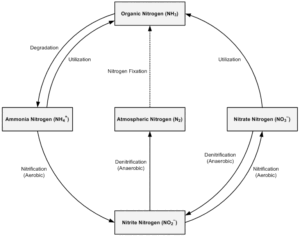
- Purpose: it is a natural way of regulating the amount of nitrogen in the soil and air.
- Source: the air is about four-fifths nitrogen gas, but crops cannot use the gas directly.
- Form used by crops: nitrates and ammonium compounds in the soil.
How is nitrogen added to the soil?
Nitrogen is added to the soil by fixation, decomposition and the application of manure or fertiliser.
- Symbiotic nitrogen fixation: bacteria in root nodules of legumes such as cowpea and groundnut fix nitrogen.
- Non-symbiotic nitrogen fixation: free-living bacteria in the soil fix nitrogen without a host plant.
- Electrical discharge: lightning during rainfall fixes nitrogen directly, and rain carries it into the soil.
- Decomposition of organic matter: dead plants and animals release nitrogen compounds.
- Application of organic manure: farmyard manure and compost return nitrogen to the soil.
- Application of nitrogen fertilisers: examples are urea and ammonium sulphate.
- Ammonification and nitrification: these change organic nitrogen into forms crops can absorb (see below).
How is nitrogen lost from the soil?
Nitrogen is lost from the soil through the following processes.
- Denitrification: bacteria change nitrates into nitrogen gas, mostly in waterlogged soil.
- Soil erosion: running water carries away topsoil and its nitrogen.
- Leaching: water washes nitrates down beyond the reach of roots.
- Bush burning: fire destroys plant residues and organic matter, and nitrogen escapes as gas.
- Crop removal: harvested crops carry away the nitrogen they absorbed.
- Volatilisation: ammonia escapes into the air from fertilisers and manure.
How is nitrate formed from organic matter?
Nitrate forms from organic matter in four steps.
- Putrefaction: microorganisms decay plant and animal remains into simpler nitrogenous compounds.
- Breakdown to amino compounds: the products of putrefaction are converted to simple amino compounds and amines.
- Ammonification: amino compounds and amines are converted into ammonium compounds.
- Nitrification: ammonium compounds are oxidised into nitrites and then nitrates.
What is the carbon cycle?
The carbon cycle is the series of processes which contribute to the circulation of carbon in nature.
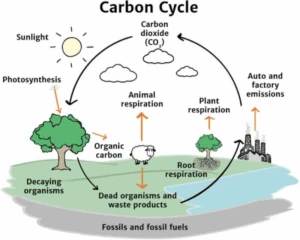
How does carbon move in nature?
- Removal from the air: carbon dioxide is removed mainly by photosynthesis.
- Loss from the soil: carbon is lost as carbonates of calcium and magnesium through leaching and drainage.
How does the atmosphere gain carbon dioxide?
- Burning of fuel: coal and wood release carbon dioxide.
- Volcanoes: volcanic action releases carbon dioxide.
- Respiration: plants and animals give out carbon dioxide.
- Decay: death, decay and putrefaction of plants and animals release carbon dioxide.
- Diffusion: carbon dioxide passes out of seas and other bodies of water.
What is the importance of the carbon cycle?
- Plants use carbon dioxide from the air to manufacture food during photosynthesis.
- It provides carbon, the essential building block of all organic matter.
- Organic matter, which is made from carbon, helps to replenish soil nutrients.
What is the water cycle?
The water cycle is the continuous movement of water from the atmosphere to the earth and from the earth to the atmosphere.
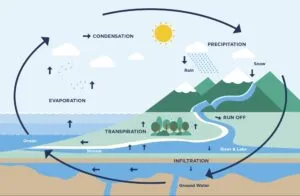
How does the atmosphere receive water?
- Evaporation: water vapour rises from oceans, rivers and land.
- Transpiration: plants lose water vapour through their leaves.
- Breathing and respiration: plants and animals give off water vapour.
How does the land receive water?
- Rainfall and precipitation: water vapour condenses into clouds and falls as rain.
- Infiltration and percolation: water enters the soil and moves down through it.
What are the forms of water in the soil?
Soil water exists in three forms: hygroscopic, capillary and gravitational water.
- Hygroscopic water: a thin film held tightly around soil particles, not available to plants.
- Capillary water: water held in the small pores between soil particles, the main source for plants.
- Gravitational water: water that drains down through the soil under gravity, beyond the roots.
What are the ways of conserving water in the soil?
Water is conserved in the soil by reducing water loss and improving the soil’s ability to hold water.
- Reducing run-off: stopping or slowing the flow of water over the surface.
- Adding humus or organic manure: organic matter helps soil hold water.
- Weeding: removing weeds reduces transpiration and water loss.
- Mulching: covering the soil with dry grass or leaves reduces evaporation.
- Cover cropping: low-growing crops shade the soil and slow run-off.
- Contour ridging: ridges made across a slope hold back running water.
- Appropriate tillage: correct cultivation lets water enter the soil.
- Strip cropping: alternate strips of different crops reduce run-off.
What is the importance of water to crops?
- Water provides the medium for the absorption of mineral salts.
- It carries nutrients to other parts of the plant.
- It is an essential raw material in photosynthesis.
- It makes enzyme activity possible in the protoplasm of crop plants.
- It is a constituent of protoplasm.
- It has a cooling effect on crops.
- It helps to sustain life.
- It helps in seed germination.
- It maintains plant turgor (turgidity).
Evaluation
- Name three macronutrients and three micronutrients.
- State two deficiency symptoms of nitrogen in crops.
- List three ways by which nitrogen is lost from the soil.
- State three ways by which the atmosphere gains carbon dioxide.
- List four ways of conserving water in the soil.
Assignment
Answer all the questions below.
- The conversion of nitrates to nitrogen gas by certain bacteria is ___ (a) oxidation (b) reduction (c) nitrification (d) denitrification
- Microbial decay of plant and animal remains into simpler nitrogenous compounds is ___ (a) nitrification (b) putrefaction (c) leaching (d) burning
- The washing away of soil nutrients down beyond the reach of the roots is called ___ (a) erosion (b) mulching (c) leaching (d) fertilisation
- The following are macronutrients except ___ (a) boron (b) nitrogen (c) magnesium (d) calcium
- Which of these is not a micronutrient? (a) copper (b) zinc (c) boron (d) potassium
- Differentiate between macronutrients and micronutrients.
- State three functions of nitrogen to plants.
This term's Agricultural Science topics
SS2 First Term · 7 topics
Get Agricultural Science as PDF and Word
Every week of SS2 Agricultural Science, First Term, formatted and ready to print. Ad-free, and the copy lock comes off.
Get this term Card, bank transfer, USSD or OPay
SS2 Agricultural Science Lesson Notes for Other Topics
Environmental Physiology
Read the full lesson note.

Surveying And Planning Of Farmstead
Read the full lesson note.
Irrigation And Drainage
Read the full lesson note.
Factors Affecting Nutrient Availability In The Soil
Read the full lesson note.
Environmental Factors Affecting Agricultural Productivity And Distribution
Read the full lesson note.

Surveying And Planning Of Farmstead II
Read the full lesson note.

Forest Management
Read the full lesson note.

Floriculture And Ornamental Plants
Read the full lesson note.

Diseases In Crops
Read the full lesson note.
General Effects Of Diseases On Crop Production
Read the full lesson note.
Pest Of Crops
Read the full lesson note.
Pasture, Forage Crops And Range Management
Read the full lesson note.

Common Weeds Found On The Farm
Read the full lesson note.

Crop Improvement
Read the full lesson note.

Basic Economic Principles - Law of Demand, Supply & Diminishing Returns
Read the full lesson note.
Lesson Notes for Other Classes

SS1 Lesson Note
The complete lesson note to guide your studies.

SS3 Lesson Note
The complete lesson note to guide your studies.
