
Common Weeds Found on the Farm – SS2 Agricultural Science Lesson Note (Third Term)
Download this term · ₦1,000Lesson note at a glance
- Subject
- Agricultural Science
- Class
- SS2
- Term
- Third Term
- Topic
- Common Weeds Found on the Farm
- Order
- Topic 1 of 7 this term
- Reading time
- 6 min
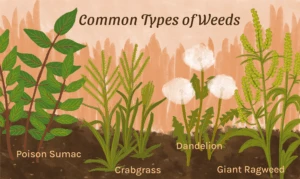
A weed is any plant that grows where it is not wanted.
Behavioural objectives
By the end of the lesson, students should be able to:
- define a weed and classify weeds by life cycle and leaf type;
- state the harmful effects and the benefits of weeds to farmers;
- describe the characteristics and growth habits of weeds;
- explain how weed seeds and fruits are dispersed;
- identify common weeds by their common and botanical names;
- describe the methods of weed control and give reasons why weeds are difficult to control.
What are the types of weeds?
Weeds are grouped by life cycle into annual, biennial and perennial weeds, and by leaf type into grasses, broadleaves and sedges.
Types of weeds by life cycle
- Annual weeds: complete their life cycle in one year or one season, as in goat weed and pigweed.
- Biennial weeds: complete their life cycle in two years, growing leaves in the first year and seeding in the second.
- Perennial weeds: live for many years and regrow from roots, stems or rhizomes, as in cogon grass, Bahama grass and elephant grass.
Types of weeds by leaf type
- Grasses: narrow leaves with parallel veins, as in guinea grass, carpet grass and cogon grass.
- Broadleaves: wide leaves with net-like veins, as in pigweed, tridax and goat weed.
- Sedges: grass-like weeds with solid, three-sided stems, as in purple nutsedge (Cyperus rotundus).
What are the harmful effects of weeds on the farm?
Weeds harm farmers by competing with crops and by lowering crop yield, quality and income.
- Competition for space: weeds crowd crops and reduce room for roots and shoots.
- Competition for sunlight: tall or fast-growing weeds shade young crops.
- Competition for nutrients: weeds take up mineral salts the crop needs.
- Competition for soil moisture: weeds absorb water, especially in the dry season.
- Competition for soil oxygen: weed roots use up oxygen in the soil.
- Harbouring pests and pathogens: weeds shelter insects and disease organisms that attack crops.
- Loss of yield: crops grow poorly, so harvests are smaller.
- Poor crop quality: weed seeds and debris mix with harvested produce.
- Lower income: smaller, poorer harvests and extra labour reduce a farmer’s profit.
- Reduced taste of some grasses: some weeds lower the palatability of pasture.
- Toxicity to farm animals: some weeds poison livestock that eat them.
How do weeds benefit farmers?
Some weeds are useful as food, medicine, mulch, manure and raw materials.
- Erosion control: weed cover holds the soil and checks soil erosion.
- Human food: some weeds are eaten as vegetables, as in waterleaf.
- Animal feed: some weeds serve as fodder for livestock.
- Medicine: certain weeds have medicinal value.
- Green manure: weeds ploughed into the soil add organic matter and nutrients.
- Craft materials: some weeds are used for making ropes, mats and baskets.
- Mulching: cut weeds cover the soil and reduce water loss.
- Compost making: weeds are added to compost heaps to make manure.
What are the characteristics and growth habits of weeds?
Weeds are fast-growing plants that reproduce in large numbers by seeds or vegetative parts.
- Many seeds: a single weed produces large quantities of seeds.
- Reproduction by seed: some weeds spread only through their seeds.
- Vegetative propagation: some weeds regrow from stem, root or rhizome pieces.
- Fast leaf growth: large leaves develop within a short time.
- Rainy season growth: weed growth is favoured by rain.
- Wind pollination: many weeds, especially grasses, are wind-pollinated.
- Much pollen: weeds produce a large quantity of pollen grains.
How are weed seeds and fruits dispersed?
Weed seeds and fruits are dispersed mainly by wind and animals, and also by water and explosive mechanisms.
Dispersal by wind
- Features: feathery, winged or powdery seeds that are light and float in air.
- Examples: tridax, goat weed, guinea grass, elephant grass and many other grasses.
Dispersal by animals
- Features: sticky, hooked, edible or colourful fruits or seeds.
- Sticky and hooked fruits: they cling to the coats of grazing animals and are carried to new places.
- Animal carriers: rabbits, rats, squirrels, antelope and man.
- Examples: pigweed and commelina species.
Dispersal by water
- Features: waterproof cuticles, air spaces within the fruit and light weight.
- Effect: the seeds float and are carried by streams, floods and run-off.
Dispersal by explosive mechanism
- How it works: the dry pod or capsule bursts open and throws the seeds away from the parent plant.
- Examples: waterleaf, centro, pueraria, calapo and mucuna.
What are the common weeds found on farms?
The table lists nineteen common weeds with their common and botanical names.
| SN | Common name | Botanical name |
|---|---|---|
| 1 | Guinea grass | Panicum maximum |
| 2 | Bahama grass | Cynodon dactylon |
| 3 | Carpet grass | Axonopus compressus |
| 4 | Cogon grass | Imperata cylindrica |
| 5 | Speargrass | Heteropogon contortus |
| 6 | Wild sunflower | Aspilia africana |
| 7 | Centro | Centrosema pubescens |
| 8 | Waterleaf | Talinum triangulare |
| 9 | Wire/sida weed | Sida acuta |
| 10 | Goat weed | Ageratum conyzoides |
| 11 | Elephant grass | Pennisetum purpureum |
| 12 | Giant star grass | Cynodon plectostachyus |
| 13 | Pigweed | Amaranthus spinosus |
| 14 | Tridax | Tridax procumbens |
| 15 | Calapo | Calopogonium mucunoides |
| 16 | Sunhemp | Crotalaria juncea |
| 17 | Mucuna | Mucuna utilis |
| 18 | Stylo | Stylosanthes gracilis |
| 19 | Northern gamba | Andropogon gayanus |
How are weeds controlled?
There are five methods of weed control: mechanical, physical, biological, cultural and chemical.
Mechanical control
- Meaning: the use of machines to get rid of unwanted plants.
- Examples: bulldozers, tree pullers and ploughs.
Physical or manual control
- Meaning: the removal of weeds by hand or with simple tools.
- Examples: hand pulling, hoeing and slashing with a cutlass.
Biological control
- Meaning: the introduction of insects and herbivorous animals to farmland.
- Effect: they eat the leaves of the weed, and in some cases the entire plant.
Cultural control
- Meaning: the use of farming practices to suppress weeds.
- Crop rotation: changing crops from season to season breaks the growth pattern of weeds.
- Cover crops: crops that spread over the soil and suppress weed growth.
- Other methods: flooding, bush burning and mulching.
Chemical control
- Meaning: the use of chemical solutions called herbicides to kill weeds.
- Selective herbicides: kill certain weeds without harming the crop, as in 2,4-D.
- Non-selective herbicides: kill all plants they reach, as in glyphosate.
Why are weeds difficult to control?
Weeds are difficult to control because they grow fast, reproduce in large numbers and survive for long periods.
- Vigorous growth: weeds are aggressive and persistent.
- High reproductive capacity: they produce many seeds.
- Long seed viability: seeds stay alive in the soil for many years.
- Long dormancy: seeds wait in the soil until conditions suit growth.
- Efficient dispersal: wind, animals, water and bursting pods spread seeds widely.
- Efficient propagation: broken stems, roots and rhizomes grow into new plants.
- Short life cycle: weeds mature and seed before they are removed.
Evaluation
- Define a weed.
- State four harmful effects of weeds on the farm.
- Name two weeds whose seeds are dispersed by wind.
- List the five methods of weed control.
- Give four reasons why weeds are difficult to control.
Assignment
Choose the correct option.
- A cowpea growing in a maize plot is a ________. A. plant B. weed C. crop D. animal
- Seeds of centro and calapo are usually dispersed by ________. A. wind B. water C. explosive mechanism D. animals
- Which of the following is not a cultural weed control method? A. flooding B. burning C. mulching D. hoeing
- Which of the following is not a physical method of weed control? A. hand pulling B. mulching C. hoeing D. slashing
- Weeds have a ________ life cycle. A. long B. medium C. short D. average
This term's Agricultural Science topics
SS2 Third Term · 7 topics
Get Agricultural Science as PDF and Word
Every week of SS2 Agricultural Science, Third Term, formatted and ready to print. Ad-free, and the copy lock comes off.
Get this term Card, bank transfer, USSD or OPay
SS2 Agricultural Science Lesson Notes for Other Topics

Crop Improvement
Read the full lesson note.

Basic Economic Principles - Law of Demand, Supply & Diminishing Returns
Read the full lesson note.

Farm Records
Read the full lesson note.
Agricultural Pollution
Read the full lesson note.

Farm Accounts
Read the full lesson note.

Animal Nutrition
Read the full lesson note.

Environmental Physiology
Read the full lesson note.

Surveying And Planning Of Farmstead
Read the full lesson note.
Irrigation And Drainage
Read the full lesson note.
Factors Affecting Nutrient Availability In The Soil
Read the full lesson note.
Environmental Factors Affecting Agricultural Productivity And Distribution
Read the full lesson note.
Plant Nutrient And Nutrient Cycle
Read the full lesson note.

Surveying And Planning Of Farmstead II
Read the full lesson note.

Forest Management
Read the full lesson note.

Floriculture And Ornamental Plants
Read the full lesson note.
Lesson Notes for Other Classes

SS1 Lesson Note
The complete lesson note to guide your studies.

SS3 Lesson Note
The complete lesson note to guide your studies.
