
Animal Nutrition – SS2 Agricultural Science Lesson Note (Third Term)
Download this term · ₦1,000Lesson note at a glance
- Subject
- Agricultural Science
- Class
- SS2
- Term
- Third Term
- Topic
- Animal Nutrition
- Order
- Topic 7 of 7 this term
- Reading time
- 9 min

Animal nutrition is the process by which an animal obtains the nutrients it needs for healthy growth and development.
Behavioural objectives
By the end of the lesson, students should be able to:
- state the importance of animal feeds;
- classify livestock feeds into concentrates, roughages, succulents and supplements, and give examples of each;
- describe hay, straw, soilage and silage;
- list the six classes of food nutrients of livestock with their sources and functions;
- state the deficiency diseases of some vitamins and minerals;
- explain diet, ration and balanced ration, and name the types of balanced ration.
Why are animal feeds important?
Animal feeds supply the nutrients an animal needs to live, grow and produce.
- Growth: feeds supply materials for building new body tissue.
- Repair: feeds replace worn-out tissue.
- Energy: feeds provide energy for movement and body activities.
- Well-being: feeds keep the animal healthy and comfortable.
- Disease resistance: well-fed animals resist diseases better.
- Maturity: good feeding influences how early an animal matures.
- Optimal production: feeds support the best output of meat, milk and eggs.
What is feed?
Feed is the food given to animals.
- Feeds contain nutrient elements, alone or combined with other substances.
- These nutrients support the healthy growth and development of livestock.
How are livestock feeds classified?
Livestock feeds are classified into four groups: concentrates, roughages, succulents and supplements.
- The classification is based on digestibility, quantity of fibre, quantity required and moisture in the feed.
- Concentrates are further split into carbohydrate concentrates and protein concentrates.
What are concentrates?
Concentrates are feeds with a low proportion of fibre and water that farm animals digest easily.
- Carbohydrate concentrates (basal or energy feed): high in carbohydrates, e.g. maize, guinea corn and cassava.
- Plant protein concentrates: high in protein, e.g. beans, peas, cottonseed, sunflower seeds and heads, groundnuts and palm kernel.
- Animal protein concentrates: high in protein, e.g. meat, blood meal, bone meal, fishmeal and milk.
What are roughages?
Roughages are feeds that are high in fibre and very low in protein and carbohydrates.
- Animals do not digest them easily.
- They are fed together with concentrates to young animals and to animals kept for milk and meat.
- Examples: hay, groundnut hulls, straw, bean pods and maize stover.
What are succulents?
Succulents are feeds with a high water content that are easy to digest.
- Soilage: freshly cut, lush grass and legume plants.
- Silage: preserved green forage.
- Others: pumpkin, melons and most green crops.
What are supplements?
Supplements are minerals and vitamins added to feed in small quantities.
- They are low in energy, protein and fibre but high in vitamins and minerals.
- They aid digestion and increase resistance to diseases.
- They are also present in basal and protein concentrate feeds.
- Other sources: bone meal, oyster shells and salt licks.
What are the characteristics of each class of feed?
Each class of feed differs in fibre, energy, protein, digestibility and mineral content.
| Feature | Basal feed (energy feed) | Protein concentrates | Mineral and vitamin supplements | Roughages |
|---|---|---|---|---|
| Crude fibre | Less than 18% | Less than 18% | Low | Greater than 18% |
| Energy (carbohydrates or fats) | High, starchy, e.g. maize and cassava | Low | Low | Low in digestible carbohydrates |
| Protein | Low | High | Low | Low |
| Digestibility | High | High | Not applicable | Poor or low |
| Minerals and vitamins | Low in minerals | Low in minerals | High | Not stated |
- Supplements: needed in small quantities, they supplement basal and protein concentrates.
- Supplements: they are necessary for growth and development, digestion and disease resistance.
- Roughages: pasture grasses and legumes form roughages.
What are the forms of roughage?
Roughages exist in four forms: hay, straw, silage and soilage.
- Hay: the aerial part of a young and succulent grass or herbage, cut and dried for feeding animals.
- Straw: the aerial part of grass or harvested crops, cut and stored for future use. It is difficult to digest.
- Soilage: fresh or succulent grass or legumes cut from the field and taken to the animals in their pens. The practice is called zero-grazing.
- Silage: green and succulent forage crops preserved under anaerobic conditions (without air).
Hay and straw are called dry roughages. The table below compares hay and silage.
| Point | Hay | Silage |
|---|---|---|
| Raw material | Young, succulent grass or herbage | Green, succulent forage crops |
| Method | Cut and dried | Preserved under anaerobic conditions |
| Moisture | Dry | Succulent |
| Class | Dry roughage | Succulent feed |
What are animal feed ingredients?
Animal feed ingredients are the raw materials used in the production of animal feeds.
- Blood meal: animal protein ingredient.
- Fish meal: animal protein ingredient.
- Bone meal: source of minerals and protein.
- Groundnut cake: plant protein ingredient.
- Palm kernel cake: plant protein and fat ingredient.
- Cottonseed meal: plant protein ingredient.
- Maize and guinea corn: energy ingredients.
What are the food nutrients of livestock?
There are six classes of food nutrients: carbohydrates, proteins, fats and oils, minerals, vitamins and water.
Carbohydrates
Carbohydrates are nutrients made up of carbon, hydrogen and oxygen.
Sources of carbohydrates
- Maize, guinea corn, wheat, rice and millet.
- Cassava, potato and yam.
- Grasses, hay and silage.
Function of carbohydrates
- They provide energy for growth, reproduction, milk production and other activities.
Proteins
Proteins are nutrients composed of carbon, hydrogen, oxygen and nitrogen, and sometimes sulfur and phosphorus.
Sources of protein
- Animal protein: fish meal, blood meal, meat meal, milk, earthworms and eggs.
- Plant protein: soybean meal, groundnut cake, palm kernel cake, cottonseed meal, sunflower seed meal, cashew nut meal and leguminous forage.
- Synthetic protein: methionine, lysine and cysteine.
Functions of protein
- They are essential for the growth of young animal tissue.
- They repair worn-out tissue.
- They are used in the formation of gametes in reproduction.
- They are needed for the production of enzymes.
- They are necessary for flesh build-up.
- They are essential for sustenance of life.
- They provide raw materials for protective coverings such as hair, nails, hoof, wool and feathers.
Fats and oils
Fats and oils are nutrients composed of carbon, hydrogen and oxygen.
Sources of fats and oils
- Palm oil, palm kernel cake, groundnut cake, coconut meal and cottonseed cake.
- Milk, lard and tallow.
Functions of fats and oils
- Fats provide more energy than carbohydrates for the same weight.
- They supply essential fatty acids and fat build-up.
- They provide fat-soluble vitamins.
- They improve the diet.
- They help in the maintenance of body temperature.
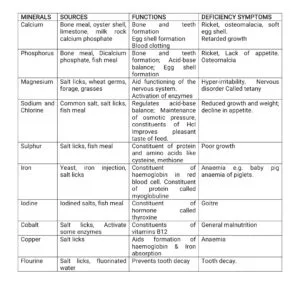
Minerals
Minerals are essential elements needed by the body but which the body cannot produce.
Minerals are grouped into two major classes:
- Structural elements: carbon, hydrogen, oxygen and nitrogen.
- Mineral elements: divided into macro-elements and trace elements.
- Macro-elements: needed in large quantities, e.g. calcium, phosphorus, magnesium, potassium, sulfur, sodium and chlorine.
- Trace elements (microelements): needed in small quantities, e.g. iodine, iron, cobalt, copper, manganese, zinc and fluorine.
Sources of minerals
- Bone meal, oyster shell, limestone and salt licks.
Functions of minerals
- They help to ensure good health and productivity.
- They are present in muscles for muscle contractions.
- They are constituents of milk, egg and meat.
- They help in the formation of hormones.
- They maintain the pH balance of body fluids.
- They prevent diseases.
- They regulate blood clotting.
- They help in bone and teeth formation.
- They prevent tooth decay.
Vitamins
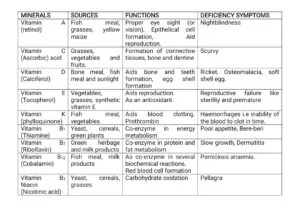
Vitamins are organic substances required by animals for proper growth and body development.
- Fat-soluble vitamins: dissolve in fat, e.g. A, D, E and K.
- Water-soluble vitamins: vitamin C and the B-complex, e.g. cobalamin, pantothenic acid and folic acid.
Water
Water is a nutrient that animals take in by drinking and through feed.
Sources of water
- Tap water, rain, rivers and ponds.
- Feed and fresh fodder.
Functions of water
- It is provided for drinking.
- It is used for metabolism and digestion of food.
- It is used for dipping or drenching animals against ectoparasites.
- It is used for washing or cleaning animals.
- It is used for sanitation and cleaning of floors and pens.
- It is used for processing animal products.
- It helps to maintain body temperature.
- It is used for irrigation of pasture.
- It helps to get rid of waste products in the body.
- It helps to maintain body turgidity.
What are the deficiency diseases of some nutrients?
A deficiency disease is an illness caused by a shortage of a nutrient in the diet.
| Nutrient lacking | Deficiency effect |
|---|---|
| Vitamin A | Night blindness (poor sight in dim light) |
| Vitamin D | Rickets (soft, weak or bent bones in young animals) |
| Vitamin K | Poor blood clotting |
| Calcium | Weak bones and teeth |
| Iodine | Goitre (swelling of the thyroid gland in the neck) |
| Iron | Anaemia |
What are diet, ration and balanced ration?
Diet, ration and balanced ration are terms used for the feed given to animals.
- Diet: the feed formulated to meet the specific needs of an animal, or the amount of feed regularly given to or eaten by animals.
- Diet (purpose): it meets specific metabolic or physiological functions such as growth, lactation, maintenance of pregnancy, reproduction or egg laying.
- Ration: the total supply of food given to an animal in twenty-four hours.
- Balanced ration: a feed containing all essential nutrients in the correct quantity and adequate proportion.
What are the types of balanced ration?
There are two types of balanced ration: maintenance ration and production ration.
- Maintenance ration: given to farm animals just to maintain the normal functioning of the body system.
- Production ration: given to farm animals to enable them to produce.
What factors decide the type of ration to feed an animal?
- Purpose: the reason the animal is kept.
- Age: the age of the animal.
- Health: the animal’s condition of health.
- Management: the management system in use.
- Physiological state: for example pregnancy or lactation.
Which farm animals need a production ration?
- Lactating animals: animals producing milk.
- Weaned animals: young animals taken off their mother’s milk.
- Pregnant animals: females carrying young.
- Fattening animals: animals being fed for meat.
- Broilers: birds raised for meat.
- Layers: birds raised for eggs.
- Animals being steamed up or flushed: females given extra feed before mating or late in pregnancy.
Evaluation
- State five reasons why animal feeds are important.
- Name the four groups of livestock feeds and give one example of each.
- Differentiate between hay and silage.
- Distinguish between macro-elements and trace elements, giving two examples of each.
- Define balanced ration and name its two types.
Assignment
Answer the following questions on nutrients and their deficiencies.
- ____ is essential for bone formation. A. iron B. calcium C. carbon
- Night blindness is a result of lack of vitamin ____. A. A B. B C. C D. D
- Rickets is a result of a deficiency of vitamin ____. A. A B. B C. C D. D
- Which of these is a micronutrient? A. calcium B. manganese C. magnesium D. sulfur
- Goitre is a result of deficiency of ____.
This term's Agricultural Science topics
SS2 Third Term · 7 topics
Get Agricultural Science as PDF and Word
Every week of SS2 Agricultural Science, Third Term, formatted and ready to print. Ad-free, and the copy lock comes off.
Get this term Card, bank transfer, USSD or OPay
SS2 Agricultural Science Lesson Notes for Other Topics

Common Weeds Found On The Farm
Read the full lesson note.

Crop Improvement
Read the full lesson note.

Basic Economic Principles - Law of Demand, Supply & Diminishing Returns
Read the full lesson note.
Farm Records
Read the full lesson note.
Agricultural Pollution
Read the full lesson note.

Farm Accounts
Read the full lesson note.
Environmental Physiology
Read the full lesson note.

Surveying And Planning Of Farmstead
Read the full lesson note.
Irrigation And Drainage
Read the full lesson note.
Factors Affecting Nutrient Availability In The Soil
Read the full lesson note.
Environmental Factors Affecting Agricultural Productivity And Distribution
Read the full lesson note.
Plant Nutrient And Nutrient Cycle
Read the full lesson note.

Surveying And Planning Of Farmstead II
Read the full lesson note.

Forest Management
Read the full lesson note.

Floriculture And Ornamental Plants
Read the full lesson note.
Lesson Notes for Other Classes

SS1 Lesson Note
The complete lesson note to guide your studies.

SS3 Lesson Note
The complete lesson note to guide your studies.
