
The Earth’s Structure – SS1 Geography Lesson Note (First Term)
Lesson note at a glance
- Class
- SS1
- Subject
- Geography
- Term
- First Term
- Reading time
- 5 min
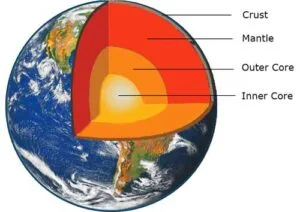
The structure of the earth is the arrangement of its layers. It is grouped into two zones: the outer structure (lithosphere, hydrosphere, atmosphere and biosphere) and the internal structure (crust, mantle and core).
Behavioural objectives
- Name the four layers of the outer structure of the earth and describe each one.
- State the importance of the lithosphere, hydrosphere, atmosphere and biosphere.
- List the gases that make up the atmosphere and their percentages.
- Name the three layers of the internal structure of the earth.
- Describe the crust, mantle and core, including their main minerals.
Key terms
- Layer: a zone of the earth with its own materials and features.
- Concentric: having the same centre, like rings drawn around one point.
- Mineral: a natural substance found in rocks, such as iron, silica and olivine.
- Density: how heavy a material is for its size. Denser layers lie deeper in the earth.
- Sphere: a round body or zone, used in the names of the earth’s layers.
What is the outer structure of the earth?
The outer structure is the set of four zones found on and above the earth’s surface: lithosphere, hydrosphere, atmosphere and biosphere.
| Layer | State | What it contains |
|---|---|---|
| Lithosphere | Solid | Rocks, soil and minerals |
| Hydrosphere | Liquid | Oceans, seas, rivers, lakes and springs |
| Atmosphere | Gaseous | Nitrogen, oxygen, carbon dioxide and rare gases |
| Biosphere | Living | Plants, animals and other living things |
What is the lithosphere?
The lithosphere is the solid portion of the earth, made of rocks and minerals.
- Position: the outermost zone of the earth.
- Make-up: rocks and mineral materials.
- Extent: it represents about 30% of the earth’s surface.
- Examples: mountains, hills, plateaus, plains and valleys, such as the Jos Plateau in Nigeria.
Why is the lithosphere important?
- Settlement: it forms the basis for all human settlement.
- Minerals: all mineral resources are obtained from it, such as tin, limestone and coal.
- Transport: roads, railways and airports are built on it.
- Farming: crops grow in its soil.
- Other activities: mining and trading take place on it.
What is the hydrosphere?
The hydrosphere is the liquid portion of the earth, made up of all its water bodies.
- Make-up: oceans, seas, rivers, streams, springs and lakes.
- Extent: it covers about 70% of the earth’s surface.
- Nigerian examples: River Niger, River Benue and Lake Chad.
Why is the hydrosphere important?
- Domestic use: water for drinking, cooking and washing.
- Transport: a medium for moving people and goods by boat and ship.
- Industry: water for industrial uses.
- Food: fish, prawns and other water life.
- Employment: fishing, boat-making and shipping give people jobs.
- Tourism: beaches and lakes serve as tourist centres.
- Power: falling water generates hydro-electric power (HEP), as at Kainji Dam on the River Niger.
What is the atmosphere?
The atmosphere is the gaseous portion of the earth, the layer of air around it.
- Make-up: a mixture of gases, shown in the table below.
| Gas | Percentage |
|---|---|
| Nitrogen | 78% |
| Oxygen | 21% |
| Carbon dioxide | 0.03% |
| Rare gases | 0.97% |
Why is the atmosphere important?
- Habitat: some living organisms, such as birds, live in it.
- Respiration: it supplies oxygen for breathing.
- Photosynthesis: it supplies carbon dioxide for green plants.
- Combustion: it supplies oxygen for burning.
- Transport: it is the medium for air transport.
- Nitrogen: nitrogen from the air is changed into forms plants use to make protein.
What is the biosphere?
The biosphere is the zone of the earth where living things are found.
- Position: it overlaps the lithosphere, hydrosphere and atmosphere.
- Examples: forests, farms, rivers with fish, and the air where birds fly.
Why is the biosphere important?
- Food: plants provide food for man.
- Employment: farming, fishing and forestry give people work.
- Raw materials: it provides timber, cotton, rubber and similar materials.
- Air balance: it balances and purifies the atmosphere.
What is the internal structure of the earth?
The internal structure is made up of three concentric layers, from the outside to the centre:
- The crust (also called the lithosphere)
- The mantle (also called the mesosphere)
- The core (also called the barysphere)
What is the crust?
The crust is the thin, solid outer layer of the earth’s interior.
- Division: it is subdivided into an upper crust and a lower crust.
- Upper crust: made of granite rocks, and it forms the continents.
- SIAL: the main minerals of the upper crust are silica and aluminium. Its average density is 2.7.
- Lower crust: made of basalt rocks, and it forms the ocean floor.
- SIMA: the lower crust contains silica, iron and magnesium. Its average density is 3.0.
What is the mantle?
The mantle is the thick layer lying just beneath the crust.
- Thickness: about 2900 km.
- Density: 3.3.
- Main mineral: olivine.
- State: plastic and semi-liquid.
What is the core?
The core is the innermost and densest layer of the earth.
- Size: about 3500 km in radius.
- NIFE: it contains two minerals, nickel (Ni) and iron (Fe).
- Temperature: the hottest part of the earth, at several thousand degrees Celsius.
- State: molten.
How do the three internal layers compare?
| Layer | Other name | Main materials | Features |
|---|---|---|---|
| Crust | Lithosphere | Granite (SIAL) and basalt (SIMA) | Density 2.7 to 3.0; forms continents and ocean floor |
| Mantle | Mesosphere | Olivine | About 2900 km thick; density 3.3; semi-liquid |
| Core | Barysphere | Nickel and iron (NIFE) | About 3500 km radius; molten |
What is the difference between the outer and internal structure?
- Outer structure: the zones on and above the surface that we can see and live in.
- Internal structure: the layers inside the earth, studied through rocks, mining and earthquake waves.
| Point | Outer structure | Internal structure |
|---|---|---|
| Number of layers | Four | Three |
| Layers | Lithosphere, hydrosphere, atmosphere, biosphere | Crust, mantle, core |
| Position | On and above the surface | Below the surface |
| Main interest | Human life and activities | Rock types, minerals and density |
Evaluation
- Name the four layers of the outer structure of the earth.
- State four uses of the hydrosphere.
- List the gases in the atmosphere and give the percentage of each.
- What are SIAL, SIMA and NIFE, and in which layers of the earth are they found?
- Name the three layers of the internal structure and state one other name for each.
Assignment
Draw the internal structure of the earth. Label the crust, mantle and core, and write the main minerals of each layer.
This term's Geography topics
SS1 First Term · 9 topics
SS1 Geography Lesson Notes for Other Topics
Geography: An Introduction
Read the full lesson note.

The Earth's Rotation
Read the full lesson note.
The Earth's Revolution
Read the full lesson note.

Latitude & Longitude
Read the full lesson note.

Rocks
Read the full lesson note.

Mountains
Read the full lesson note.

Lowlands
Read the full lesson note.
The Environment - Ecosystem & Its Component
Read the full lesson note.
Nigeria: Location And Position
Read the full lesson note.
Physical Setting Of Nigeria: Relief And Drainage
Read the full lesson note.

The Nigerian Climate
Read the full lesson note.
Nigeria Vegetation
Read the full lesson note.
Nigerian Population
Read the full lesson note.
Nigeria Resources
Read the full lesson note.
Agriculture in Nigeria
Read the full lesson note.
Lesson Notes for Other Classes

SS2 Lesson Note
The complete lesson note to guide your studies.

SS3 Lesson Note
The complete lesson note to guide your studies.
