
The Earth’s Rotation – SS1 Geography Lesson Note (First Term)
Lesson note at a glance
- Class
- SS1
- Subject
- Geography
- Term
- First Term
- Reading time
- 6 min
The rotation of the earth is the spinning of the earth on its axis from west to east. The earth turns through 360° in 24 hours, which makes one day. It rotates through 15° in one hour, or 1° in four minutes. Its effects include day and night and differences in local time.
Behavioural objectives
By the end of the lesson, students should be able to:
- describe the shape and size of the earth;
- give proofs that the earth is spherical;
- explain what the rotation of the earth means;
- state the speed of the earth’s rotation in degrees per hour;
- explain the effects of the earth’s rotation;
- calculate simple time differences between places using longitude.
What are the shape and size of the earth?
What is the shape of the earth?
The earth is a sphere that is slightly flattened at the poles, a shape called a geoid.
- Looks flat: the ground seems flat only because we see a very small part of a very large earth.
- Flattened poles: the earth bulges a little at the equator and is slightly flattened at the North and South Poles.
- Proofs: many facts show that the earth is nearly spherical (see the next section).
What is the size of the earth?
The earth is the fifth largest planet in the solar system.
- Surface area: about 510 million square kilometres (197 million square miles).
- Equatorial diameter: about 12,756 km.
- Polar diameter: about 12,714 km.
- Equatorial circumference: about 40,075 km.
- Polar circumference: about 40,008 km.
- Mean density: about 5.5 grams per cubic centimetre.
What are the proofs that the earth is spherical?
There are seven common proofs that the earth is spherical, listed below.
- Circumnavigation of the earth: Ferdinand Magellan’s expedition sailed around the world between 1519 and 1522 and returned to its starting point. Others have done so since. On a flat earth, they would have reached an edge.
- Sunrise and sunset: Places have sunrise and sunset at different times. On a flat earth, the sun would rise and set at the same time everywhere. Places in the east see the sun before places in the west.
- Aerial photographs: Photographs taken from high above the earth, for example from rockets and satellites, show a round earth. This is the most recent proof.
- The lunar eclipse: During a lunar eclipse, the earth casts a circular shadow on the moon. Only a sphere always casts a circular shadow.
- Ships’ visibility: An approaching ship shows its mast first, then the hull. A ship leaving a harbour disappears in the reverse order. On a flat earth, the whole ship would appear and vanish at once.
- Shape of other heavenly bodies: The sun, moon and planets look round from every angle. So the earth is likely to be round too.
- Experimental proof (surveyors’ poles): Three poles of equal length are driven to the same depth in level ground along a line. The centre pole projects slightly above the other two because of the earth’s curvature.
How does the earth move?
The earth makes two movements: rotation and revolution.
- Rotation: the earth spins on its axis and turns its different sides to the sun.
- Revolution: the earth travels around the sun in a fixed path called an orbit.
- Sunrise and sunset: when a place turns into the sun’s light, we say the sun is rising. When it turns out of the light, we say the sun is setting.
What is the rotation of the earth?
The rotation of the earth is the movement of the earth on its axis from west to east.
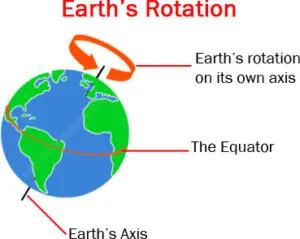
- Axis: an imaginary line through the North Pole and the South Pole, around which the earth spins.
- Direction: west to east.
- One rotation: 360° in 24 hours, which makes one day.
- Speed in degrees: 360° ÷ 24 hours = 15° in 1 hour.
- Time for 1°: 60 minutes ÷ 15 = 4 minutes.
What is the difference between rotation and revolution?
Rotation is the earth’s spin on its axis. Revolution is the earth’s movement around the sun.
| Point | Rotation | Revolution |
|---|---|---|
| Movement | Spinning on its axis | Moving around the sun in an orbit |
| Time taken | 24 hours (one day) | About 365¼ days (one year) |
| Main effects | Day and night, time differences, deflection of winds | Change of seasons, length of the year |
What are the effects of the earth’s rotation?
The earth’s rotation causes day and night, differences in local time, apparent sunrise and sunset, deflection of winds and currents, and the timing of tides.
Day and night
- Day: the half of the earth facing the sun receives its rays and has daylight.
- Night: the half facing away from the sun is dark.
- Change: because the earth keeps turning, day and night follow each other every 24 hours.
Differences in local time
- Eastward: local time is ahead by 1 hour for every 15° of longitude.
- Westward: local time is behind by 1 hour for every 15° of longitude.
- Reason: places in the east meet the sun earlier because the earth turns from west to east.
To find the time at another place:
- Find the difference in longitude between the two places.
- Divide the difference by 15 to get the hours (or multiply by 4 to get minutes).
- Add the time if the place is east. Subtract the time if the place is west.
- Example 1: it is 12 noon at Greenwich (0°). At 45°E, the difference is 45° ÷ 15 = 3 hours, so the time is 3:00 pm.
- Example 2: at 30°W, the difference is 30° ÷ 15 = 2 hours, so the time is 10:00 am.
Apparent sunrise and sunset
- Sunrise: the part of the earth turning into the sun’s rays.
- Sunset: the part of the earth turning away from the sun’s rays.
- Apparent: the sun seems to move across the sky, but it is the earth that is turning.
Deflection of winds and ocean currents
- Northern hemisphere: moving winds and ocean currents are deflected to the right.
- Southern hemisphere: they are deflected to the left.
Timing of tides
- Tide: the regular rising and falling of the water level in seas and oceans.
- Main cause: the pull of the moon and the sun on the earth’s waters.
- Role of rotation: as the earth turns, a coast passes through high tide and low tide, so most coasts have two high tides each day.
Evaluation
- State three proofs that the earth is spherical.
- Through how many degrees does the earth rotate in one hour?
- Explain how the earth’s rotation causes day and night.
- In which direction are winds deflected in the northern hemisphere?
- It is 12 noon at Greenwich. What is the time at 60°E?
Assignment
Explain the term earth rotation, mention three effects of the earth’s rotation, and complete this sentence: the earth rotates on its own ______.
This term's Geography topics
SS1 First Term · 9 topics
SS1 Geography Lesson Notes for Other Topics

Geography: An Introduction
Read the full lesson note.
The Earth's Revolution
Read the full lesson note.

Latitude & Longitude
Read the full lesson note.

The Earth's Structure
Read the full lesson note.

Rocks
Read the full lesson note.

Mountains
Read the full lesson note.

Lowlands
Read the full lesson note.

The Environment - Ecosystem & Its Component
Read the full lesson note.
Nigeria: Location And Position
Read the full lesson note.

Physical Setting Of Nigeria: Relief And Drainage
Read the full lesson note.

The Nigerian Climate
Read the full lesson note.

Nigeria Vegetation
Read the full lesson note.

Nigerian Population
Read the full lesson note.

Nigeria Resources
Read the full lesson note.

Agriculture in Nigeria
Read the full lesson note.
Lesson Notes for Other Classes

SS2 Lesson Note
The complete lesson note to guide your studies.

SS3 Lesson Note
The complete lesson note to guide your studies.
