
Geography: An Introduction – SS1 Geography Lesson Note (First Term)
Lesson note at a glance
- Class
- SS1
- Subject
- Geography
- Term
- First Term
- Reading time
- 4 min
Geography is the study and description of the earth, its surface features, and the relationship between people and their environment.
Behavioural objectives
- Explain the meaning of geography.
- State the origin of the word geography.
- Describe the scope of geography.
- Distinguish between physical geography and human geography.
- List the values (importance) of geography.
What is geography?
Geography is the social science that describes the earth and studies how people and their environment affect each other.
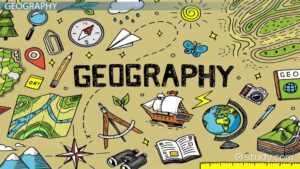
- Description of the earth: geography describes the surface of the earth and its features.
- Man and environment: it also studies how people and their surroundings affect each other.
- People, activities and places: it studies people, what they do, the places they live in and the physical things around them.
- Social science: it deals with man, his activities and his environment.
What is the origin of the word geography?
The word geography comes from two Greek words, geo and graph, which together mean “description of the earth”.
- Geo: a Greek word meaning the earth.
- Graph: a Greek word meaning description.
- Geography: the two parts together give “description of the earth”.
What does geography study?
Geography studies physical things, people and their activities, and the peoples of the world.
Physical things
- Landforms: plains, valleys and mountains, such as the Jos Plateau.
- Water bodies: rivers and oceans, such as the River Niger and the Atlantic Ocean.
- Weather and climate: rainfall, temperature and wind.
- Soils: the different types of soil and where they are found.
- Vegetation: forests, savanna and other plant cover.
People and their activities
- Agriculture: farming of crops and rearing of animals.
- Mining: removal of minerals from the earth.
- Trading: buying and selling of goods.
- Fishing: catching fish from rivers, lakes and the sea.
- Manufacturing: making raw materials into finished goods.
- Construction: building of houses, roads and bridges.
Peoples of the world
- Occupations: the work people do in different places.
- Culture: the way of life of a people.
- Dressing: the clothes people wear in different regions.
- Religion: the beliefs and worship of different groups.
What are the two main branches of geography?
There are two main branches of geography: physical geography and human geography.
Physical geography
- Meaning: the study of the natural features of the earth.
- Focus: things nature made, such as landforms, rivers, climate, soils and vegetation.
Human geography
- Meaning: the study of people and their activities on the earth.
- Focus: how people live and work, such as farming, mining, trade, settlement, population and culture.
Difference between physical and human geography
| Branch | Meaning | Examples of topics |
|---|---|---|
| Physical geography | Study of the natural features of the earth | Landforms, rivers, climate, soils, vegetation |
| Human geography | Study of people and their activities on the earth | Farming, mining, trade, settlement, population, culture |
What is the scope of geography?
The scope of geography is the range of things the subject covers, from the earth in space to human activities in different places.
- The earth and heavenly bodies: the size, shape and movement of the earth and other bodies in space.
- Landmass: continents, islands and other land areas.
- Bodies of water: oceans, seas, rivers and lakes.
- Climate: the average weather of a place over a long time.
- Vegetation: the plant cover of different areas.
- Events in different places: things that happen in various parts of the world.
- Spatial distribution: how animals, natural resources and human activities are spread over the earth.
How does geography link with other subjects?
Geography shares topics with Economics, Agricultural Science, Government and History.
| Subject | Link with geography |
|---|---|
| Economics | Resources, trade and production in different places |
| Agricultural Science | Soils and climate that affect crops and animals |
| Government | States, boundaries and population of countries |
| History | Places where past events happened |
What is the value of geography?
The value of geography is that it helps people understand their environment, other peoples and the world of work.
- Understanding our environment: it helps man understand his surroundings better.
- Problems and solutions: it raises issues, problems and solutions that matter to modern society.
- Knowledge of other peoples: it lets us study the ways of people in other parts of the world.
- Planning roles: a trained geographer can serve in politics and the socio-economic sector, for example in economic, rural or regional planning.
- Support for other subjects: it helps us understand related topics in physics, chemistry, biology, economics, history and mathematics.
- Understanding physical things: it explains vegetation, climate, rivers, soil, oceans and mountains.
- Career choice: it prepares us for careers that earn a living.
What careers are linked to geography?
Careers linked to geography include teaching, planning, surveying, map making and weather forecasting.
- Geography teacher: teaches the subject in schools.
- Town or regional planner: plans the use of land and services.
- Surveyor: measures land and marks boundaries.
- Cartographer: draws maps.
- Meteorologist: studies and forecasts weather.
Evaluation
- What does the word Geography mean, and which language does it come from?
- Name four human activities studied in Geography.
- State three things that the scope of geography covers.
- Give four reasons why geography is important.
- Distinguish between physical geography and human geography, with two examples of topics each.
Assignment
List five physical features studied in Geography and explain, in your own words, how geography helps us to understand our environment.
This term's Geography topics
SS1 First Term · 9 topics
SS1 Geography Lesson Notes for Other Topics

The Earth's Rotation
Read the full lesson note.
The Earth's Revolution
Read the full lesson note.

Latitude & Longitude
Read the full lesson note.

The Earth's Structure
Read the full lesson note.
Rocks
Read the full lesson note.

Mountains
Read the full lesson note.
Lowlands
Read the full lesson note.
The Environment - Ecosystem & Its Component
Read the full lesson note.
Nigeria: Location And Position
Read the full lesson note.
Physical Setting Of Nigeria: Relief And Drainage
Read the full lesson note.

The Nigerian Climate
Read the full lesson note.
Nigeria Vegetation
Read the full lesson note.
Nigerian Population
Read the full lesson note.
Nigeria Resources
Read the full lesson note.
Agriculture in Nigeria
Read the full lesson note.
Lesson Notes for Other Classes
SS2 Lesson Note
The complete lesson note to guide your studies.

SS3 Lesson Note
The complete lesson note to guide your studies.
