
The Earth’s Revolution – SS1 Geography Lesson Note (First Term)
Lesson note at a glance
- Class
- SS1
- Subject
- Geography
- Term
- First Term
- Reading time
- 6 min
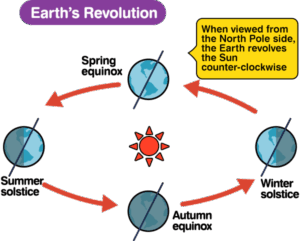
Revolution is the movement of one body around another in a fixed path, as the earth moves around the sun once in about 365¼ days.
Behavioural objectives
- Define revolution.
- State the time the earth takes to revolve around the sun.
- Explain what a leap year is and why it occurs.
- Distinguish between a solar eclipse and a lunar eclipse.
- Explain how revolution and the tilt of the earth’s axis cause the seasons.
- State the effects of the earth’s revolution.
What is revolution?
Revolution is the movement of one body around another in a fixed path.
- Orbit: the path a body follows as it revolves. The earth’s orbit is slightly oval (elliptical).
- Earth’s revolution: the movement of the earth in its orbit around the sun once in about 365¼ days, which is one year.
- Moon’s revolution: the moon revolves around the earth once in about a month.
- Earth and moon together: they travel round the sun as a pair and complete one trip in a year.
- Direction: the earth moves round the sun from west to east, the same direction in which it rotates.
- Perihelion: the point in the orbit where the earth is nearest the sun, in early January.
- Aphelion: the point in the orbit where the earth is farthest from the sun, in early July.
What is the difference between rotation and revolution?
Rotation is the spinning of the earth on its own axis, while revolution is the movement of the earth around the sun.
- Rotation: the earth turns once on its axis in about 24 hours, giving day and night.
- Revolution: the earth goes once round the sun in about 365¼ days, giving the year.
| Point | Rotation | Revolution |
|---|---|---|
| Meaning | The earth spins on its own axis. | The earth moves around the sun. |
| Time taken | About 24 hours. | About 365¼ days. |
| Main result | Day and night. | Seasons, leap years and changing day length. |
What is a leap year?
A leap year is a year of 366 days, which usually occurs every fourth year.
- Ordinary year: a year with 365 days.
- Extra day: 29 February is the added day in a leap year, so February has 29 days.
- Examples: 2020 and 2024 are leap years.
- Simple rule: a year that divides exactly by 4 is a leap year.
- Century years: a year such as 1900 is a leap year only if it divides exactly by 400. So 2000 was a leap year, but 1900 was not.
Why do we need a leap year?
- The earth takes about 365¼ days to go round the sun.
- The calendar counts only 365 days in an ordinary year.
- The left-over quarter day adds up to about one full day in four years.
- One day is added to February every fourth year to keep the calendar in step with the seasons.
How do eclipses occur?
An eclipse occurs when the sun, the earth and the moon are in a straight line, so that one body’s shadow falls on another.
There are two kinds of eclipse seen from the earth: the solar eclipse and the lunar eclipse.
What is a solar eclipse?
- Meaning: an eclipse of the sun, when the moon passes between the earth and the sun.
- Effect: the moon’s shadow falls on part of the earth and blocks the sun’s light.
- Moon phase: it happens at new moon.
- Visibility: only a small part of the earth sees it.
What is a lunar eclipse?
- Meaning: an eclipse of the moon, when the earth passes between the sun and the moon.
- Effect: the earth’s shadow falls on the moon.
- Moon phase: it happens at full moon.
- Visibility: it can be seen wherever the moon is above the horizon.
Solar eclipse and lunar eclipse compared
| Eclipse | Position of the bodies | What happens |
|---|---|---|
| Eclipse of the sun (solar eclipse) | The moon is between the earth and the sun. | The moon’s shadow falls on part of the earth and blocks the sun’s light. |
| Eclipse of the moon (lunar eclipse) | The earth is between the sun and the moon. | The earth’s shadow falls on the moon. |
- Not every month: the moon’s orbit is tilted to the earth’s orbit, so the three bodies seldom line up exactly.
- Safety: never look straight at the sun during a solar eclipse.
How does revolution cause the seasons?
Seasons are caused by the earth’s revolution together with the tilt of its axis.
- Tilted axis: the earth’s axis is tilted at 23½° from the vertical to its orbit (66½° to the plane of the orbit).
- Fixed direction: the axis keeps pointing the same way as the earth moves round the sun.
- Unequal heating: as the earth moves, first the northern and then the southern hemisphere leans towards the sun.
- Result: the amount of sunlight and heat each place receives changes through the year, giving the seasons.
- Not distance: the seasons come from the tilt, not from the earth being nearer to or farther from the sun.
What are equinoxes and solstices?
- Equinox: a time when day and night are about equal (12 hours each) everywhere, with the sun overhead at the Equator.
- Solstice: a time when the sun is overhead at one of the tropics, giving the longest day in one hemisphere and the shortest in the other.
| Event | Approximate date | Mid-day sun overhead at |
|---|---|---|
| March equinox | 21 March | The Equator |
| June solstice | 21 June | Tropic of Cancer (23½°N) |
| September equinox | 23 September | The Equator |
| December solstice | 22 December | Tropic of Capricorn (23½°S) |
What are the effects of the earth’s revolution?
The effects of the earth’s revolution are the year, the seasons, changing mid-day sun, changing day length, seasonal temperature changes and leap years.
- It determines a year. The time a planet takes to go once round the sun is one year on that planet. One year on earth is 365¼ days.
- It determines the seasons. The seasons differ between the tropical and temperate belts (see below).
- Changes in the altitude of the mid-day sun. These changes are seen in the equinoxes and solstices.
- Varying length of day and night. The length of day and night changes with the earth’s position in its orbit.
- Changes in seasonal temperature. In the Arctic region, summers are short and cool with very long daylight, while winters are cold and dark.
- Leap years. The extra quarter day in each year makes a leap year necessary.
What are the seasons in the tropical belt?
The tropical belt has two seasons: the rainy season and the dry season.
- Rainy season: the wet part of the year, as in Nigeria.
- Dry season: the dry part of the year, which includes the harmattan in Nigeria.
- Day length: places in the tropics, such as Nigeria, have little change in day length through the year.
What are the seasons in the temperate belt?
The temperate belt has four seasons: spring, summer, autumn and winter.
| Season | Months in the Northern Hemisphere |
|---|---|
| Spring | March to May |
| Summer | June to August |
| Autumn | September to November |
| Winter | December to February |
- Southern Hemisphere: the seasons are reversed. It is summer there when it is winter in the north.
Evaluation
- Define revolution.
- How long does the earth take to complete one revolution around the sun?
- What is a leap year, and how many days does it have?
- Name the type of eclipse that occurs when the moon is between the earth and the sun.
- State two differences between rotation and revolution.
Assignment
- Explain the earth’s revolution and state four of its effects.
This term's Geography topics
SS1 First Term · 9 topics
SS1 Geography Lesson Notes for Other Topics
Geography: An Introduction
Read the full lesson note.

The Earth's Rotation
Read the full lesson note.

Latitude & Longitude
Read the full lesson note.

The Earth's Structure
Read the full lesson note.

Rocks
Read the full lesson note.

Mountains
Read the full lesson note.
Lowlands
Read the full lesson note.
The Environment - Ecosystem & Its Component
Read the full lesson note.
Nigeria: Location And Position
Read the full lesson note.

Physical Setting Of Nigeria: Relief And Drainage
Read the full lesson note.

The Nigerian Climate
Read the full lesson note.
Nigeria Vegetation
Read the full lesson note.
Nigerian Population
Read the full lesson note.
Nigeria Resources
Read the full lesson note.
Agriculture in Nigeria
Read the full lesson note.
Lesson Notes for Other Classes
SS2 Lesson Note
The complete lesson note to guide your studies.

SS3 Lesson Note
The complete lesson note to guide your studies.
