
Settlement – SS2 Geography Lesson Note (Second Term)
Lesson note at a glance
- Class
- SS2
- Subject
- Geography
- Term
- Second Term
- Reading time
- 6 min
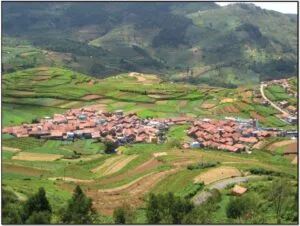
A settlement is a place where people live in one or more buildings, such as a compound, village, town or city.
Behavioural objectives
By the end of the lesson, students should be able to:
- define a settlement and state the conditions that favour its siting;
- list the factors that affect the growth of a settlement;
- distinguish between rural and urban settlements and name their types and functions;
- describe the dispersed, linear and nucleated patterns of settlement;
- explain what a confluence town is, with examples.
What conditions favour the siting of a settlement?
Five conditions favour the siting of a settlement: water, fertile soil, low well-drained land, good communication and defence.
- Adequate water supply: people need water for drinking, cooking, farming and washing.
- Fertile soil: good soil supports crop farming and a steady food supply.
- Low and well-drained land: flat land is easy to build on and does not flood.
- Good communication network: roads, rivers and paths link the settlement to other places.
- Defence or protection: hills, rivers and forests protect people from enemies and danger.
What factors affect the growth of a settlement?
The growth of a settlement depends on factors that attract people and lead finally to urbanisation.
- Accessibility: roads, rail and air transport bring people, goods and services.
- Economic activities: trading, farming and mining give people jobs and income.
- Good administration: a seat of government attracts offices, workers and services.
- Social amenities: pipe-borne water, electricity, schools and hospitals attract settlers.
- Good soil: fertile soil encourages intensive agriculture.
- Absence of disaster: places free from flood, erosion and similar hazards keep their people.
- Political stability: peace encourages people to live and invest in the place.
- Relief and drainage: gentle slopes and well-drained land make building easy.
- Favourable climate: a pleasant climate supports farming and comfortable living.
What are the types of settlement?
There are two types of settlement: rural settlements and urban settlements.
What is a rural settlement?
A rural settlement is a relatively small settlement whose people know one another very well.
- Population: socially homogeneous, with the same culture and language.
- Size: a few buildings, with people ranging from one family to a few hundred.
- Activities: primary activities such as farming, fishing, hunting and lumbering.
- Lifestyle: simple, with few social amenities.
- Pattern: may be nucleated, dispersed or linear.

What are the types of rural settlement?
There are three types of rural settlement: homestead, hamlet and village.
- Homestead: a family residence. Homesteads form dispersed settlements separated by bushes called buffer zones.
- Hamlet: a small nucleated settlement of a few houses, smaller than a village.
- Village: a large nucleated rural settlement formed from several hamlets, with hundreds or a thousand people and limited services.
What are the functions of a rural (village) settlement?
A village performs mainly agricultural and other primary functions.
- Agricultural function: growing crops and keeping animals.
- Lumbering function: cutting trees for timber and firewood.
- Fishing function: fishing in nearby rivers, lakes or the sea.
- Small-scale shopping: petty shops and local markets.
- Religious function: local churches, mosques and shrines.
What is an urban settlement?
An urban settlement is a large, densely populated settlement whose people do not know one another very well.
- Population: socially heterogeneous, with different cultures and languages.
- Size: many buildings with thousands of people.
- Activities: mainly secondary and tertiary activities such as manufacturing, construction and banking.
- Amenities: abundant social amenities.
- Pattern: nucleated.

What are the types of urban settlement?
There are four types of urban settlement: town, city, conurbation and megalopolis.
- Town: a settlement with several thousands of people.
- City: a large town with more people and services than an ordinary town.
- Conurbation: several towns joined together, where each town still keeps its identity.
- Megalopolis: the largest urban settlement, formed when large cities join into one huge urban area of several millions of people.
What are the functions of an urban settlement?
An urban settlement performs industrial, commercial, administrative, socio-cultural, mining and residential functions.
- Industrial: manufacturing industries.
- Commercial: markets, banks and shopping malls.
- Administrative: seats of government, such as state and federal capitals.
- Socio-cultural: universities, churches, mosques and cinemas.
- Mining: towns that grow around mineral extraction.
- Residential: places where many people live.
What is the difference between rural and urban settlements?
A rural settlement is small, farming-based and has few amenities. An urban settlement is large, densely populated and offers many amenities and non-farming jobs.
| Feature | Rural settlement | Urban settlement |
|---|---|---|
| Size | Small | Large |
| Population | One family to a few hundred | Thousands to millions |
| People | Homogeneous, know one another | Heterogeneous, do not know one another well |
| Main activities | Primary | Secondary and tertiary |
| Social amenities | Few | Abundant |
| Pattern | Nucleated, dispersed or linear | Nucleated |
What are the patterns of settlement?
The pattern of a settlement is the arrangement of its buildings, and there are three patterns: dispersed, linear and nucleated.
What is a dispersed settlement?
A dispersed settlement is one in which buildings are scattered and far apart from one another.
- Spacing: individual buildings are widely spaced, with family parcels of land behind them.
- Amenities: few, because the settlement is rural.
- Activities: mainly primary, such as farming and lumbering.
- Lifestyle: quiet.
- Conflict: less conflict among families, because each family is far from the others.
What is a linear settlement?
A linear settlement is one in which buildings are arranged along a route such as a road, railway or river.
- Location: buildings line the route.
- Layout: gardens lie behind the houses, and farmlands may lie behind the gardens.
- Length: may extend for several kilometres.
- Nodal town: forms where two or more routes meet.
- Confluence town: forms where two rivers meet.
What is a confluence town?
A confluence town is a settlement that grows where two rivers meet.
- Lokoja (Nigeria): built where the River Niger and the River Benue meet.
- Khartoum (Sudan): built where the Blue Nile and the White Nile meet.
Why do linear settlements form?
- Transport: the need to be close to a transport network.
- Accessibility: easy access to other areas.
- Markets: the need to carry farm produce to markets.
What is a nucleated settlement?
A nucleated settlement is one in which buildings are close together in a small area.
- Spacing: buildings are concentrated in a small area.
- Amenities: many social amenities.
- Type: a feature of urban settlement.
- Activities: mainly secondary and tertiary, such as manufacturing and construction.
- Roads: the area is well connected by roads.
- Farmland: lies outside the settlement.
- Interaction: a very high level among inhabitants.
Why do nucleated settlements form?
- Social ties: the wish to keep people together.
- Infrastructure: roads and amenities are easy to provide.
- Defence: people are safer in a group.
- Communication: people reach one another easily.
- Commerce: trade develops where many people live close together.
- Leadership: it supports a well-defined leadership structure.
Evaluation
- Define a settlement.
- List four favourable conditions for siting a settlement.
- State four characteristics of an urban settlement.
- Name the three patterns of settlement.
- What is a confluence town? Give one example in Nigeria.
Assignment
Choose a town or village you know. State whether it is rural or urban and name its pattern. Give two reasons it was sited there and two functions it performs.
This term's Geography topics
SS2 Second Term · 9 topics
SS2 Geography Lesson Notes for Other Topics
Environmental Conservation
Read the full lesson note.
Transportation In Nigeria
Read the full lesson note.

Manufacturing Companies In Nigeria
Read the full lesson note.

Commercial Activities In Nigeria
Read the full lesson note.

World Population I
Read the full lesson note.
World Population II
Read the full lesson note.
Soil
Read the full lesson note.
Geo- Political Issues (Land Reclamation)
Read the full lesson note.

Action Of Running Water
Read the full lesson note.

Action Of Wind
Read the full lesson note.

Glacial Action
Read the full lesson note.

Action Of Wave
Read the full lesson note.
Climate & Climate Classification
Read the full lesson note.
Climate & Climate Classification II
Read the full lesson note.

Vegetation
Read the full lesson note.
Lesson Notes for Other Classes

SS1 Lesson Note
The complete lesson note to guide your studies.

SS3 Lesson Note
The complete lesson note to guide your studies.
