
Volcanicity – SS3 Geography Lesson Note (First Term)
Download this term · ₦1,000Lesson note at a glance
- Subject
- Geography
- Class
- SS3
- Term
- First Term
- Topic
- Volcanicity
- Order
- Topic 1 of 10 this term
- Reading time
- 5 min
Volcanicity is the set of geological processes that lead to the formation and eruption of volcanoes. Magma forms in the Earth’s mantle, rises through the crust, collects in a magma chamber and is expelled through a vent. Volcanicity produces intrusive and extrusive features and affects people and their environment.
Behavioural objectives
By the end of the lesson, students should be able to:
- Explain the meaning and processes of volcanicity.
- Identify regions of volcanic occurrence and explain why such regions are associated with earthquakes.
- Describe the characteristics and forms of intrusive and extrusive features of volcanicity.
- Analyse the effects of volcanicity on man and his environment.
Instructional techniques
- Identification
- Explanation
- Questions and answers
- Demonstration
- Videos from the source
Instructional materials
- Videos
- Loudspeaker
- Textbook
- Pictures
What is volcanicity?
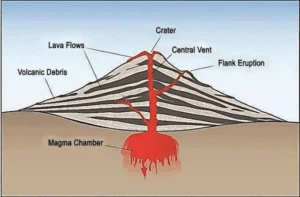
Volcanicity refers to the geological processes related to the formation and eruption of volcanoes. It involves the movement of molten rock (magma) from the Earth’s mantle to the surface, resulting in volcanic activity.
What are the processes of volcanicity?
The major processes of volcanicity are:
- Magma generation: Magma, a molten mixture of rock, gases and minerals, is formed within the Earth’s mantle due to heat and pressure.
- Magma ascent: The magma rises through the Earth’s crust, driven by buoyancy and pressure. It can move through cracks, fissures or existing volcanic conduits.
- Magma chamber: The magma accumulates in a reservoir beneath the Earth’s surface known as a magma chamber. This chamber acts as a temporary storage for magma before eruption.
- Volcanic eruption: When the pressure in the magma chamber exceeds the strength of the overlying rocks, a volcanic eruption occurs. Magma, gases and volcanic ash are expelled onto the Earth’s surface through a vent or opening in the crust.
Where does volcanic activity occur?
Volcanic activity is prevalent in specific regions. Some notable areas include the Pacific Ring of Fire, which encircles the Pacific Ocean, and the East African Rift. Iceland, Indonesia and parts of Italy, such as Mount Vesuvius, are also known for frequent volcanic activity.
Why are volcanic regions associated with earthquakes?
The association between volcanic occurrences and earthquakes is primarily due to the dynamic nature of tectonic plate movements. The same geological forces that lead to magma generation and volcanic eruptions can also induce stress and strain on the Earth’s crust, resulting in earthquakes.
What are the intrusive features of volcanicity?
Intrusive features form when magma cools and solidifies beneath the Earth’s surface. The main forms are:
- Batholiths: Batholiths are large, intrusive igneous rock masses that form deep within the Earth’s crust. They represent the most massive and deeply seated type of intrusive rock bodies. Batholiths form from the cooling and solidification of magma beneath the Earth’s surface over extended periods, typically millions of years.
- Dikes: Dikes are tabular, sheet-like intrusive igneous rock formations that cut across existing rock layers vertically. They are formed by the intrusion of magma into pre-existing fractures and weaknesses in the Earth’s crust. Dikes are often associated with volcanic activity.
- Sills: Sills are tabular, sheet-like intrusive igneous rock formations that parallel the existing rock layers. Like dikes, sills form through the intrusion of magma, but in this case the magma spreads horizontally between existing rock layers.
What are the extrusive features of volcanicity?
Extrusive features form when material from an eruption settles on the Earth’s surface. The main forms are:
- Volcanic cones: Volcanic cones, also known as stratovolcanoes or composite volcanoes, are conical-shaped mountains formed by the accumulation of erupted materials such as lava, ash and volcanic rocks. These cones typically result from explosive eruptions that involve both lava flows and pyroclastic materials. The alternating layers of lava and pyroclastic deposits give them their characteristic cone shape.
- Lava plateaus: Lava plateaus are large, flat areas covered with solidified lava flows. They result from extensive volcanic activity that leads to the accumulation of successive lava layers. Lava plateaus form when fluid basaltic lava erupts from fissures or vents, spreading over a wide area and creating a thick layer of solidified basalt.
- Pyroclastic deposits: Pyroclastic deposits consist of fragmented volcanic materials ejected during explosive volcanic eruptions. These materials include ash, pumice, volcanic bombs and lapilli. They form when magma is fragmented into fine particles during explosive eruptions, and these particles are then transported and deposited by volcanic processes.
What are the effects of volcanicity on man and his environment?
Beneficial effects
- Volcanic soils are often rich in minerals, making them fertile for agriculture. Regions around volcanic areas may benefit from enhanced soil fertility, supporting crop growth.
- Volcanic landscapes attract tourists, contributing to local economies. Volcanic features such as craters, lava fields and hot springs can be popular attractions.
- Volcanic regions often have geothermal resources, providing a sustainable and clean source of energy for power generation and heating.
Harmful effects
- Volcanic eruptions can pose threats to human settlements, destroying infrastructure, homes and farmland.
- Volcanic ash and gases released during eruptions can pose health risks. Inhalation of volcanic ash can cause respiratory problems, and exposure to volcanic gases may be harmful.
- Eruptions can lead to economic disruptions by damaging agriculture, disrupting transportation and causing the evacuation of populated areas.
- Large volcanic eruptions can release significant amounts of ash and gases into the atmosphere, affecting global climate.
Evaluation
- What is volcanicity?
- Describe the processes of volcanicity.
- Identify the characteristics of intrusive and extrusive features of volcanicity.
- Mention five effects of volcanicity on man and his environment.
Assignment
- Explain why regions of volcanic activity are also associated with earthquakes.
- State two differences between dikes and sills.
This term's Geography topics
SS3 First Term · 10 topics
Get Geography as PDF and Word
Every week of SS3 Geography, First Term, formatted and ready to print. Ad-free, and the copy lock comes off.
Get this term Card, bank transfer, USSD or OPay
SS3 Geography Lesson Notes for Other Topics
Karst (Limestone) Topography
Read the full lesson note.

Denudational Processes
Read the full lesson note.
Weathering
Read the full lesson note.

Mass Movements
Read the full lesson note.
Climatic Change
Read the full lesson note.

ECOWAS
Read the full lesson note.

World Trade
Read the full lesson note.

Tourism
Read the full lesson note.

Satellite Remote Sensing
Read the full lesson note.

GIS Application
Read the full lesson note.

Bush Fallowing in West Africa
Read the full lesson note.

Mining in Africa (Copper, Gold, and Petroleum)
Read the full lesson note.

Principle of Elementary Surveying
Read the full lesson note.

Representation of Relief Form
Read the full lesson note.

Map Readings
Read the full lesson note.
Lesson Notes for Other Classes

SS1 Lesson Note
The complete lesson note to guide your studies.

SS2 Lesson Note
The complete lesson note to guide your studies.
