
Mass Movements – SS3 Geography Lesson Note (First Term)
Lesson note at a glance
- Class
- SS3
- Subject
- Geography
- Term
- First Term
- Reading time
- 6 min
Mass movement is the downslope movement of soil, rock and debris under the influence of gravity.
Behavioural objectives
By the end of the lesson, students should be able to:
- Explain the concept of mass movements.
- Identify the types of mass movements.
- Describe the processes involved in the different types of mass movements.
- State the causes of mass movements.
- Analyse the effects of mass movements on people.
Instructional techniques and materials
Instructional techniques
- Identification
- Explanation
- Questions and answers
- Demonstration
- Videos
Instructional materials
- Videos
- Loudspeaker
- Textbook
- Pictures
What is mass movement?
Mass movement is the transfer of soil, rock and debris from higher ground to lower ground, driven by gravity.
- Gravity: the force that pulls all earth materials downslope.
- Slope: the inclined ground along which the material moves.
- Regolith: the loose layer of soil and broken rock that covers solid rock.
- Debris: loose broken rock, soil and plant material.
- Speed: it can be slow, over many years, or rapid, in seconds or minutes.
- Agent: unlike river or wind erosion, mass movement does not need a moving agent to carry the material.
What causes mass movements?
Mass movements happen when the pull of gravity on a slope becomes greater than the strength holding the material in place.
- Steep slopes: the steeper the slope, the stronger the downslope pull.
- Heavy rainfall: water makes soil heavier and reduces the grip between particles.
- Saturation of soil: waterlogged soil loses stability and slides easily.
- Weathering: it breaks rock and weakens it along cracks and joints.
- Earthquakes and volcanic activity: shaking loosens rock and soil.
- Removal of vegetation: without roots to bind the soil, the slope is weaker.
- Human activities: quarrying, mining, road cuttings and building on slopes make slopes unstable.
What are the types of mass movements?
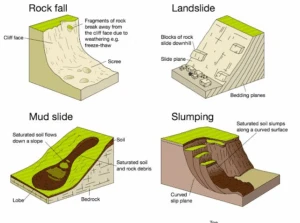
There are four main types of mass movement: landslides, rock avalanches, soil creep and slumps.
Landslides
A landslide is the movement of rock, soil and debris down a slope.
- Triggers: heavy rainfall, earthquakes, volcanic activity or human activities.
- Speed: from slow and gradual to rapid and destructive.
- Scale: from small local events to large events that change the landscape.
Rock avalanches
A rock avalanche is the rapid, chaotic descent of a large volume of rock material.
- Source: a massive amount of rock detaches from a mountain or cliff.
- Triggers: earthquakes, volcanic activity or human activities.
Soil creep
Soil creep is the slow, continuous downslope movement of soil and regolith.
- Movement: individual soil particles are displaced a little at a time.
- Cause: expansion and contraction of the soil, mainly from temperature changes.
- Visibility: hard to notice in a short time, but the landscape changes over many years.
Slumps
A slump is the rapid movement of a mass of rock or soil along a curved slip surface.
- Slip surface: concave (curved), unlike slides that move along a flat plane.
- Trigger: saturation of the soil, which reduces its stability.
- Result: the material tilts or rotates, leaving distinct features on the slope.
What is the difference between slow and rapid mass movements?
A slow mass movement moves a few particles at a time over a long period, while a rapid mass movement moves a large mass at once.
- Slow movement: soil creep is the example, with almost no sudden damage.
- Rapid movement: landslides, rock avalanches and slumps are examples, and they can cause sudden disasters.
| Feature | Slow movement | Rapid movement |
|---|---|---|
| Example | Soil creep | Landslides, rock avalanches, slumps |
| Speed | Very slow, hardly noticed | Fast, sudden |
| Material moved | Fine soil and regolith | Large masses of rock, soil and debris |
| Danger to people | Low and gradual | High, often with loss of life |
What processes are involved in the different types of mass movements?
Each type of mass movement has its own process, which depends on the material, the slope and the trigger.
- Rockfalls: individual rocks detach because of weathering or seismic activity, then fall or bounce downslope.
- Rockslides: blocks of rock move as a unit, often along existing fractures, sliding downslope.
- Debris flows: a rapid downslope movement of soil, rock and water, often triggered by heavy rainfall or rapid snowmelt.
- Rock avalanches: a swift, chaotic descent of large volumes of rock, triggered by earthquakes, volcanic eruptions or oversteepening of rock slopes.
- Creep: slow, continuous movement of soil and regolith, caused by expansion and contraction of soil particles.
- Slumps: rapid movement along a curved slip surface, started by saturation of the soil.
How does soil creep happen?
- The soil expands when it is heated or wetted.
- Particles are pushed slightly outward from the slope surface.
- The soil contracts when it cools or dries.
- Gravity pulls the particles straight down, so each lands a little lower on the slope.
- The cycle repeats many times, giving a slow downslope movement.
- Signs of creep: leaning fence posts and electric poles, bent tree trunks and cracked walls.
How does a slump happen?
- Heavy rain saturates the soil on a slope.
- The water adds weight and reduces the strength of the material.
- A curved slip surface forms inside the slope.
- The mass slides down and rotates along this curved surface.
- A step-like scar is left at the top and a bulge forms at the bottom.
How does a landslide happen?
- The slope becomes unstable through steepness, weathering, saturation or loss of vegetation.
- A trigger such as heavy rainfall, an earthquake or human activity acts on the slope.
- The pull of gravity becomes greater than the strength of the material.
- The mass breaks away and moves downslope.
- The material settles at the foot of the slope.
What are the effects of mass movements on people?
Mass movements harm people through loss of life, damage to property, loss of income and damage to the environment.
- Loss of lives: rapid movements such as landslides and mudflows can kill people.
- Damage to property: homes and farmland can be badly damaged or buried.
- Forced relocation: communities in prone areas may have to move because of destroyed homes and the risk of future hazards.
- Damage to infrastructure: roads, bridges and other structures may be destroyed, which blocks transport and access to affected areas.
- Economic loss: there are costs of rebuilding, loss of livelihoods and disruption of local economies.
- Environmental degradation: ecosystems, water quality and biodiversity are affected.
- Reduced farm productivity: soil erosion, loss of topsoil and disruption of farming lower crop yields.
Evaluation
- What is mass movement?
- Mention and discuss the types of mass movement.
- Discuss five processes that take place in mass movement.
- Mention five effects of mass movement on people.
Classwork: Answer the evaluation questions.
Assignment
Explain soil creep and slumps, and state three effects of mass movements on people.
This term's Geography topics
SS3 First Term · 10 topics
SS3 Geography Lesson Notes for Other Topics
Volcanicity
Read the full lesson note.
Karst (Limestone) Topography
Read the full lesson note.

Denudational Processes
Read the full lesson note.
Weathering
Read the full lesson note.

Climatic Change
Read the full lesson note.
ECOWAS
Read the full lesson note.

World Trade
Read the full lesson note.

Tourism
Read the full lesson note.

Satellite Remote Sensing
Read the full lesson note.

GIS Application
Read the full lesson note.

Bush Fallowing in West Africa
Read the full lesson note.

Mining in Africa (Copper, Gold, and Petroleum)
Read the full lesson note.

Principle of Elementary Surveying
Read the full lesson note.
Representation of Relief Form
Read the full lesson note.
Map Readings
Read the full lesson note.
Lesson Notes for Other Classes

SS1 Lesson Note
The complete lesson note to guide your studies.

SS2 Lesson Note
The complete lesson note to guide your studies.
