
Grammar: Revises Tenses, Words for the Week 1 – SS2 English Lesson Note (Third Term)
Download this term · ₦1,000Lesson note at a glance
- Subject
- English Studies
- Class
- SS2
- Term
- Third Term
- Topic
- Grammar: Revises Tenses, Words for the Week 1
- Order
- Topic 1 of 10 this term
- Reading time
- 3 min
Tense shows the time of the verb in a sentence, that is, whether an action, event or state is in the past, present or future. English has three main tenses: present, past and future. The present tense expresses habitual actions and facts, the past tense expresses completed actions, and the future tense expresses actions expected to happen.
Behavioural objectives
By the end of the lesson, students should be able to:
- explain what tense is;
- name the three main tenses in English;
- state when each tense is used;
- give correct examples of the present, past and future tenses.
What is tense?
We use tense to indicate the time of verbs in a sentence. In other words, tense shows what time the verb of the sentence refers to. It may show whether an action, event or state is in the past, present or future. Consider these conversations:
A: Where does she live?
B: She lives with relatives close to her workplace.
C: She is presently living with her aunt close by.
In speaking or writing, the rules governing tenses have to do with paying particular attention to the verb sequence of your clauses and sentences to determine when an action takes place. For instance, an action in the future obviously cannot happen before an action in the past. The past must come before the present, and the present before the future.
For example:
- The man was begging because he had nothing left.
- The robbers absconded after robbing the neighbourhood.
What are the three main tenses?
There are three main verb tenses in English: the present tense, the past tense and the future tense.
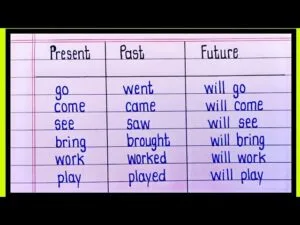
Present tense
The present tense is mostly used to express habitual actions, that is, actions that happened in the past, may be happening now and will happen in the future. It also expresses statements of fact. For example:
- Dogs eat.
- Oil floats on water.
- The sun rises in the east and sets in the west.
Past tense
The past tense shows that an action happened in the past and was completed in the past. It is also used to describe a past habitual event that is no longer occurring. For example:
- The dogs ate his bones.
- The plane left Lagos airport at eleven o’clock last Friday.
- She broke her wrist during her gymnastic training.
Future tense
The future tense is used to express an action that is expected to happen in the future. It is often introduced by the auxiliary verbs will, may, shall and so on. For example:
- Now that you have a large firm, you will need
- I will see you at school tomorrow.
- I may decide to come over to your place next week.
Words for the week
- Acronym
- Troupe
- Socialism
- Ardour
- Professionalism
- Behemoth
- Calumny
- Compliment
- Indigent
- Dissemble
Evaluation
- What is tense?
- Name the three main tenses in English.
- Which tense is used for statements of fact? Give one example.
- Which tense is used in the sentence “She broke her wrist during her gymnastic training”?
- Which auxiliary verbs often introduce the future tense?
Assignment
Write down five more examples of each tense discussed today.
This term's English Studies topics
SS2 Third Term · 10 topics
- Grammar: Revises Tenses, Words for the Week 1
- Grammar, Writing, Vocabulary Development, Words for the Week 2
- Grammar, Summary, Vocabulary Development, Words for the Week 3
- Grammar, Oral, Writing, Words for the Week 4
- Oral, Comprehension , Grammar, Words for the Week 5
- Structure, Writing, Vocabulary Development, Words for the Week 6
- Oral, Structure, Comprehension , Writing, Words of the Week 8
- Structure, Writing , Vocabulary Development, Words of the Week 9
- Structure, Comprehension, Vocabulary Development, Words for the Week 10
- Oral, Structure, Vocabulary Development, Words for the Week 11
Get English Studies as PDF and Word
Every week of SS2 English Studies, Third Term, formatted and ready to print. Ad-free, and the copy lock comes off.
Get this term Card, bank transfer, USSD or OPay
Third Term English Studies Lesson Notes for Other Topics
Figures of Speech
Read the full lesson note.
Activities on Comprehension Passage
Read the full lesson note.

Vocabulary Development
Read the full lesson note.
Turning Similes to Metaphors in Sentences
Read the full lesson note.
Comprehension: Where There Is No Doctor
Read the full lesson note.

Polar Questions
Read the full lesson note.

Composition: Expository Essay
Read the full lesson note.
Literature
Read the full lesson note.

Comprehension
Read the full lesson note.
Composition
Read the full lesson note.
Vocabulary
Read the full lesson note.
Vocabulary Development
Read the full lesson note.
Vocabulary Development
Read the full lesson note.

Comprehension
Read the full lesson note.

Comprehension: Currency
Read the full lesson note.
Lesson Notes for Other Classes

Basic 1 Lesson Note
The complete lesson note to guide your studies.

Basic 2 Lesson Note
The complete lesson note to guide your studies.

Basic 3 Lesson Note
The complete lesson note to guide your studies.

Basic 4 Lesson Note
The complete lesson note to guide your studies.

Basic 5 Lesson Note
The complete lesson note to guide your studies.

Basic 6 Lesson Note
The complete lesson note to guide your studies.
