
Structure, Writing, Vocabulary Development, Words for the Week 6 – SS2 English Lesson Note (Third Term)
Lesson note at a glance
- Class
- SS2
- Subject
- English Studies
- Term
- Third Term
- Reading time
- 4 min
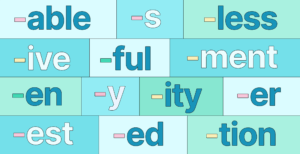
Affixation is the addition of prefixes, suffixes and infixes to words to form new words, meanings and word classes.
Behavioural objectives
By the end of the lesson, students should be able to:
- explain what affixation is;
- form new words from verbs by adding suffixes such as -ment, -ion, -ation, -age, -ist, -er/-or and -ee;
- form new words from adjectives by adding suffixes such as -ness, -ity, -hood, -ance/-ence and -ancy/-ency;
- use the ten words for the week correctly in sentences.
What is a suffix?
A suffix is a group of letters added to the end of a word to form a new word.
- Prefix: added to the beginning of a word, as in un- in unkind.
- Suffix: added to the end of a word, as in -ness in kindness.
- Infix: placed inside a word. It is rare in English.
- Base word: the word before any affix is added, such as “employ” in employee.
- Nominalisation: forming a noun from a verb or an adjective, such as achieve to achievement.
This lesson deals with suffixes. Most of them change verbs and adjectives into nouns.
Which suffixes are added to verbs?
Many suffixes added to verbs form nouns that name an action, a result, a person or a place.
| Suffix | Usual meaning | Examples (base word to new word) |
|---|---|---|
| -ment | action or result | enslave to enslavement, achieve to achievement, manage to management, move to movement, develop to development |
| -ion | action or state | act to action, conclude to conclusion, decide to decision |
| -ation | action or result | organise to organisation, document to documentation, mobilise to mobilisation |
| -age | action, result or amount | marry to marriage, drain to drainage, carry to carriage |
| -ist | person who does or supports something | type to typist, separate to separatist |
| -er / -or | person who does the action | teach to teacher, debate to debater, direct to director, oppress to oppressor |
| -ee | person who receives or experiences the action | amputate to amputee, employ to employee, invite to invitee |
| -ive | describing quality (usually an adjective) | correct to corrective, cure to curative |
| -ant | person who does the action | attend to attendant, appeal to appellant |
| -ing | action or thing | clone to cloning, house to housing |
| -ry, -ery, -ary | place or practice | brew to brewery, refine to refinery, cook to cookery, dispense to dispensary |
Doer and receiver
- Employer: the person who gives the job.
- Employee: the person who receives the job.
- Invitee: the person who is invited.
Which suffixes are added to adjectives?
Suffixes added to adjectives form nouns that name a state or quality.
| Suffix | Usual meaning | Examples (adjective to noun) |
|---|---|---|
| -ness | state or quality | useful to usefulness, useless to uselessness, dry to dryness, conscious to consciousness, responsive to responsiveness, sad to sadness, ill to illness |
| -ity | quality or condition | ethnic to ethnicity, public to publicity |
| -hood | state or condition | false to falsehood |
| -ance / -ence | state or quality | important to importance, different to difference |
| -ancy / -ency | state or quality | flippant to flippancy, efficient to efficiency |
What spelling changes happen when a suffix is added?
Some base words change their spelling when a suffix is added.
- Silent e kept: manage to management, achieve to achievement.
- Silent e dropped: organise to organisation, refine to refinery.
- y changes to i: marry to marriage, happy to happiness.
- Word changes more: decide to decision, conclude to conclusion.
- -ant and -ent: important to importance, different to difference.
- Check the dictionary: use it when you are not sure of the spelling.
What are the words for the week?
The ten words for the week are consigned, repentant, sagacity, wrath, patent, paragon, rancid, sedentary, verdant and councillor.
| Word | Word class | Meaning | Example sentence |
|---|---|---|---|
| Consigned | verb (past form) | handed over or sent to a place or state | The old files were consigned to the store. |
| Repentant | adjective | sorry for doing wrong | The repentant boy apologised to his teacher. |
| Sagacity | noun | wisdom and good judgement | The chief settled the dispute with great sagacity. |
| Wrath | noun | very strong anger | The king’s wrath fell on the thieves. |
| Patent | adjective | obvious, plain to see | It was patent that she had not read the book. |
| Patent | noun | official right to make or sell an invention | The inventor applied for a patent. |
| Paragon | noun | a perfect example of a quality | She is a paragon of honesty. |
| Rancid | adjective | having a bad smell or taste because it is stale | The rancid oil spoiled the soup. |
| Sedentary | adjective | involving much sitting and little movement | A sedentary life can harm your health. |
| Verdant | adjective | green with grass or plants | The verdant farmland stretched to the river. |
| Councillor | noun | an elected member of a council | The councillor visited the market. |
Words often confused
- Councillor: a member of a council, such as a local government council.
- Counsellor: a person who gives advice or guidance, such as a school counsellor.
Evaluation
- What is affixation?
- Add a suitable suffix to each word to form a noun: employ, debate, drain, useful, efficient.
- Name the suffix in each of these words: management, marriage, typist, falsehood.
- Give the noun formed from the adjective “responsive”.
- Use “sagacity” and “rancid” in sentences of your own.
Assignment
Write six nominalisations (nouns formed from verbs or adjectives) using two suffixes from this lesson. Then use each of the ten words for the week in a sentence.
This term's English Studies topics
SS2 Third Term · 10 topics
- Grammar: Revises Tenses, Words for the Week 1
- Grammar, Writing, Vocabulary Development, Words for the Week 2
- Grammar, Summary, Vocabulary Development, Words for the Week 3
- Grammar, Oral, Writing, Words for the Week 4
- Oral, Comprehension , Grammar, Words for the Week 5
- Structure, Writing, Vocabulary Development, Words for the Week 6
- Oral, Structure, Comprehension , Writing, Words of the Week 8
- Structure, Writing , Vocabulary Development, Words of the Week 9
- Structure, Comprehension, Vocabulary Development, Words for the Week 10
- Oral, Structure, Vocabulary Development, Words for the Week 11
SS2 English Studies Lesson Notes for Other Topics
Grammar: Revises Tenses, Words For The Week 1
Read the full lesson note.
Grammar, Writing, Vocabulary Development, Words For The Week 2
Read the full lesson note.

Grammar, Summary, Vocabulary Development, Words For The Week 3
Read the full lesson note.

Grammar, Oral, Writing, Words For The Week 4
Read the full lesson note.

Oral, Comprehension ,Grammar, Words For The Week 5
Read the full lesson note.

Oral, Structure, Comprehension , Writing, Words Of The Week 8
Read the full lesson note.

Structure, Writing , Vocabulary Development, Words Of The Week 9
Read the full lesson note.
Structure, Comprehension, Vocabulary Development, Words For The Week 10
Read the full lesson note.

Oral, Structure, Vocabulary Development, Words For The Week 11
Read the full lesson note.
Structure: The Use Of Possesive Apostrophe
Read the full lesson note.
Structure: Punctuation Marks
Read the full lesson note.
Vocabulary Development: Words Associated With Press
Read the full lesson note.

Oral: Intonation
Read the full lesson note.
Structure: Sentences Types
Read the full lesson note.
Oral: Falling Tone Statements
Read the full lesson note.
Lesson Notes for Other Classes

SS1 Lesson Note
The complete lesson note to guide your studies.
SS3 Lesson Note
The complete lesson note to guide your studies.
