
Grammar, Summary, Vocabulary Development, Words for the Week 3 – SS2 English Lesson Note (Third Term)
Lesson note at a glance
- Class
- SS2
- Subject
- English Studies
- Term
- Third Term
- Reading time
- 4 min
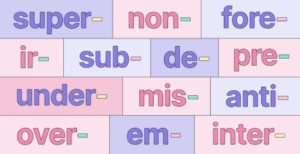
Affixation is the way of forming new words by adding a letter or group of letters to the beginning or end of a word.
Behavioural objectives
By the end of the lesson, students should be able to:
- explain what an affix and a prefix are;
- state the meanings of common prefixes such as anti-, un-, mono-, re- and bi-;
- use prefixes to form antonyms of given words;
- give the meanings of words associated with industries;
- use the words for the week correctly in sentences.
What is affixation?
Affixation is a major source of word formation in English, in which an affix is added to a root word.
- Affix: a letter or group of letters added to the beginning or end of a word to change its meaning or use.
- Root word: the base word to which an affix is added, such as happy in unhappy.
- Forms of affixation: affixation occurs in two forms, the prefix and the suffix.
What is the difference between a prefix and a suffix?
- Prefix: an affix placed before a root word, as in unkind.
- Suffix: an affix placed after a root word, as in kindness.
| Point | Prefix | Suffix |
|---|---|---|
| Position | Before the root word | After the root word |
| Effect on word class | Usually does not change it | Often changes it |
| Example | dis + obey = disobey | care + less = careless |
What is a prefix?
A prefix is a letter or group of letters placed before a root word to modify its meaning.
- Word class: a prefix usually does not change the word class (part of speech) of the root word.
- Examples of prefixes: dis-, out-, un-, non-, mis-, il-, im-, bi-, extra-, super-, mal-, fore-, poly-, mono-, under-.
- Use: knowing what a prefix means helps you understand the word to which it is added.
What do some common prefixes mean?
Each prefix carries its own meaning, which it adds to the root word.
| Prefix | Meaning | Example |
|---|---|---|
| Anti- | against | anti-social |
| Un- | not | unhappy |
| Mono- | one | monotone |
| Re- | back or again | return, rewrite |
| Bi- | two | bicycle |
| Mis- | wrongly | misspell |
| Poly- | many | polygon |
| Fore- | before | foretell |
| Super- | above or beyond | supernatural |
Which prefixes form antonyms?
Some prefixes have a negative meaning and form the antonym (opposite) of the root word.
| Prefix | Word | Antonym |
|---|---|---|
| Un- | lawful | unlawful |
| Il- | legal | illegal |
| Ir- | regular | irregular |
| Im- | possible | impossible |
| In- | equality | inequality |
| Dis- | advantage | disadvantage |
| Non- | profit | non-profit |
How do you choose the right negative prefix?
- Il- before l: legal becomes illegal, logical becomes illogical.
- Ir- before r: regular becomes irregular, responsible becomes irresponsible.
- Im- before m, b or p: possible becomes impossible, modest becomes immodest.
- Un-, dis- and non-: no fixed rule, so learn each word, as in unkind, disobey and non-stop.
- Check a dictionary: a root word takes only one correct negative prefix.
Vocabulary development: what are the words associated with industries?
Industry words are the terms used to describe how goods are made, checked and improved.
| Word | Meaning |
|---|---|
| Assembly | The process of putting together different parts to create a finished product. |
| Automation | The use of machines to perform tasks that would otherwise be done by humans. |
| CAD/CAM | Computer-aided design and computer-aided manufacturing. These are technologies that use computers to design and manufacture products. |
| Engineering | The application of science and mathematics to solve practical problems. |
| Factory | A building or group of buildings where goods are manufactured. |
| Inspection | The process of checking products to make sure they meet quality standards. |
| Laboratory | A place where scientific experiments are conducted. |
| Machinery | Tools and equipment used in manufacturing. |
| Manufacturing | The process of transforming raw materials into finished goods. |
| Quality control | The process of ensuring that products meet quality standards. |
| Testing | The process of evaluating products to make sure they meet performance standards. |

What are the words for the week?
The words for the week are eleven advanced words, each with a meaning and an example sentence.
- Cherish: to hold something dear and take good care of it. She cherishes her grandmother’s gift.
- Capricious: changing mood or behaviour suddenly and without a clear reason. The capricious manager changed the rules daily.
- Eschew: to deliberately avoid or keep away from something. A good student eschews examination malpractice.
- Perusal: a careful reading or examination of something. The contract is ready for your perusal.
- Renunciation: the formal giving up of a claim, belief or habit. His renunciation of smoking improved his health.
- Rhapsodize: to speak or write about something with great enthusiasm. The fans rhapsodized about the match.
- Spurious: false or not genuine. The police rejected his spurious claim.
- Tenable: able to be defended against attack or criticism. Your argument is not tenable.
- Catalogue: a complete list of items, usually arranged in order. The library keeps a catalogue of its books.
- Turgid: swollen, or (of language) overly grand and difficult to follow. The speech was long and turgid.
- Antediluvian: very old-fashioned. The school still uses antediluvian equipment.
Evaluation
- What is an affix?
- What is a prefix, and does it usually change the word class of the root word?
- State the meanings of the prefixes anti-, un-, mono-, re- and bi-.
- Form the antonyms of lawful, possible and advantage using a prefix.
- What is the meaning of manufacturing?
Assignment
Use a prefix to form the antonym of each word below:
- Modest
- Behave
- Honest
- Logical
- Regular
This term's English Studies topics
SS2 Third Term · 10 topics
- Grammar: Revises Tenses, Words for the Week 1
- Grammar, Writing, Vocabulary Development, Words for the Week 2
- Grammar, Summary, Vocabulary Development, Words for the Week 3
- Grammar, Oral, Writing, Words for the Week 4
- Oral, Comprehension , Grammar, Words for the Week 5
- Structure, Writing, Vocabulary Development, Words for the Week 6
- Oral, Structure, Comprehension , Writing, Words of the Week 8
- Structure, Writing , Vocabulary Development, Words of the Week 9
- Structure, Comprehension, Vocabulary Development, Words for the Week 10
- Oral, Structure, Vocabulary Development, Words for the Week 11
SS2 English Studies Lesson Notes for Other Topics
Grammar: Revises Tenses, Words For The Week 1
Read the full lesson note.
Grammar, Writing, Vocabulary Development, Words For The Week 2
Read the full lesson note.

Grammar, Oral, Writing, Words For The Week 4
Read the full lesson note.

Oral, Comprehension ,Grammar, Words For The Week 5
Read the full lesson note.
Structure, Writing, Vocabulary Development, Words For The Week 6
Read the full lesson note.

Oral, Structure, Comprehension , Writing, Words Of The Week 8
Read the full lesson note.

Structure, Writing , Vocabulary Development, Words Of The Week 9
Read the full lesson note.
Structure, Comprehension, Vocabulary Development, Words For The Week 10
Read the full lesson note.

Oral, Structure, Vocabulary Development, Words For The Week 11
Read the full lesson note.
Structure: The Use Of Possesive Apostrophe
Read the full lesson note.
Structure: Punctuation Marks
Read the full lesson note.
Vocabulary Development: Words Associated With Press
Read the full lesson note.

Oral: Intonation
Read the full lesson note.
Structure: Sentences Types
Read the full lesson note.
Oral: Falling Tone Statements
Read the full lesson note.
Lesson Notes for Other Classes

SS1 Lesson Note
The complete lesson note to guide your studies.

SS3 Lesson Note
The complete lesson note to guide your studies.
