
Grammar, Writing, Vocabulary Development, Words for the Week 2 – SS2 English Lesson Note (Third Term)
Lesson note at a glance
- Class
- SS2
- Subject
- English Studies
- Term
- Third Term
- Reading time
- 7 min
A conditional sentence is a sentence with at least two clauses, one of which begins with if or unless. This lesson also covers complex sentences, words associated with publishing, and the types and features of a speech.
Behavioural objectives
By the end of the lesson, students should be able to:
- identify and write likely, unlikely and unfulfilled conditional sentences;
- write complex sentences and identify the main and subordinate clauses in them;
- explain and use ten words associated with publishing;
- state the types and features of a speech;
- write a farewell speech.
What is a conditional sentence?
A conditional sentence has at least two clauses, one beginning with if (or unless, which means “if … not”).
- Clause: a group of words with its own subject and verb.
- If clause: the subordinate clause, which states the condition.
- Result clause: the main clause, which states what follows if the condition is met.
- Unless: means “if … not”, as in “Unless you study, you will fail” (If you do not study, you will fail).
- Order: the result clause can come before the if clause.
Example: If inflation is high, the value of life insurance policies goes down.
Reordered: The value of life insurance policies goes down if inflation is high.
What are the types of conditional sentences?
There are three types of conditional sentence: likely (probable), unlikely (remote) and unfulfilled (impossible).
1. Likely or probable conditionals
A likely conditional talks about something that can really happen. It has two forms:
- Present + present: the if clause and the result clause are both in the present simple tense. Example: If you have a life insurance policy, your family has financial protection.
- Present + future: the if clause is in the present simple tense and the result clause is in the future tense. Example: With your policy, the insurance company will pay up, even if you drive into a tree.
2. Unlikely or remote conditionals
An unlikely conditional talks about something that is possible but not expected to happen.
- If clause: past tense (also called the subjunctive, with “were” for all subjects).
- Result clause: “would” plus the base form of the verb.
Example: If you left the keys in the car and if it were stolen, the insurance company would probably not pay you.
3. Unfulfilled or impossible conditionals
An unfulfilled conditional talks about what did not happen.
- If clause: past perfect tense.
- Result clause: “would have” plus a past participle.
Example: If I had left the keys in the car, the insurance company would not have paid up.
How do the three types compare?
| Type | If clause | Result clause | Example |
|---|---|---|---|
| Likely | Present simple | Present simple or future | If you steal, you may be jailed. |
| Unlikely | Past tense | would + base verb | If you stole, you would be jailed. |
| Unfulfilled | Past perfect | would have + past participle | I would have left if you had arrived earlier. |
What is a complex sentence?
A complex sentence consists of one main clause and one or more subordinate clauses, written as (M1, S1 or more).
- Main clause: makes complete sense on its own.
- Subordinate clause: depends on the main clause and cannot stand alone.
- Position: any clause can come first, but it is advisable to write the dependent clause before the main clause to give the sentence vigour.
- Conditional sentences: all conditional sentences are complex sentences.
What are clause markers?
Clause markers are the words that begin a subordinate clause.
- Time: when, whenever, since, after, before, while.
- Condition: if, unless.
- Reason: because, since.
- Relative: who, whom, which, that.
What are examples of complex sentences?
| Sentence | Clause structure |
|---|---|
| If I were your father, I would punish you. | Sub. cl. + M. cl. |
| Whenever it rains, I don’t go to work. | Sub. cl. + M. cl. |
| Since I came to this school, I have never been punished because I always obey the rules. | Sub. cl. + M. cl. + Sub. cl. |
| I will call you when I’m less busy. | M. cl. + Sub. cl. |
| The book which you gave me has been stolen. | M. cl. with the sub. cl. “which you gave me” inside it |
What are the words associated with publishing?
Publishing words are the terms used for preparing, printing and selling books. Ten of them are listed below.
- Publishing: The profession or business of preparing and printing books, magazines, CD-ROMs etc. and selling them or making them available to the public. e.g. Evans Brothers is a reputable publishing company.
- Manuscript: A copy of a book, piece of music etc. before it has been printed, or a very old book or document that was written by hand before printing. e.g. The author has sold his manuscript to a publishing outfit.
- Reader: A worker in a publishing house who reads a manuscript to see if it will appeal to the public. e.g. The reader recommended the manuscript for publication.
- Author: A person who writes books or who wrote a particular book. e.g. Who is your favourite author?

- Edition: The form or number of copies of a book, newspaper or magazine. e.g. Sally Wehmeier is the chief editor of the seventh edition of the Oxford Advanced Learner’s Dictionary.
- Revised edition: A published book in which the author has added new ideas or removed obsolete concepts. e.g. The revised edition of the textbook will soon be published.
- Hardback or paperback: A book may have a hard outer covering or a light outer covering. This affects its cost. e.g. The hardback costs more than the paperback.
- Review: An examination of something to change it if necessary. e.g. This textbook is due to be reviewed.
- Imprint (technical): The name of the publisher of a book, usually printed below the title on the first page. e.g. The publisher’s imprint is too vague.
- Copyright: A statement showing the person who holds publication rights, usually forbidding unauthorised duplication. e.g. It is still a matter of debate if the photocopying of a book infringes copyright laws.
What is speech writing?
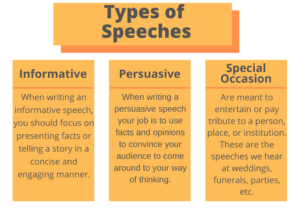
A speech is a written composition that is meant to be delivered to a live audience.
- Language: it must suit the interest of the audience.
- Purpose: speeches should be informative, educational and entertaining.
What are the types of speech?
There are three basic types of speech: the address of welcome, the farewell address and a talk on any topic.
- Address of welcome: greets and receives guests or new members, for example at a school event.
- Farewell address or speech: bids goodbye to a person leaving, for example a retiring teacher.
- A talk on any topic: informs or advises the audience on a chosen subject.
What are the features of a speech?
The features of a speech follow this order:
- Title: follows this pattern: A FAREWELL SPEECH WAS DELIVERED BY MR JAMES BODE, THE VICE PRINCIPAL OF GLORY SHOWER SCHOOL, ON THE SENDOFF CEREMONY OF THE DEAN, MRS CAROLINE BARRY AT THE CONFERENCE HALL ON THE 20TH OF JUNE, 2020 AT 10:00 AM.
- Salutation: greet the dignitaries in order of hierarchy, status or prominence, e.g. the Proprietor, the Principal, the PTA Chairman, Parents, Members of Staff, Students, Ladies and Gentlemen.
- Appreciation: thank the audience for the privilege to address the gathering.
- Body: discuss your points logically, one after the other.
- Impression: describe your impression of the event or person in question.
- Impact: discuss its impact on the community or society.
- Challenge: urge your audience to positive actions.
- Good wishes: wish them well to their destinations.
- Style: use formal language with occasional humour.
What are the words for the week?
The words for the week are Balik, Complicit, Impecunious, Encumber, Mollify, Frivolous, Confection, Disrepute, Benevolent and Generous.
| Word | Meaning | Example |
|---|---|---|
| Complicit | Involved with others in a wrongdoing | The clerk was complicit in the fraud. |
| Impecunious | Having little or no money | The impecunious student could not buy the textbook. |
| Encumber | To weigh down or burden | Do not encumber the child with heavy bags. |
| Mollify | To calm someone who is angry | The principal tried to mollify the angry parents. |
| Frivolous | Not serious or sensible | Stop asking frivolous questions. |
| Confection | A sweet food, such as a cake or candy | She sold confections at the school fair. |
| Disrepute | Loss of good name or reputation | His conduct brought the school into disrepute. |
| Benevolent | Kind and wishing to do good | A benevolent man paid the fees of the orphans. |
| Generous | Willing to give freely | She is generous with her time. |
Evaluation
- What does “unless” mean in a conditional sentence?
- Identify these as likely, unlikely or unfulfilled conditions: (a) If you steal, you may be jailed. (b) I would have left if you had arrived earlier. (c) If you stole, you would be jailed.
- Identify the subordinate clause in this sentence: Whenever it rains, I don’t go to work.
- Explain the words “manuscript” and “copyright”.
- Name the three basic types of speech.
Assignment
Write a farewell speech for an important retiring member of staff in your school, using the features of a speech taught in this lesson.
This term's English Studies topics
SS2 Third Term · 10 topics
- Grammar: Revises Tenses, Words for the Week 1
- Grammar, Writing, Vocabulary Development, Words for the Week 2
- Grammar, Summary, Vocabulary Development, Words for the Week 3
- Grammar, Oral, Writing, Words for the Week 4
- Oral, Comprehension , Grammar, Words for the Week 5
- Structure, Writing, Vocabulary Development, Words for the Week 6
- Oral, Structure, Comprehension , Writing, Words of the Week 8
- Structure, Writing , Vocabulary Development, Words of the Week 9
- Structure, Comprehension, Vocabulary Development, Words for the Week 10
- Oral, Structure, Vocabulary Development, Words for the Week 11
SS2 English Studies Lesson Notes for Other Topics
Grammar: Revises Tenses, Words For The Week 1
Read the full lesson note.

Grammar, Summary, Vocabulary Development, Words For The Week 3
Read the full lesson note.

Grammar, Oral, Writing, Words For The Week 4
Read the full lesson note.

Oral, Comprehension ,Grammar, Words For The Week 5
Read the full lesson note.
Structure, Writing, Vocabulary Development, Words For The Week 6
Read the full lesson note.

Oral, Structure, Comprehension , Writing, Words Of The Week 8
Read the full lesson note.

Structure, Writing , Vocabulary Development, Words Of The Week 9
Read the full lesson note.
Structure, Comprehension, Vocabulary Development, Words For The Week 10
Read the full lesson note.

Oral, Structure, Vocabulary Development, Words For The Week 11
Read the full lesson note.
Structure: The Use Of Possesive Apostrophe
Read the full lesson note.
Structure: Punctuation Marks
Read the full lesson note.
Vocabulary Development: Words Associated With Press
Read the full lesson note.

Oral: Intonation
Read the full lesson note.
Structure: Sentences Types
Read the full lesson note.
Oral: Falling Tone Statements
Read the full lesson note.
Lesson Notes for Other Classes
SS1 Lesson Note
The complete lesson note to guide your studies.

SS3 Lesson Note
The complete lesson note to guide your studies.
