
Mechanism of Transportation in Higher Mammals – SS2 Biology Lesson Note (Second Term)
Download this term · ₦1,000Lesson note at a glance
- Subject
- Biology
- Class
- SS2
- Term
- Second Term
- Topic
- Mechanism of Transportation in Higher Mammals
- Order
- Topic 4 of 6 this term
- Reading time
- 5 min
Transport in plants is the movement of water, mineral salts and manufactured food to the parts of the plant that need them.
Behavioural objectives
- Explain why higher plants need a transport system.
- State the functions of the xylem and the phloem.
- Define translocation and transpiration.
- List the conditions that affect the rate of transpiration.
- State the importance of transpiration to plants.
- Describe how water moves from the soil into the xylem and up the plant.
Why do higher plants need a transport system?
Higher plants, such as ferns and flowering plants, need a transport system because they are large and their cells are far from the soil and the leaves.
- Unicellular plants: materials move in and out by simple diffusion from the water around them, so no transport system is needed.
- Higher plants: diffusion alone is too slow over long distances, so an elaborate transport system is needed.
- Water and mineral salts: carried from the soil to all parts of the plant.
- Manufactured food: carried from the leaves to parts where it is used or stored.
What are vascular bundles?
Vascular bundles are the strands of xylem and phloem tissues that make up the transport system of higher plants.
- Position: they are found in the roots, stems and leaves of flowering plants.
- Cambium: in the roots and stems of dicotyledonous plants, a layer called cambium lies between the xylem and the phloem.
What are the xylem and the phloem?
The xylem is the tissue that carries water and dissolved mineral salts from the roots upward, and the phloem is the tissue that carries manufactured food from the leaves to other parts.
- Xylem: conducts water with dissolved mineral salts from the soil to the stem and leaves. It also gives support.
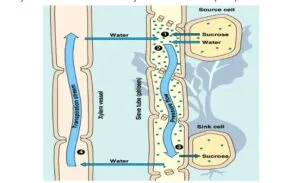
- Phloem: conducts manufactured food from the leaves to other parts of the plant. This is called translocation.
| Feature | Xylem | Phloem |
|---|---|---|
| Substance carried | Water and mineral salts | Manufactured food |
| Direction | Upward, from roots to leaves | From leaves to other parts |
| Main cells | Vessels and tracheids | Sieve tubes and companion cells |
| State of mature cells | Dead, with strong walls | Living |
What processes aid transport in plants?
Four processes aid transport in plants: translocation, transpiration, absorption of water and mineral salts, and water movement in the xylem.
What is translocation?
Translocation is the movement of manufactured food through the phloem from where it is made to where it is used or stored.
- Source: usually the leaves, where photosynthesis takes place.
- Destination: growing points, roots, fruits and storage organs such as yam tubers.
What is transpiration?
Transpiration is the loss of water from plants into the atmosphere as water vapour.
- Stomatal transpiration: water vapour escapes through the stomata in the leaves. This is the largest amount.
- Lenticular transpiration: water vapour escapes through the lenticels in the stems.
- Cuticular transpiration: water vapour escapes through the cuticle of the leaf surface.
- Measurement: a potometer is used to measure the rate of water uptake, which shows the rate of transpiration.
What are the conditions that affect the rate of transpiration?
Six conditions affect the rate of transpiration: stomatal size, humidity, temperature, light, wind and soil water.
- Size of the stomatal pores: flaccid guard cells close the pores and stop transpiration. Turgid guard cells open the pores.
- Humidity: the higher the humidity, the slower the rate of transpiration.
- Temperature: a rise in temperature increases the rate of transpiration.
- Light: high light intensity raises the rate of photosynthesis and temperature, so transpiration increases.
- Wind: the higher the wind speed, the higher the rate of transpiration.
- Soil water: more soil water means more absorption, so transpiration increases.
How do guard cells control the stomatal pores?
Guard cells control the stomatal pores by changing between turgid and flaccid states.
- Turgid guard cells: they swell with water, curve apart and open the pore.
- Flaccid guard cells: they lose water, become limp and close the pore.
What is the importance of transpiration to plants?
Transpiration helps the plant to absorb water, move water and cool itself.
- It helps plants to absorb water and mineral salts from the soil.
- It helps the movement of water from the roots to the leaves.
- It cools the plant as water evaporates from the leaves.
How do plants absorb water and mineral salts?
Plants absorb water from the soil through the root hairs by osmosis.
- Soil water has a lower concentration of dissolved substances than the sap in the root hair cells.
- Water enters the root hair cells by osmosis.
- The turgor pressure of the vacuole of the root cells increases.
- The water passes from cell to cell into the xylem vessels.
How does water move in the xylem?
Water moves up the xylem by root pressure, suction pressure, capillary action and transpiration pull.
- Root pressure: the push from water entering the roots forces water up the xylem.
- Suction pressure: the loss of water from the leaves pulls water up from the xylem.
- Capillary action: water molecules are attracted to the walls of the narrow xylem vessels, so water rises in them.
- Transpiration pull: water lost from the leaves pulls a continuous column of water up the xylem. It is the main force in tall plants.
Evaluation
- Why do unicellular plants not need an elaborate transport system?
- State the functions of the xylem and the phloem.
- Define transpiration and name three places where water can be lost from a plant.
- Explain how humidity and wind affect the rate of transpiration.
- List three things that help water move in the xylem tissue.
Assignment
In your notebook, define translocation, state three importance of transpiration to plants, and explain how the guard cells control the size of the stomatal pores.
This term's Biology topics
SS2 Second Term · 6 topics
- Digestive System
- Transport System
- Circulatory System in Mammals
- Mechanism of Transportation in Higher Mammals
- Cell Division
- Reproductive System in Vertebrates
Get Biology as PDF and Word
Every week of SS2 Biology, Second Term, formatted and ready to print. Ad-free, and the copy lock comes off.
Get this term Card, bank transfer, USSD or OPay
SS2 Biology Lesson Notes for Other Topics
Digestive System
Read the full lesson note.
Transport System
Read the full lesson note.
Circulatory System In Mammals
Read the full lesson note.

Cell Division
Read the full lesson note.
Reproductive System In Vertebrates
Read the full lesson note.
Reproduction - Asexual Reproduction
Read the full lesson note.
Reproduction II - Sexual Reproduction
Read the full lesson note.
Reproductive Health
Read the full lesson note.
Cellular Respiration
Read the full lesson note.

Respiratory System
Read the full lesson note.

Excretory System
Read the full lesson note.

Tissues And Supporting Systems In Animals
Read the full lesson note.

Supporting Tissues In Plants
Read the full lesson note.
Joints
Read the full lesson note.
Reproductive System In Flowering Plants
Read the full lesson note.
Lesson Notes for Other Classes

SS1 Lesson Note
The complete lesson note to guide your studies.

SS3 Lesson Note
The complete lesson note to guide your studies.
