
Reproductive System in Flowering Plants – SS2 Biology Lesson Note (Third Term)
Lesson note at a glance
- Class
- SS2
- Subject
- Biology
- Term
- Third Term
- Reading time
- 6 min
The flower is the reproductive structure of a flowering plant, and it carries the male and female sex organs.
Behavioural objectives
By the end of the lesson, students should be able to:
- name the parts of a typical flower and state the function of each;
- describe the three types of ovary position and give an example of each;
- distinguish between monoecious and dioecious plants;
- explain what placentation is;
- describe the five types of placentation and give an example of each.
What are the reproductive organs of a flowering plant?
The reproductive organs of a flowering plant are found in the flower, which has both male and female parts and carries out sexual reproduction.
- Seed formation: after fertilisation takes place in the flower, seeds are produced.
- Floral part (whorls): the four sets of parts arranged on the flower.
- Flower stalk (pedicel): the stalk that joins the flower to the plant.
The floral part is made up of four whorls:
- calyx (sepals)
- corolla (petals)
- androecium (stamens)
- gynoecium (carpels)
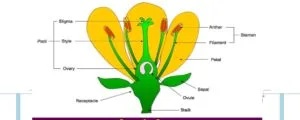
What are the parts of a typical flower?
A typical flower has a pedicel and four floral parts: calyx, corolla, androecium and gynoecium.
| Part | Made up of | Main function |
|---|---|---|
| Pedicel | Flower stalk | Joins the flower to the plant |
| Calyx | Sepals | Protects the flower in the bud |
| Corolla | Petals | Attracts pollinators such as insects |
| Androecium | Stamens (filament and anther) | Produces pollen grains, the male part |
| Gynoecium | Carpels (stigma, style, ovary) | Produces ovules, the female part |
What is the calyx?
The calyx is the outermost whorl of the flower and is made up of sepals.
- Colour and size: sepals are usually small and green.
- Function: they protect the flower while it is in the bud.
- Number: sepals are usually 3 to 5.
- Polysepalous: the sepals are separate.
- Gamosepalous: the sepals are joined to form a cup.
- Epicalyx: an extra ring of sepal-like parts below the calyx, e.g. in hibiscus.
What is the corolla?
The corolla is the whorl of petals found inside the sepals.
- Appearance: petals are the attractive part of the flower and may number 4 to 10.
- Polypetalous: the petals are separate.
- Gamopetalous: the petals are joined to form a tube.
- Function: petals are generally coloured and scented to attract pollinators such as insects.
What is the androecium?
The androecium is the male reproductive organ of a flower, made up of a group of stamens.
- Number: stamens may be 3 or more, free or joined together.
- Filament: the stalk that holds up the anther.
- Anther: a 2 to 4 lobed structure that produces pollen grains (fine yellowish particles).
- Pollen grain: produces the male gamete.
- Release of pollen: at maturity, the anther lobes open to release the pollen grains.
What is the gynoecium?
The gynoecium is the female reproductive organ of a flower and the innermost floral part.
- Carpels: the gynoecium consists of one or many carpels.
- Monocarpous: the gynoecium has one carpel, e.g. flamboyant.
- Apocarpous: there are many carpels and they are separate.
- Syncarpous: there are many carpels and they are fused, e.g. hibiscus.
A carpel has three parts:
- Stigma: the top part that receives the pollen grains.
- Style: the stalk that joins the stigma to the ovary.
- Ovary: the swollen base that contains the ovules; each ovule produces the female gamete.
After fertilisation:
- Ovary: develops into the fruit.
- Ovule: develops into the seed.
What are the types of ovary position?
There are three types of ovary position: superior, inferior and half inferior.
- Superior ovary: the ovary is above the other floral parts. The flower is hypogynous, e.g. hibiscus.
- Inferior ovary: the ovary is below the other floral parts. The flower is epigynous, e.g. sunflower.
- Half inferior ovary: the ovary is at the same level as the other floral parts. The flower is perigynous, e.g. rose.
| Ovary position | Position of ovary | Type of flower | Example |
|---|---|---|---|
| Superior | Above other floral parts | Hypogynous | Hibiscus |
| Inferior | Below other floral parts | Epigynous | Sunflower |
| Half inferior | Level with other floral parts | Perigynous | Rose |
What are the types of flower?
Flowers are grouped by how they differ from one another in several features.
- Number of floral parts: some flowers have all four whorls, others have fewer.
- Colour of petals: petals differ in colour.
- Size and shape: flowers vary in size and form.
- Symmetry: flowers may be regular or irregular.
What are the ways of grouping flowers?
- By symmetry: a regular flower is radially symmetrical (actinomorphic). An irregular flower is zygomorphic.
- By completeness: a complete (perfect) flower has all four floral parts. An incomplete (imperfect) flower lacks one or more of them.
- By ovary position: flowers are hypogynous, epigynous or perigynous.
- By arrangement: a solitary flower occurs singly. An inflorescence is a group of flowers.
- By position on the plant: axillary flowers are borne in the axils of leaves. Terminal flowers are borne at the end of the stem or branches.
What are the sexes in plants?
Most flowers are bisexual, with both stamens and carpels, while a few are unisexual, with either stamens or carpels only.
Unisexual flowers give two kinds of plant:
- Monoecious plant: male and female flowers occur on the same plant, e.g. maize.
- Dioecious plant: male and female flowers occur on different plants, e.g. pawpaw.
| Feature | Monoecious plant | Dioecious plant |
|---|---|---|
| Position of flowers | Male and female flowers on the same plant | Male and female flowers on different plants |
| Example | Maize | Pawpaw |
What is placentation?
Placentation is the arrangement of the ovules within the ovary of a flower.
- Placenta: the fleshy structure in the ovary to which the ovules are attached.
- Funicle: the short stalk that joins each ovule to the placenta.
What are the types of placentation?
There are five types of placentation: marginal, parietal, free central, axile and basal.
- Marginal placentation: ovules are arranged at the margin of the ovary, e.g. beans, flamboyant.
- Parietal placentation: ovules are arranged at the side of the ovary, within a single chamber or cavity, e.g. pawpaw.
- Free central placentation: ovules are borne on a knob projecting from the base of the ovary, e.g. primrose.
- Axile placentation: carpels meet at the centre to form the placenta that carries the ovules, e.g. tomato.
- Basal placentation: ovules are attached to the base of the ovary, e.g. sunflower.
| Type | Where the ovules are attached | Example |
|---|---|---|
| Marginal | Margin of the ovary | Beans, flamboyant |
| Parietal | Side of the ovary, in one chamber | Pawpaw |
| Free central | Knob rising from the base of the ovary | Primrose |
| Axile | Central placenta formed where carpels meet | Tomato |
| Basal | Base of the ovary | Sunflower |
Evaluation
- Name the four floral parts of a flower.
- State the function of the calyx and the corolla.
- State the difference between a monoecious plant and a dioecious plant, with one example of each.
- Name the three types of ovary position and give one example of each.
- What is placentation?
Assignment
Answer all the questions below.
Section A
- The reproductive parts of the flower include all the following except A. corolla B. androecium C. gynoecium D. stigma
- A plant that has both male and female flowers on the same plant is referred to as A. monoecious B. dioecious C. hypogynous D. axillary
- An example of a flower with a half inferior ovary is A. hibiscus B. sunflower C. rose D. flamboyant
- The arrangement of ovules in the ovary is referred to as A. pollination B. placentation C. fertilisation D. solitary
- An example of axile placentation is found in A. sunflower B. lily C. pawpaw D. tomato
Section B
- Distinguish between a monocarpous, an apocarpous and a syncarpous gynoecium, with one example where possible.
- Describe five types of placentation and give one example in each case.
This term's Biology topics
SS2 Third Term · 9 topics
- Reproductive System in Flowering Plants
- Pollination in Plants
- Fruits
- Habitat: Marine Habitat
- Estuarine and Freshwater Habitat
- Terrestrial Habitat
- Grassland Habitats
- Ecology of Population
- Food Storage
SS2 Biology Lesson Notes for Other Topics
Pollination In Plants
Read the full lesson note.
Fruits
Read the full lesson note.
Habitat - Marine Habitat
Read the full lesson note.
Estuarine And Freshwater Habitat
Read the full lesson note.
Terrestrial Habitat
Read the full lesson note.
Grassland Habitats
Read the full lesson note.
Ecology Of Population
Read the full lesson note.
Food Storage
Read the full lesson note.
Reproduction - Asexual Reproduction
Read the full lesson note.
Reproduction II - Sexual Reproduction
Read the full lesson note.
Reproductive Health
Read the full lesson note.
Cellular Respiration
Read the full lesson note.

Respiratory System
Read the full lesson note.
Excretory System
Read the full lesson note.
Tissues And Supporting Systems In Animals
Read the full lesson note.
Lesson Notes for Other Classes

SS1 Lesson Note
The complete lesson note to guide your studies.

SS3 Lesson Note
The complete lesson note to guide your studies.
