
Excretory System – SS2 Biology Lesson Note (First Term)
Download this term · ₦1,000Lesson note at a glance
- Subject
- Biology
- Class
- SS2
- Term
- First Term
- Topic
- Excretory System
- Order
- Topic 6 of 9 this term
- Reading time
- 8 min
Excretion is the process by which metabolic waste products are removed from the body of all living things. Excretion is different from egestion, which is the removal of solid waste (undigested food, that is faeces) through the anus.
Behavioural objectives
By the end of the lesson, students should be able to:
- define excretion and distinguish it from egestion;
- state why excretion is necessary;
- name the excretory structures and waste products of different organisms;
- describe excretion in protozoa, flatworms, earthworms and insects;
- describe the structure and functions of the mammalian kidney and the nephron;
- describe how urine is formed and how plants excrete waste.
Why is excretion necessary?
Excretion is necessary for the following reasons:
- To avoid or prevent any harm that would be caused by any excretory product.
- Some excretory products are poisonous to the body and should be removed.
- To maintain water balance in the body (homeostasis).
- To avoid interference of waste products with normal metabolic activities in the body.
What are the excretory structures and waste products in organisms?
| Organism | Excretory structure | Excretory waste product |
|---|---|---|
| Protozoa | Contractile vacuole | CO2 and water vapour |
| Flatworm | Flame cells | CO2, ammonia and water |
| Earthworm | Nephridia | CO2, ammonia and water |
| Crustacean | Green glands | CO2, ammonia and water |
| Insect | Malpighian tubules | CO2, ammonia and uric acid |
| Fish | Kidney | CO2, ammonia and water |
| Amphibians (toads) | Kidney | H2O and salt |
| Reptiles | Kidney | H2O and salt |
| Birds | Kidney and lungs | CO2 and water vapour |
| Mammals | Kidney, lungs, skin, liver | CO2, water, urea |
| Flowering plants | Stomata, lenticels, leaves | H2O, CO2, O2, tannins, gum, alkaloids, oil and latex |
What are the types of excretory systems?
Contractile vacuole in protozoa
The contractile vacuole is a simple structure found in the cell of freshwater protozoa. Water constantly enters the cell of a protozoan through the selectively permeable membrane because the cell is hypertonic to its environment. As water enters the cell, a contractile vacuole forms and collects the water. It expands, and when it reaches its maximum size it contracts and discharges the water through a temporary break in the cell membrane at intervals.
Carbon dioxide and ammonia are excreted by diffusion through the cell membrane.
Flame cell in flatworms
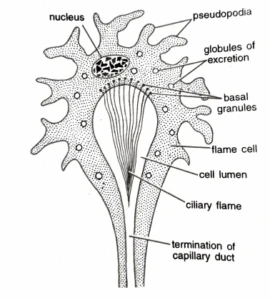
The excretory system consists of two longitudinal canals with branched tubules which end in flame cells. The flame cell has a large hollow called the cell lumen with a bunch of flagella hung on it. The waste product from the surrounding cells enters the flame cells. The flagella help to propel the fluid into the tubules, and the fluid passes to the exterior through a narrow tube called a duct.
Nephridium in earthworms
A pair of nephridia is found on each segment of the earthworm except the first three and the last. Each nephridium consists of a ciliated funnel, the nephrostome, which leads into a long coiled tube (narrow and middle ciliated tubes, wide non-ciliated tubes and a muscular tube). The tube opens to the exterior as a nephridiopore (excretory pore).
Waste product, mainly urea, is absorbed from the blood capillaries surrounding the nephridia. As the fluid containing the waste passes through the long tube of the nephridium, salt and other useful substances are reabsorbed through the wall of the tube. The unabsorbed substances and water gather in the muscular tube and are discharged to the exterior through the excretory pore.
Malpighian tubule in insects
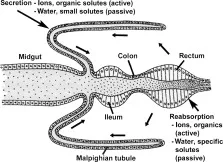
Malpighian tubules are found between the midgut (small intestine) and the hindgut (large intestine). One end opens into the gut while the other end floats freely in the haemocoel. Nitrogenous waste and water in the haemocoel are absorbed into the tubule at the distal closed end.
The waste is converted into uric acid as it passes along the Malpighian tubule towards the gut. A lot of water is also reabsorbed, so by the time the uric acid reaches the proximal end it has changed to solid crystals. More water is reabsorbed in the rectum, therefore concentrated urine leaves the body as almost dried solid.
Excretory system in mammals
Mammalian lungs excrete water vapour and CO2. The liver excretes a bile pigment called bilirubin, the skin excretes water, salt and urea through sweat, and the kidney excretes water, mineral salt and urea.
The excretory system of mammals consists of a pair of kidneys, a ureter, a bladder, a renal artery and a renal vein.
What is the structure of the kidney?
The mammalian kidney is a bean-shaped, reddish-brown organ located in the posterior end of the abdomen. The right kidney is slightly lower in the body than the left. When a kidney is cut longitudinally, two distinct regions are seen: an outer cortex and an inner medulla.
Several narrow tubules called urinary tubules (nephrons) pass through the two regions. The tubules open at the tips of triangular-shaped masses of tissue called pyramids. The pyramids open into a funnel-shaped cavity called the pelvis. The kidney has many tiny capillaries which are branches of the renal artery and the renal vein. The pelvis continues as a ureter, a long narrow tube connecting the kidney to the urinary bladder.
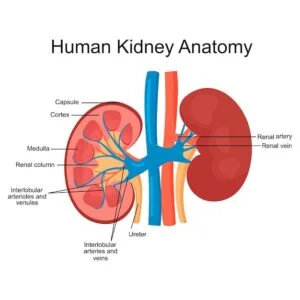
Diagram of the kidney
What are the functions of the kidney?
The three major functions carried out by the kidney are as follows:
- Osmoregulation: This is the process by which an animal regulates the balance between water and salt in its body fluid. When the concentration of the blood is higher or lower than normal, the kidney removes the excess water or salt from the blood, so that normal osmotic balance is maintained in the body.
- Maintenance of acid-base balance: The kidney excretes excess acids or bases when either of them is more concentrated in the body. If the body’s concentration of base is higher than that of acid, more salt is excreted with the urine. As a result, acid-base balance is maintained in the body.
- Excretion: The kidney removes metabolic waste products from the body in the form of urine. Urine formation is made possible by the numerous urinary tubules, which are the functional units of the kidney.
What is the structure of the urinary tubule (nephron)?
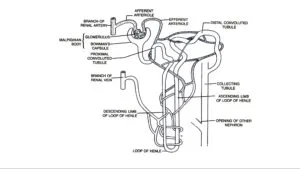
The nephron consists of a cup-shaped Bowman’s capsule which opens into a short coiled proximal convoluted tubule. The tubule continues as a U-shaped loop, the loop of Henle, in the medulla. The loop re-enters the cortex as the distal convoluted tubule, which widens as it enters the pelvis.
The nephron is associated with several networks of capillaries. The renal artery branches into the Bowman’s capsule and forms a knot of capillaries called the glomerulus. The capillaries rejoin to form a blood vessel leading out of the capsule. This vessel branches into a capillary network around the urinary tubule before joining the renal vein.
How is urine formed?
Urine is formed in three stages:
- Ultrafiltration: Blood is brought to the kidney by the renal artery, which enters the glomeruli (capillaries) in the Bowman’s capsule. Water, mineral salt, sugar and other solutes are filtered from the blood into the capsule.
- Selective reabsorption: The glomerular filtrate flows down the proximal convoluted tubule and the loop of Henle, where some water, sugar, amino acids and salts useful to the body are reabsorbed into the blood capillaries by active transport. This process of reabsorbing useful materials back into the blood is called selective reabsorption.
- Hormonal secretion: As the fluid flows through the distal convoluted tubules, more water is reabsorbed by the action of antidiuretic hormone (ADH), and urine is finally formed. The urinary tubules empty their contents into the pelvis. From the pelvis, urine trickles through the ureter into the urinary bladder, which contracts when full and discharges urine out of the body through the urethra.
How do plants excrete waste?
Plants have no special excretory organs and their excretory wastes are minimal. Waste is eliminated through the stomata and lenticels.
The main waste products of plants are water, which is eliminated through transpiration and guttation, and carbon dioxide from respiration at night, when photosynthesis is not taking place. Other waste products are alkaloids (quinine, nicotine, cocaine, morphine). These are converted into harmless substances and stored in some parts of the plant, where they serve as useful commercial products.
Evaluation
- Define excretion and state how it differs from egestion.
- State four reasons why excretion is necessary.
- Name the excretory structure of the flatworm, the earthworm and the insect.
- Describe the three stages in the formation of urine.
- List the main waste products of plants and say how they are eliminated.
Assignment
- Excess water in plants is excreted as water vapour and droplets respectively through
A. transpiration and guttation
B. respiration and guttation
C. photosynthesis and guttation
D. guttation and condensation - Which of the following is not an excretory organ?
A. kidney
B. skin
C. leaf
D. large intestine - Which of the following waste products in plants is excreted through the stomata and lenticels?
A. carbon dioxide
B. alkaloids
C. tannins
D. anthocyanins - Which of the following is responsible for the removal of excess water in humans?
A. small intestine
B. kidney
C. spleen
D. bladder - The urinary tubule of the kidney functions through
A. ultrafiltration and selective reabsorption
B. osmosis and diffusion
C. active transport and osmosis
D. active transport and cytoplasmic strand - Differentiate between excretion in plants and animals.
- Mention five structural parts of the excretory system in mammals and their functions.
This term's Biology topics
SS2 First Term · 9 topics
Get Biology as PDF and Word
Every week of SS2 Biology, First Term, formatted and ready to print. Ad-free, and the copy lock comes off.
Get this term Card, bank transfer, USSD or OPay
SS2 Biology Lesson Notes for Other Topics
Reproduction - Asexual Reproduction
Read the full lesson note.
Reproduction II - Sexual Reproduction
Read the full lesson note.
Reproductive Health
Read the full lesson note.
Cellular Respiration
Read the full lesson note.

Respiratory System
Read the full lesson note.
Tissues And Supporting Systems In Animals
Read the full lesson note.

Supporting Tissues In Plants
Read the full lesson note.
Joints
Read the full lesson note.
Digestive System
Read the full lesson note.
Transport System
Read the full lesson note.
Circulatory System In Mammals
Read the full lesson note.
Mechanism Of Transportation In Higher Mammals
Read the full lesson note.
Cell Division
Read the full lesson note.
Reproductive System In Vertebrates
Read the full lesson note.
Reproductive System In Flowering Plants
Read the full lesson note.
Lesson Notes for Other Classes

SS1 Lesson Note
The complete lesson note to guide your studies.
SS3 Lesson Note
The complete lesson note to guide your studies.
