
Digestive System – SS2 Biology Lesson Note (Second Term)
Download this term · ₦1,000Lesson note at a glance
- Subject
- Biology
- Class
- SS2
- Term
- Second Term
- Topic
- Digestive System
- Order
- Topic 1 of 6 this term
- Reading time
- 10 min
Digestion is the breakdown of ingested food into simple, soluble and diffusible substances by mechanical and chemical processes.
- Digestive system: the alimentary canal plus the glands and organs that produce enzyme-rich secretions.
- Absorbed food: taken into the body fluids and assimilated, that is, used by the cells.
- Undigested food: removed from the body by egestion.
Behavioural objectives
By the end of the lesson, students should be able to:
- Describe feeding and digestion in Hydra, flatworms, the earthworm, insects and birds.
- List the parts of the alimentary canal of the earthworm, insects and birds.
- Describe digestion in the mouth, stomach and small intestine of man, naming the enzymes and their products.
- Explain how the small intestine is adapted for absorption.
- Name the feeding mechanisms in animals with one example of each.
How does Hydra feed and digest food?
Hydra is a small aquatic animal that catches prey with stinging cells and digests it in a sac-like gut called the enteron.
- Nematocysts on the tentacles capture small aquatic organisms, e.g. crustaceans.
- The tentacles pass the food into the mouth.
- Gland cells secrete digestive enzymes into the enteron (extracellular digestion).
- Digestion is completed inside the body cells (intracellular digestion).
- The digested food is absorbed into the body.
- Undigested food is sent back into the enteron and released through the mouth.
- Type of digestion: both extracellular and intracellular.
- Openings: one only, the mouth.

How does digestion occur in flatworms (tapeworm and planaria)?
Flatworms digest food in different ways: the tapeworm has no gut, while the planarian has a simple branched gut with one opening.
Tapeworm
- Way of life: a parasitic worm that lives in its host.
- Alimentary canal: none.
- Feeding: absorbs the digested food of the host through its body surface.
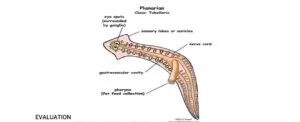
Planaria
- Way of life: a free-living flatworm that feeds on small animals.
- Mouth: the only opening, on the ventral (under) side of the body.
- Pharynx: extended out of the mouth during feeding.
- The pharynx pumps and sucks in pieces of food.
- The food moves from the pharynx into the intestine.
- Digestion is partly extracellular and partly intracellular.
- The branched intestine lets digested food diffuse to all parts of the body.
- Undigested food is egested through the mouth.
How does digestion occur in the earthworm?
The earthworm has a straight alimentary canal, a tube with a mouth at one end and an anus at the other.
What are the parts of the alimentary canal of the earthworm?
- Mouth and buccal cavity: thin-walled, for ingestion of food.
- Pharynx: muscular, sucks in soil and secretes mucus to lubricate food.
- Oesophagus: narrow, thin-walled tube that carries food backwards.
- Crop: thin-walled, stores food temporarily.
- Gizzard: thick muscular organ where food is ground against small stones.
- Intestine: long, straight tube where extracellular digestion and absorption occur.
- Anus: the opening through which undigested food leaves.
What is the mechanism of digestion in the earthworm?
- The earthworm has no jaws or teeth. The prostomium, a lobe above the mouth, guides soil into the mouth.
- The muscular pharynx sucks in soil containing food.
- Food passes through the oesophagus into the crop for temporary storage.
- The gizzard contracts and expands. Sand grains and food rub together and the food is ground up.
- Enzymes break the food down chemically in the intestine.
- Digested food is absorbed into the blood in the intestinal wall.
- Useless inorganic matter passes out unchanged and is left on the ground as castings.
- Design: the gut is a tube within a tube (the body wall is the outer tube).
- Position: the digestive organs fill most of the front half of the body.
Why are earthworms useful to the soil?
- Aeration: feeding loosens the soil so air and water enter easily.
- Fertility: their wastes add nutrients to the soil.
- Crops: fertile, loose soil supports crops, grasses and other plants.
How does digestion occur in insects?
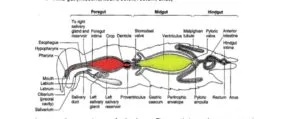
The alimentary canal of an insect has three parts: the foregut, the midgut and the hindgut.
- Foregut: mouth, pharynx, oesophagus, crop and gizzard.
- Midgut: the stomach, where digestion and absorption occur.
- Hindgut: intestine, ileum, colon, rectum and anus.
How does a grasshopper digest its food?
- The mouth parts cut and crush the leaves.
- The salivary gland pours saliva on the leaves to soften them.
- The chewed food goes into the crop, which stores it.
- The gizzard grinds the food into smaller pieces.
- Enzyme-rich juice is secreted into the midgut, where digestion and absorption occur.
- The hindgut absorbs water from the waste.
- Solid faecal pellets are egested through the anus.
- Malpighian tubules: join the gut where the midgut meets the hindgut and pass waste into it.
How does digestion occur in birds?
Birds have no teeth, so they feed with horny beaks, and in many birds the feet are also adapted for feeding.
What are the parts of the alimentary canal of a bird?
- Oesophagus: carries swallowed food down.
- Crop: stores and softens food.
- Proventriculus: the glandular stomach that adds gastric juice.
- Gizzard: strong muscular bag that grinds food.
- Small intestine: completes digestion and absorbs food.
- Caeca: small pouches joined to the gut near its end.
- Cloaca: common chamber through which waste leaves.

What is the mechanism of digestion in birds?
- The bird swallows its food whole and stores it in the crop.
- Secretion from the crop wall softens the food.
- The food passes through the proventriculus, where gastric juice is added.
- In the gizzard, strong muscles grind the food into smaller units.
- Small stones in the gizzard help the grinding.
- Intestinal and pancreatic juices complete digestion in the small intestine.
- Absorption also occurs in the small intestine.
- Solid waste passes into the cloaca and out of the body.
What is digestion in man?
Digestion in man is the breakdown of food into simple, soluble and diffusible substances by chemical and mechanical processes.
- Heterotrophs: organisms that get food from autotrophs or from other heterotrophs.
- Ingestion: taking food into the body.
- Digestion: breaking food into small soluble molecules.
- Absorption: movement of digested food into the body fluids.
- Assimilation: use of the absorbed food by the cells.
- Egestion: removal of undigested food.
How do holozoic animals feed and digest food?
Holozoic animals take in solid food and have structures for obtaining it and capturing prey.
- Large food particles: the body is modified into claws, teeth and beaks.
- Small food pieces: the animal has fluid-feeding or filter-feeding structures.
- Saprophytes: change food into a digested, absorbable form before taking it in.
- Parasites: have structures for boring into the bodies of their hosts.
Most holozoic animals, unlike unicellular animals, have a gut called the alimentary canal with two openings.
- Mouth: the anterior opening.
- Anus: the posterior opening.
A typical alimentary canal is adapted to do three jobs:
- Breaking up food: into smaller units.
- Producing secretions: digestive juices.
- Absorbing: digested food and water.
- Digestive system: the alimentary canal plus the glands and organs that produce enzyme-rich secretions.
- Teeth: bring about mechanical breakdown of food.
- Enzymes: speed up chemical digestion.
How does food pass through the human body?
Food in man passes through five stages: ingestion, digestion, absorption, assimilation and egestion.
What happens in the mouth?
- Food is ingested and the teeth grind it into smaller units.
- Saliva, a watery, slightly alkaline fluid from the salivary glands, mixes with the food.
- Ptyalin in saliva acts on cooked starch and converts it to maltose.
- The tongue mixes the food with saliva and rolls it into a ball called a bolus.
- The bolus is swallowed and the entrance to the trachea closes to prevent choking.
What is peristalsis?
Peristalsis is the wave of muscle contraction and relaxation that pushes food along the gut.
- Oesophagus: its muscular wall contracts and relaxes to push each bolus down into the stomach.
How is food digested in the stomach?
In the stomach, gastric juice and churning break down proteins and curdle milk.
- Churning: the muscular wall contracts and relaxes forcefully and mixes food with gastric juice.
- Hydrochloric acid: activates pepsinogen into pepsin and helps to kill bacteria in food.
- Pepsin: digests protein into peptones and polypeptides, and works best in an acid medium.
- Rennin: coagulates milk into thick curd by changing soluble caseinogen to insoluble casein.
- Time: food stays in the stomach for about 3 to 4 hours.
How is food digested in the small intestine?
The small intestine is where digestion of food is completed, in two parts: the duodenum and the ileum.
What happens in the duodenum?
- Pancreas: secretes pancreatic juice containing digestive enzymes.
- Liver: produces bile, which is stored in the gall bladder.
- Bile: a greenish liquid that emulsifies fat. It contains no digestive enzymes.
The pancreatic juice contains three important enzymes:
- Amylopsin: converts starch to maltose.
- Trypsin: converts protein to polypeptides.
- Lipase: converts lipids to fatty acids and glycerol.

What happens in the ileum?
The wall of the ileum secretes five important enzymes:
- Maltase: converts maltose to glucose + glucose.
- Sucrase: converts sucrose to glucose + fructose.
- Lactase: converts lactose to glucose + galactose.
- Erepsin: converts polypeptides to amino acids.
- Lipase: converts fats and oils to fatty acids and glycerol.
What are the end products of digestion?
Digestion in man ends in the small intestine, and each food class gives its own end products.
| Food class | End products |
|---|---|
| Carbohydrates | Glucose, fructose and galactose |
| Proteins | Amino acids |
| Fats and oils | Fatty acids and glycerol |
Summary table of enzymes in man
| Region | Enzyme | Food acted on | Product |
|---|---|---|---|
| Mouth | Ptyalin | Cooked starch | Maltose |
| Stomach | Pepsin | Protein | Peptones and polypeptides |
| Stomach | Rennin | Milk caseinogen | Casein (curd) |
| Duodenum | Amylopsin | Starch | Maltose |
| Duodenum | Trypsin | Protein | Polypeptides |
| Duodenum | Lipase | Lipids | Fatty acids and glycerol |
| Ileum | Maltase | Maltose | Glucose + glucose |
| Ileum | Sucrase | Sucrose | Glucose + fructose |
| Ileum | Lactase | Lactose | Glucose + galactose |
| Ileum | Erepsin | Polypeptides | Amino acids |
| Ileum | Lipase | Fats and oils | Fatty acids and glycerol |
How is food absorbed and assimilated?
Absorption is the movement of digested food from the small intestine into the blood and lymph.
- Substances absorbed: glucose, amino acids, fatty acids, glycerol, vitamins and mineral salts.
- Methods: diffusion or active transport.
- Carriers: blood vessels carry blood and lymphatic vessels carry lymph.
How is the small intestine adapted for absorption?
- Folds and furrows: the wall is folded to give a large surface area.
- Villi: finger-like projections (singular: villus) increase the surface area further.
- Thin epithelium: the inner surface layer of each villus is thin, so food passes through easily.
- Blood capillaries: a network around each villus carries absorbed food away.
- Lacteal: a blind lymphatic tube in each villus that carries fats.
What happens to absorbed fats?
- Fatty acids and glycerol are absorbed into the villus.
- They recombine to form fats, which pass into the lacteal.
- The lymph and then the blood carry the fats to where they are needed.
- Excess fats are stored in fat cells as adipose tissue, under the skin and around organs.
What are the feeding mechanisms in animals?
Two main feeding mechanisms in animals are filter feeding and fluid feeding.
What is filter feeding?
Filter feeding is feeding on very tiny organisms in water by straining them out with sieve-like structures.
- Who uses it: mainly aquatic animals.
- Examples: mosquito larvae, ducks and prawns.
What is fluid feeding?
Fluid feeding is feeding on liquid food, and it has two classes of animals.
- Suckers: suck up fluids, e.g. bugs, mosquitoes, butterflies, houseflies and tsetse fly.
- Wallowers: live in their food and absorb it, e.g. tapeworms.
The tapeworm lives within the digested food of its host.
- Absorption: through the entire body surface.
- Alimentary canal: none.
What are the modifications and mechanisms of feeding in animals?
There are five feeding mechanisms in animals: absorption, biting and chewing, sucking, grinding, and trapping and absorbing.
| Mechanism | Example |
|---|---|
| Absorption | Tapeworm |
| Biting and chewing | Grasshopper |
| Sucking | Mosquito |
| Grinding | Man |
| Trapping and absorbing | Bladder worm |
Evaluation
- Name the three enzymes in pancreatic juice and state what each one converts.
- State the function of the gizzard in the earthworm and in the bird.
- What is peristalsis?
- Describe two ways in which the small intestine is adapted for absorption.
- List the five mechanisms of feeding in animals, with one example of each.
Assignment
Answer both parts. (1) State the region of the alimentary canal where chemical digestion of each of these begins: (a) carbohydrate, (b) protein, (c) lipids. (2) State the role of pancreatic juice in digestion.
This term's Biology topics
SS2 Second Term · 6 topics
Get Biology as PDF and Word
Every week of SS2 Biology, Second Term, formatted and ready to print. Ad-free, and the copy lock comes off.
Get this term Card, bank transfer, USSD or OPay
SS2 Biology Lesson Notes for Other Topics
Transport System
Read the full lesson note.
Circulatory System In Mammals
Read the full lesson note.
Mechanism Of Transportation In Higher Mammals
Read the full lesson note.
Cell Division
Read the full lesson note.
Reproductive System In Vertebrates
Read the full lesson note.
Reproduction - Asexual Reproduction
Read the full lesson note.
Reproduction II - Sexual Reproduction
Read the full lesson note.
Reproductive Health
Read the full lesson note.
Cellular Respiration
Read the full lesson note.

Respiratory System
Read the full lesson note.
Excretory System
Read the full lesson note.
Tissues And Supporting Systems In Animals
Read the full lesson note.

Supporting Tissues In Plants
Read the full lesson note.
Joints
Read the full lesson note.
Reproductive System In Flowering Plants
Read the full lesson note.
Lesson Notes for Other Classes

SS1 Lesson Note
The complete lesson note to guide your studies.

SS3 Lesson Note
The complete lesson note to guide your studies.
