
Circulatory System in Mammals – SS2 Biology Lesson Note (Second Term)
Download this term · ₦1,000Lesson note at a glance
- Subject
- Biology
- Class
- SS2
- Term
- Second Term
- Topic
- Circulatory System in Mammals
- Order
- Topic 3 of 6 this term
- Reading time
- 8 min
The circulatory system of a mammal is the system of blood, heart and blood vessels that transports substances around the body.
Behavioural objectives
By the end of the lesson, students should be able to:
- State the two basic functions of blood in mammals.
- Describe how the blood protects the body, including the mechanism of clotting.
- Distinguish between open and closed, and single and double, circulatory systems.
- List the types of blood vessel and state the differences between an artery and a vein.
- Describe the structure of the mammalian heart and the two phases of the heartbeat.
- Name the main arteries and the organs they supply.
What are the parts of the circulatory system in mammals?
The circulatory system has three parts: the blood, the heart and the blood vessels.
- Blood: the fluid tissue that carries substances and protects the body.
- Heart: the muscular organ that pumps the blood.
- Blood vessels: the tubes that carry blood to and from every part of the body.
- Type of system: mammals have a closed, double circulation.
What are the functions of blood?
The blood has two basic functions in mammals: transportation of substances and protection of the body against disease.
What does the blood transport?
- Oxygen: carried from the lungs to the body cells.
- Carbon dioxide: carried from the cells to the lungs.
- Digested food: carried from the small intestine to the cells.
- Urea: carried from the liver and cells to the kidneys for removal.
- Hormones: carried from the glands to the organs they act on.
How does the blood protect the body?
The blood protects the body by making antibodies and antitoxins, engulfing germs and clotting at wounds.
- Antibody production (clumping): lymphocytes produce antibodies, which are proteins that neutralise an antigen and give an immune response.
- Vaccination (immunisation): a small dose of weakened or dead pathogens is injected to make the body produce antibodies.
- Neutralisation: the blood produces antitoxins, which neutralise the toxins released by pathogens.
- Phagocyte action (engulfing): phagocytes engulf pathogens and digest them.
- Clotting: platelets help the blood to clot, which keeps germs out and prevents loss of blood.
What is the mechanism of blood clotting?
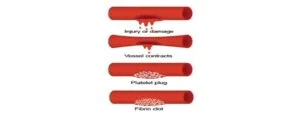
Clotting is the change of liquid blood into a solid clot at a wound.
- A blood vessel is damaged and exposed to air.
- Platelets release an enzyme, thrombokinase.
- Thrombokinase converts prothrombin (an inactive blood protein) to the enzyme thrombin.
- Thrombin converts soluble fibrinogen in the plasma to insoluble fibrin, in the presence of calcium ions.
- Threadlike fibrin forms a mesh over the wound, and blood cells are trapped in it to form a clot.
- The clot dries to form a scab over the wound.
What are the types of circulatory system?
There are two pairs of circulatory system: closed or open, and single or double.
What is a closed circulatory system?
A closed circulatory system is one in which blood stays inside vessels and the heart.
- Pathway: arteries divide into capillaries, which join up with veins.
- Contact with cells: blood does not touch the body cells directly.
- Examples: annelids (earthworm) and vertebrates.
What is an open circulatory system?
An open circulatory system is one in which blood leaves the vessels and flows through body spaces.
- Pathway: vessels lead out of the heart but end in blood spaces called haemocoels in the body cavity.
- Contact with cells: blood touches the cells directly and then returns to the heart.
- Examples: arthropods (insects, crabs) and some molluscs.
| Feature | Closed system | Open system |
|---|---|---|
| Blood location | Inside vessels only | Flows into haemocoels |
| Capillaries | Present | Absent |
| Contact with cells | Indirect | Direct |
| Examples | Earthworm, fish, mammals | Insects, crabs, some molluscs |
What is a single circulatory system?
A single circulatory system is one in which blood passes through the heart once in one complete trip around the body.
- Example: the fish, which has a two-chambered heart.
What is a double circulatory system?
A double circulatory system is one in which blood passes through the heart twice in one complete trip around the body.
- Pulmonary circulation: heart to lungs and back to the heart.
- Systemic circulation: heart to the body organs and back to the heart.
- Example: mammals.
What are the types of blood vessel?
There are five types of blood vessel: arteries, arterioles, capillaries, venules and veins.
- Arteries: carry oxygenated blood away from the heart to the organs, except the pulmonary artery, which carries deoxygenated blood.
- Arterioles: small branches of an artery that give rise to capillaries.
- Capillaries: tiny, thin-walled vessels that link arteries with veins around the tissues. They allow easy exchange of gases, nutrients and wastes between cells and blood.
- Venules: small vessels that carry blood from the capillaries to the veins.
- Veins: large vessels that carry deoxygenated blood towards the heart, except the pulmonary vein, which carries oxygenated blood.
What are the differences between an artery and a vein?
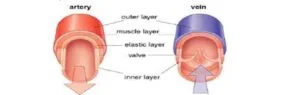
An artery carries blood away from the heart. A vein returns blood to the heart.
| SN | Artery | Vein |
|---|---|---|
| 1 | It has a thick (muscular) wall | It has a thin wall |
| 2 | Elastic wall | Non-elastic wall |
| 3 | Carries blood away from the heart | Returns blood to the heart |
| 4 | Carries oxygenated blood, except the pulmonary artery | Carries deoxygenated blood, except the pulmonary vein |
| 5 | Blood is bright red | Blood is dark red |
| 6 | Situated deep in muscles | Superficially situated |
| 7 | Has a small lumen | Has a large lumen |
| 8 | Pressure is high | Pressure is low |
| 9 | Pulse is readily detectable | Pulse is not easily detected |
| 10 | It has no valves, except semi-lunar valves | It has valves |
What is the heart?
The heart is a muscular organ that pumps blood around the body of a mammal.
- Position: inside the chest cavity, protected by the ribs and sternum.
- Heartbeat: the pumping action of the heart.
- Heart rate: varies from animal to animal and rises during excitement. A human heart beats about 72 times per minute at rest.
- Cardiac muscle: the special muscle that makes up the heart.
- Pericardium: a tough, two-layered membrane that encloses the heart.
- Pericardial fluid: fills the space between the heart and the pericardium and reduces friction as the heart pumps.
What is the structure of the heart?
The mammalian heart has four chambers: the right and left auricles and the right and left ventricles.
- Auricles (atria): the two upper chambers, which receive blood. Their walls are thin.
- Ventricles: the two lower chambers, which pump blood out. Their walls are thicker than those of the auricles.
- Left ventricle: has the thickest wall because it pumps blood to all parts of the body, which needs high pressure.
- Septum: the central barrier that divides the heart into right and left halves.
- Bicuspid valve: lies between the left auricle and left ventricle, so blood flows one way only, from auricle to ventricle.
- Tricuspid valve: lies between the right auricle and right ventricle and does the same work.
- Chordae tendineae: non-elastic cords and special fibres that hold the cuspid valves in place.
- Semi-lunar valves: found at the base of the aorta and the pulmonary artery. They stop blood flowing back into the ventricles.
What is the heartbeat?
The heartbeat is the alternate contraction and relaxation of the auricles and ventricles, and each beat has two phases: diastole and systole.
- Diastole: the heart muscle relaxes and the auricles fill with blood. Blood flows from the auricles into the ventricles, and the auricles then contract to push in the remaining blood. Oxygenated blood enters the left ventricle and deoxygenated blood enters the right ventricle.
- Systole: the ventricles contract and the cuspid valves close to stop backflow. Deoxygenated blood from the right ventricle goes into the pulmonary artery. Oxygenated blood from the left ventricle goes into the aorta. The sequence then repeats.
How does blood flow through the heart?
- Deoxygenated blood from the body enters the right auricle through the vena cava.
- It passes through the tricuspid valve into the right ventricle.
- The right ventricle pumps it through the pulmonary artery to the lungs.
- In the lungs the blood gains oxygen and loses carbon dioxide.
- Oxygenated blood returns to the left auricle through the pulmonary vein.
- It passes through the bicuspid valve into the left ventricle.
- The left ventricle pumps it through the aorta to the body.
Which organs do the main blood vessels supply?
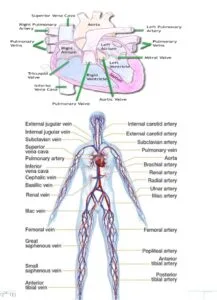
Each main artery is named after the organ or body part it supplies.
| SN | Blood vessel | Organ supplied |
|---|---|---|
| 1 | Carotid artery | Head |
| 2 | Pulmonary artery | Lungs |
| 3 | Hepatic artery | Liver |
| 4 | Gastric artery | Stomach |
| 5 | Mesenteric artery | Intestine |
| 6 | Renal artery | Kidney |
| 7 | Gonadal artery | Gonads |
| 8 | Intercostal artery | Wall of thorax |
- Corresponding veins: veins with matching names carry blood back from these organs towards the heart.
Evaluation
- State the two basic functions of blood in mammals.
- Describe how blood clots when a blood vessel is damaged.
- Distinguish between an open and a closed circulatory system.
- State four differences between an artery and a vein.
- Name the valve between the left auricle and the left ventricle and state its function.
Assignment
Write short notes on the mammalian heart: name the organs supplied by the carotid, hepatic, renal and mesenteric arteries, explain why the wall of the left ventricle is thick, and state the role of the pericardial fluid.
This term's Biology topics
SS2 Second Term · 6 topics
Get Biology as PDF and Word
Every week of SS2 Biology, Second Term, formatted and ready to print. Ad-free, and the copy lock comes off.
Get this term Card, bank transfer, USSD or OPay
SS2 Biology Lesson Notes for Other Topics
Digestive System
Read the full lesson note.
Transport System
Read the full lesson note.
Mechanism Of Transportation In Higher Mammals
Read the full lesson note.
Cell Division
Read the full lesson note.
Reproductive System In Vertebrates
Read the full lesson note.
Reproduction - Asexual Reproduction
Read the full lesson note.
Reproduction II - Sexual Reproduction
Read the full lesson note.
Reproductive Health
Read the full lesson note.
Cellular Respiration
Read the full lesson note.

Respiratory System
Read the full lesson note.
Excretory System
Read the full lesson note.
Tissues And Supporting Systems In Animals
Read the full lesson note.

Supporting Tissues In Plants
Read the full lesson note.
Joints
Read the full lesson note.
Reproductive System In Flowering Plants
Read the full lesson note.
Lesson Notes for Other Classes

SS1 Lesson Note
The complete lesson note to guide your studies.

SS3 Lesson Note
The complete lesson note to guide your studies.
