
Types, Properties and Composition of Soil – SS1 Agricultural Science Lesson Note (Second Term)
Download Lesson NoteLesson note at a glance
- Subject
- Agricultural Science
- Class
- SS1
- Term
- Second Term
- Topic
- Types, Properties and Composition of Soil
- Order
- Topic 4 of 7 this term
- Reading time
- 6 min
Soil is formed when rocks break down into tiny particles through weathering, which may be physical, chemical or biological. Soil has properties such as structure, texture, temperature and pH, and a soil profile shows its horizontal layers, called horizons. This lesson covers how soil forms, its main properties, liming of acid soil and some experiments on soil.
Behavioural objectives
By the end of the lesson, students should be able to:
- define weathering and describe the physical, chemical and biological processes of soil formation
- state the agents of physical and chemical weathering
- describe soil structure, soil texture, soil temperature and soil pH, and say why each is important
- name the soil particles and give their sizes
- state the causes of soil acidity and name some liming materials used to remove it
- describe the horizons of a soil profile
What is weathering and how does soil form?
Weathering is the disintegration or breakdown of rocks into tiny particles called soil.
The processes of soil formation are:
- Physical process
- Chemical process
- Biological process
Physical process
The agents of physical weathering are temperature, ice, wind, water and pressure.
- Temperature: The alternating heating and cooling of rocks produces pressure within the rock, which makes it break into smaller pieces.
- Wind: Solid materials carried by the wind strike rock surfaces and wear them down.
- Ice: Water inside the cracks of rocks turns into ice and increases in volume. This puts more pressure on the rocks, which eventually break into smaller pieces.
- Water: Running water carries fragments of rock along the river bed, thus breaking off small pieces of rock.
Chemical process
The agents of chemical weathering are solution, carbonation, hydration, hydrolysis and oxidation.
- Hydration: This occurs when water combines with some minerals, for example:
- Calcium sulfate changes to gypsum: CaSO4 + 2H2O → CaSO4.2H2O
- Red haematite changes to hydrated yellow haematite, or limonite: Fe2O3 + 3H2O → Fe2O3.3H2O
- CuSO4 + 5H2O → CuSO4.5H2O
- Carbonation: Carbon dioxide in the atmosphere combines with water to form a weak acid (carbonic acid). This weak acid reacts with rocks to form soil.
- Oxidation/reduction: When minerals containing iron, manganese and sulfur are exposed to air and water, the ferrous iron is oxidised to the ferric state, for example:
4FeCO3 + O2 → 2Fe2O3 + 4CO2
Here FeCO3 is iron(II) carbonate and Fe2O3 is iron oxide.
- Solution: Water reacts with soluble minerals present in the rock and eventually carries them away down the slope of the land.
- Hydrolysis: Water breaks down the chemical bonds in rock minerals, for example:
CaSiO3 + 2H2O → H2SiO3 + Ca(OH)2
Biological process
This involves the activities of plants and animals in breaking down rocks to form soil. It can happen in the following ways:
- The roots of plants penetrate rocks and break them down to form soil.
- Earthworms and termites burrow into the rocks and break off fragments.
- Human activities, such as tilling the soil, break rocks down to form soil.
What are the properties of soil?
Soil structure
Soil structure is the way the different particles of the soil are packed or arranged. A good soil structure promotes a good yield of crops.
Ways of preserving soil structure:
- Planting of cover crops
- Application of manure
- Avoidance of overgrazing
- Mulching
- Avoidance of clean clearing
Types of soil structure:
- Single grained structure
- Crumb structure
- Plate-like structure
- Spheroidal structure
- Prismatic structure
- Block-like structure
Importance of soil structure:
- It determines how fertile the soil is.
- A good soil structure supports aeration.
- It also prevents erosion and waterlogging.
- A good soil structure promotes the activities of soil microbes.
- A good soil structure supports the growth of crops.
Soil texture
Soil texture is the relative proportion of the various particles of the soil. It also refers to the degree of fineness or coarseness of the soil particles. The particles that make up a soil sample (gravel, sand, silt and clay) are usually called the primary particles of the soil.
The names and sizes of the various soil particles are shown in the table below.
| S/N | Name of particle | Diameter |
|---|---|---|
| 1 | Clay | Below 0.002 mm |
| 2 | Silt | 0.002 to 0.02 mm |
| 3 | Fine sand | 0.02 to 0.2 mm |
| 4 | Coarse sand | 0.2 to 2.0 mm |
| 5 | Gravel | Above 2 mm |
Methods of determining soil texture:
- By feeling
- By mechanical analysis through sieving
- By sedimentation
- By moulding
Importance of soil texture:
- It is useful in evaluating the ability of the soil to supply mineral nutrients.
- It supports some microorganisms essential for crop growth.
- It determines the type of crop to grow on the land.
- It enables the farmer to know the type of soil on his farm.
- It determines the movement of air and water in the soil.
Soil temperature
Soil temperature is the hotness or coldness within the soil.
Importance of soil temperature to crop growth:
- It determines the rate of formation and decomposition of organic matter.
- High temperature impedes the activities of microorganisms.
- Optimum temperature promotes seed germination.
- It determines the population of soil microbes.
- It determines the maturity or ripening of fruits.
Soil pH
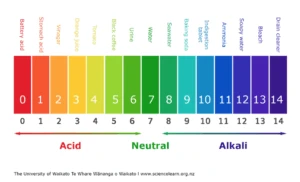
Soil pH is the measure of the degree of acidity or alkalinity of the soil. It can also be defined as the measure of the concentration of hydrogen ions (H+) in the soil. The pH scale is used to determine soil acidity, as shown below.
Causes of soil acidity
- Leaching
- Use of acid fertilisers
- Presence of acid parent materials
- Nutrient uptake by plants
- Presence of sulfur in the soil
How is soil acidity removed?
Soil acidity can be removed by applying liming materials, which are rich in calcium. Examples of liming materials are:
- Slaked lime, Ca(OH)2
- Quicklime, CaO
- Calcium bicarbonate, Ca(HCO3)2
- Wood ash
- Limestone, CaCO3
- Dolomite or calcite
- Basic slag
- Gypsum
What is a soil profile?
A soil profile is the vertical section of the soil showing a series of horizontal layers of different types of soil. The horizontal layers are called horizons.
Horizons of the soil profile
- A-horizon: This is also called the topsoil. It is rich in organic materials, and most soil organisms live here.
- B-horizon: This is rich in minerals that are carried or leached down by percolating water.
- C-horizon: This represents the type of material from which the topsoil and subsoil are derived.
- D-horizon: This is called the bedrock.
What experiments can be done on soil?
- Sedimentation experiment
- Experiment to determine the moisture content of the soil
- Experiment to determine the porosity or water holding capacity of the soil
- Experiment to determine the capillarity of the soil
- Experiment to demonstrate the preservation of microorganisms in the soil
- Experiment to determine the percentage of organic matter in a soil sample
Evaluation
- Define weathering and name the three processes of soil formation.
- State four ways of preserving soil structure.
- List the soil particles from the smallest to the largest, with their sizes.
- State three causes of soil acidity and name three liming materials.
- Name the four horizons of the soil profile.
Assignment
- What is soil?
- List 5 factors of soil formation.
- What is weathering?
- Explain the processes of physical weathering.
- Define: (i) soil acidity, (ii) soil structure, (iii) soil texture.
This term's Agricultural Science topics
SS1 Second Term · 7 topics
Second Term Agricultural Science Lesson Notes for Other Topics

Packaging of Processed Foods
Read the full lesson note.

Primary, Secondary and Tertiary Packaging
Read the full lesson note.
Types of Agricultural Market
Read the full lesson note.

Materials used for Packaging; Nylon, Carton, Paper, Sack, Boxes etc
Read the full lesson note.

Reasons for Packaging Farm Produce
Read the full lesson note.
Crops that can be Packaged
Read the full lesson note.
Market and Marketing of Agricultural Produce
Read the full lesson note.
Agricultural Marketing Activities
Read the full lesson note.

Damages Caused By Pests
Read the full lesson note.

Control Of Insect Pests
Read the full lesson note.

Classification Of Insect Pests; Piercing And Sucking Insect Pest
Read the full lesson note.
Pest And Disease Of Crops
Read the full lesson note.

Benefits Of Weeds: Animal Feed, Of Drugs, Food To Man
Read the full lesson note.
Control Of Weeds
Read the full lesson note.
Effects of Weeds on Farmers
Read the full lesson note.
Lesson Notes for Other Classes

Basic 1 Lesson Note
The complete lesson note to guide your studies.

Basic 2 Lesson Note
The complete lesson note to guide your studies.

Basic 3 Lesson Note
The complete lesson note to guide your studies.

Basic 4 Lesson Note
The complete lesson note to guide your studies.

Basic 5 Lesson Note
The complete lesson note to guide your studies.

Basic 6 Lesson Note
The complete lesson note to guide your studies.

