
The Seven Freedom of UDHR – SS1 Civic Education Lesson Note (Second Term)
Download this term · ₦1,000Lesson note at a glance
- Subject
- Civic Education
- Class
- SS1
- Term
- Second Term
- Topic
- The Seven Freedom of UDHR
- Order
- Topic 9 of 9 this term
- Reading time
- 5 min
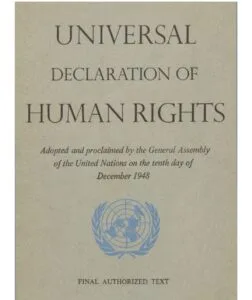
The Universal Declaration of Human Rights (UDHR) is an international document that states the basic rights and fundamental freedoms to which all human beings are entitled.
Behavioural objectives
- State what the Universal Declaration of Human Rights (UDHR) is.
- Say when the UDHR was adopted and how many articles it has.
- Explain the importance of the UDHR.
- List the core rights and freedoms contained in the UDHR.
- Group the rights and freedoms of the UDHR under simple headings.
What are the key terms in this topic?
Key terms are the words a student must understand before studying the UDHR.
- Human rights: basic claims every person has simply because he or she is human.
- Freedom: the power to think, speak, move and act without unfair control.
- Declaration: a formal statement of principles.
- Article: one numbered section of a document such as the UDHR.
- Tyranny: cruel and unjust use of power by a ruler.
- Arbitrary: done without good reason or without following the law.
- Asylum: protection given by one country to a person running away from persecution elsewhere.
- Tribunal: a court or body that hears and settles legal cases.
What are the basic facts about the UDHR?
The UDHR was adopted by the United Nations General Assembly on 10 December 1948 and has thirty articles.
| Item | Fact |
|---|---|
| Full name | Universal Declaration of Human Rights (UDHR) |
| Adopted by | The General Assembly of the United Nations Organization |
| Date adopted | 10 December 1948 |
| Number of articles | Thirty (30) |
| Who it covers | All human beings, in every country |
- Human Rights Day: 10 December is marked each year as Human Rights Day.
- Nature of the UDHR: it is a declaration of standards, and countries are expected to respect it.
- Link to Nigeria: Chapter IV of the 1999 Constitution of the Federal Republic of Nigeria sets out fundamental human rights.
What is the importance of the UDHR?
The UDHR is important because it sets a common standard of human rights for all people and nations.
- Foundation of peace: recognising human rights is the foundation of freedom, justice and peace in the world.
- Protection from oppression: it protects people so that they are not forced, as a last resort, to rebel against tyranny and oppression.
- Friendly relations: it promotes friendly relations between the nations of the world.
- Social progress: it promotes social progress and a better standard of life in larger freedom.
- Universal respect: it promotes universal respect for, and observance of, human rights and fundamental freedoms.
- Moral guide: it guides human beings in deciding what is right and what is wrong.
- Support for other rights: it reinforces all other human rights, allowing society to develop.
- Freedom of speech: the ability to express opinions and speak freely is essential to bring about change.
What are the core freedoms and rights of the UDHR?
The core freedoms are rights that concern individuals directly and affect their peaceful existence as human beings, within or outside their country.
- Grouping: the rights below are placed under six headings to make them easier to learn.
1. Freedoms of the person
- Life, liberty and security: everyone has the right to life, liberty and security of person.
- Born free and equal: all human beings are born free and equal in dignity and rights.
- No slavery: no one shall be held in slavery or servitude.
- No torture: no one shall be subjected to torture or to cruel, inhuman or degrading treatment or punishment.
- Privacy: no one shall suffer arbitrary interference with privacy, family, home or correspondence, or attacks on honour and reputation.
2. Freedoms of thought and expression
- Thought, conscience and religion: everyone may hold and practise a belief of his or her choice.
- Opinion and expression: everyone may hold opinions and speak freely.
- Peaceful assembly and association: everyone may meet and join groups peacefully.
3. Freedom of movement
- Movement and residence: freedom to move and live within the borders of each State.
- Leaving and returning: the right to leave and return to any country, including one’s own.
- Asylum: the right to flee persecution and seek asylum in other countries.
- Nationality: the right to a nationality.
4. Rights before the law
- Recognition as a person: the right to be recognised everywhere as a person before the law.
- Equality before the law: all humans are equal before the law and entitled, without discrimination, to equal protection by the law.
- Effective remedy: the right to a remedy from competent national tribunals or law courts.
- Fair hearing: everyone is entitled, in full equality, to a fair and public hearing.
- No arbitrary arrest: no one shall be arrested, detained or exiled without good reason.
- No retrospective guilt: no one shall be held guilty of an act that was not a penal offence when it was done.
5. Social, economic and cultural rights
- Property: the right to own property alone and with others.
- Work: the right to work.
- Social security: the right to social security.
- Education: the right to education.
- Marriage and family life: the right to marry and have a family.
- Cultural life: the right to take part freely in the cultural life of the community.
6. Political and international rights
- Taking part in government: the right to take part in the government of one’s country.
- Social and international order: everyone is entitled to a social and international order in which these rights can be enjoyed.
How do these rights appear in the Nigerian Constitution?
Chapter IV of the 1999 Constitution protects many of the same rights as the UDHR.
- Life and dignity: the right to life and to respect for the dignity of the person.
- Personal liberty: protection from unlawful arrest and detention.
- Fair hearing: the right to a fair hearing in court.
- Private and family life: respect for privacy, home and correspondence.
- Thought, conscience and religion: freedom to hold and practise a belief.
- Expression and the press: freedom to speak and to receive and share information.
- Assembly and association: freedom to meet and join groups peacefully.
- Movement: freedom to move and live in any part of Nigeria.
- No discrimination: freedom from unfair treatment.
- Property: the right to own property.
Evaluation
- What does UDHR stand for, and when was it adopted?
- How many articles does the Declaration have?
- State four reasons why the UDHR is important.
- List five rights contained in the UDHR.
- Explain the meaning of asylum.
Assignment
State any five reasons why the UDHR is important and list any five of the rights or freedoms contained in it.
This term's Civic Education topics
SS1 Second Term · 9 topics
Get Civic Education as PDF and Word
Every week of SS1 Civic Education, Second Term, formatted and ready to print. Ad-free, and the copy lock comes off.
Get this term Card, bank transfer, USSD or OPay
SS1 Civic Education Lesson Notes for Other Topics

Representative Democracy
Read the full lesson note.

Rule Of Law I
Read the full lesson note.

Rule Of Law II : Liberty & Types of Liberty
Read the full lesson note.

Pillars Of Democracy - The Constitution
Read the full lesson note.

Strong Institutions as Major Pillars Of Democracy
Read the full lesson note.

Federalism, State And Local Government
Read the full lesson note.

Political Parties
Read the full lesson note.

Free Press
Read the full lesson note.
Responsibilities Of Individuals And Groups In Maintaining UDHR
Read the full lesson note.

Values I
Read the full lesson note.

Values II - Community Service
Read the full lesson note.

Values III - Opportunity to Defend Oneself
Read the full lesson note.

HIV/AIDS I
Read the full lesson note.

HIV/AIDS II
Read the full lesson note.

Youth Empowerment I
Read the full lesson note.
Lesson Notes for Other Classes

SS2 Lesson Note
The complete lesson note to guide your studies.

SS3 Lesson Note
The complete lesson note to guide your studies.
