
Pillars of Democracy: The Constitution – SS1 Civic Education Lesson Note (Second Term)
Download this term · ₦1,000Lesson note at a glance
- Subject
- Civic Education
- Class
- SS1
- Term
- Second Term
- Topic
- Pillars of Democracy: The Constitution
- Order
- Topic 4 of 9 this term
- Reading time
- 4 min
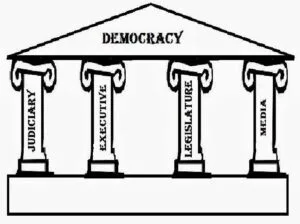
The constitution is the document containing the fundamental laws and principles by which a state is governed, including how power is shared among the arms of government. It is one of the pillars of democracy, which are the factors that help democratic processes run smoothly.
Behavioural objectives
By the end of the lesson, students should be able to:
- Define a constitution.
- Name and explain the types of constitution.
- List the main sources of the Nigerian Constitution.
- Explain why the constitution is a major pillar of democracy.
- State the functions the constitution performs in a country.
What are the pillars of democracy?
The pillars of democracy are the human and non-human factors that help a democratic system run smoothly.
- The constitution: the main written pillar, because it sets the rules for all the others.
- Rule of law: everyone, including leaders, is subject to the law and treated equally before it.
- Independent judiciary: courts settle disputes and interpret the law without pressure from government.
- Free and fair elections: citizens choose their leaders by voting freely and honestly.
- Political parties: groups that present candidates and policies for voters to choose from.
- Free press: the media report on government and keep citizens informed.
What is a constitution?
A constitution is the set of fundamental laws, rules and regulations by which a state is expected to be governed.
- As a document: a book that contains the rules and principles of government.
- As a body of principles: established rules and precedents by which a state or organisation is acknowledged to be governed.
- Power: it shows how power is shared among the arms of government.
- Citizens: it sets out the rights and duties of citizens.
What are the types of constitution?
There are two pairs of constitution: written and unwritten, and rigid and flexible.
- Written constitution: laid down in one document or a few documents, as in Nigeria.
- Unwritten constitution: based mainly on customs, conventions and past decisions, as in the United Kingdom.
- Rigid constitution: hard to amend, because it needs a special procedure.
- Flexible constitution: easy to amend, often by ordinary law.
| Type | Meaning | Example |
|---|---|---|
| Written | Laid down in one document or a few documents. | Nigeria |
| Unwritten | Based mainly on customs, conventions and past decisions. | United Kingdom |
| Rigid | Hard to amend, because it needs a special procedure. | Nigeria |
| Flexible | Easy to amend, often by ordinary law. | United Kingdom |
What are the sources of the Nigerian Constitution?
The Nigerian Constitution draws on five main sources: the history of the people, decrees, convention, customs and acts of parliament.
- History of the people: past events, struggles and experiences of Nigerians shape what the constitution contains.
- Decrees: laws made by military governments, some of which were absorbed into later constitutions.
- Convention: unwritten practices that have been accepted over time and are followed as rules.
- The customs of the people: the accepted traditions and values of Nigerian communities.
- Acts of parliament: laws passed by the legislature that become part of the legal framework.
What are some of the Nigerian constitutions?
| Constitution | Note |
|---|---|
| 1960 Independence Constitution | Came with independence from Britain. |
| 1963 Republican Constitution | Made Nigeria a republic. |
| 1979 Constitution | Introduced the presidential system. |
| 1999 Constitution | The one in use today, as amended. |
What are the features of a good constitution?
A good constitution is clear, fair and able to serve the needs of the people it governs.
- Clear and simple: citizens can read and understand its language.
- Reflects the people’s will: it carries the values and wishes of the people.
- Protects rights: it guarantees the fundamental rights of every citizen.
- Separates powers: it shares power among the executive, legislature and judiciary.
- Allows amendment: it can be changed by a fair procedure when society changes.
Why is the constitution a major pillar of democracy?
The constitution is a pillar of democracy because of the functions it performs in a country.
What functions limit and share power?
- Limits government: it sets limits on the use of the powers of government.
- Defines powers: it defines the rights and powers of the government.
- Shares power: it shares power among the arms of government.
- Organises government: it explains the organisation, powers and functions of the three organs and how they relate.
- Federal division of powers: in a federation, it divides powers between the central government and the federating states. It binds both.
What functions protect the people?
- Minority rights: it protects the rights of the minority.
- Fundamental rights: it describes and guarantees the fundamental rights of the people.
- Independent judiciary: it provides for the independence of the judiciary and the rule of law.
- Supremacy: it governs all, and no one can violate its rules.
What functions run the political system?
- Institutions: it spells out political institutions, party systems and tenure of office.
- Elections: it lays down the election system.
- Will of the people: it reflects the sovereign will of the people.
- Aims and values: it lays down the aims, objectives, values and goals the people want to secure.
- Amendment: it states the power and method of changing the constitution.
Evaluation
- What is a constitution?
- List the five main sources of the Nigerian Constitution.
- State five reasons why the constitution is regarded as a pillar of democracy.
- What does the constitution say about the division of powers in a federation?
- Differentiate between a rigid and a flexible constitution.
Assignment
- Explain, in your own words, any five functions of the constitution in a democratic country.
This term's Civic Education topics
SS1 Second Term · 9 topics
Get Civic Education as PDF and Word
Every week of SS1 Civic Education, Second Term, formatted and ready to print. Ad-free, and the copy lock comes off.
Get this term Card, bank transfer, USSD or OPay
SS1 Civic Education Lesson Notes for Other Topics

Representative Democracy
Read the full lesson note.
Rule Of Law I
Read the full lesson note.

Rule Of Law II : Liberty & Types of Liberty
Read the full lesson note.

Strong Institutions as Major Pillars Of Democracy
Read the full lesson note.

Federalism, State And Local Government
Read the full lesson note.

Political Parties
Read the full lesson note.

Free Press
Read the full lesson note.
The Seven Freedom Of UDHR
Read the full lesson note.
Responsibilities Of Individuals And Groups In Maintaining UDHR
Read the full lesson note.

Values I
Read the full lesson note.

Values II - Community Service
Read the full lesson note.

Values III - Opportunity to Defend Oneself
Read the full lesson note.

HIV/AIDS I
Read the full lesson note.

HIV/AIDS II
Read the full lesson note.

Youth Empowerment I
Read the full lesson note.
Lesson Notes for Other Classes

SS2 Lesson Note
The complete lesson note to guide your studies.

SS3 Lesson Note
The complete lesson note to guide your studies.
